
Walking into the Syracuse Archaeological Park feels like stepping into the heart of ancient Greece in Sicily. Here, in what the locals call the Parco Archeologico della Neapolis di Siracusa, you’ll see ancient amphitheaters, haunting old stone quarries, and the mystical Ear of Dionysius cave where the slightest whisper can be heard. Once one of the most powerful Greek cities in the Mediterranean, Syracuse rivaled even Athens in art, intellect, and architecture. This sprawling park is its living museum, brought back to life with just a little imagination.
I absolutely loved loved loved this site. My inner nerd-child was hardly able to be contained. We had a fabulous tour guide who took what would have been an amazing day anyway, and made it utterly unforgettable. The stories and explanations brought the whole park alive and I was learning from beginning to end. I’ve been to ancient Roman sites across Sicily, mainland Italy, France, and Germany, and this ranks among the best days of them all.
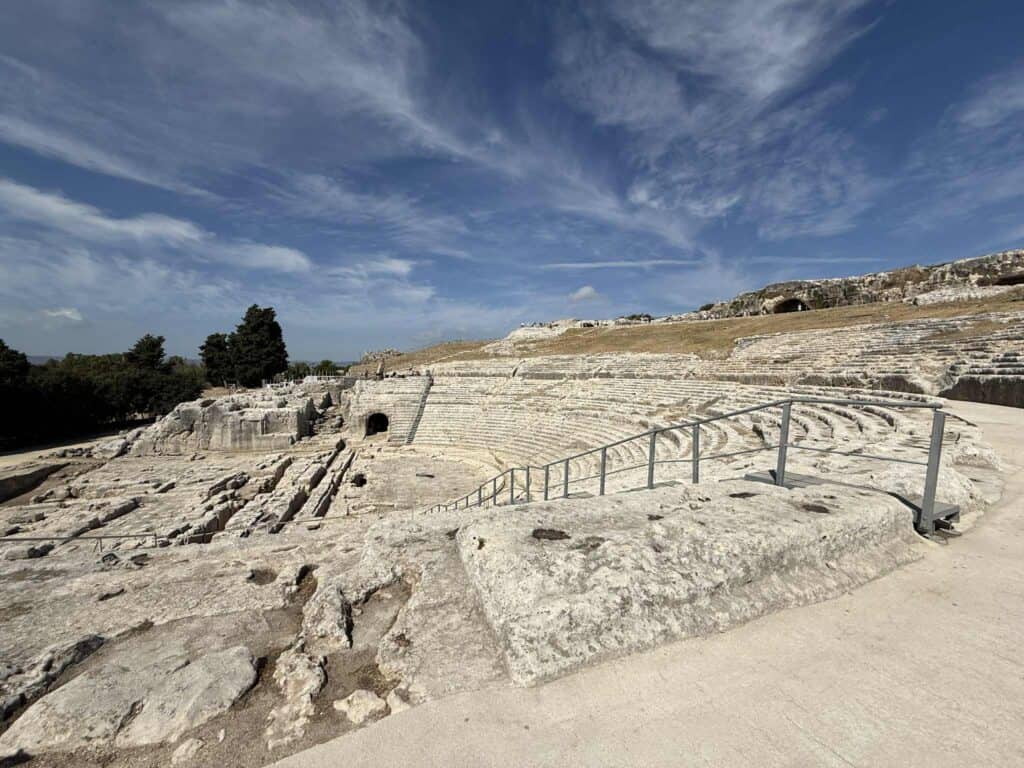
The Syracuse Archaeological Park is one of Sicily’s absolute must-see destinations for history lovers, where Greek, Roman, and early Christian eras all left their mark within short walking distance. You can wander through the majestic Greek Theater, where tragedies by Aeschylus were performed for thousands including Plato, gaze at the Roman Amphitheater where gladiators once fought and got the fateful thumbs-up or thumbs-down, and stand beneath the sun-baked cliffs that lead to the cave called the Ear of Dionysius where political prisoners were held.
Whether you’re tracing the footsteps of mathematical mastermind Archimedes, snapping photos of the fascinating plant life growing between the stones, or simply exploring history with an open mind, this UNESCO-protected site offers one of the most immersive windows into the ancient world anywhere in Italy!
In this article, I’ll share the absolute must-sees, the cool extra spot you may not see on the tour, the best time to go, how to get there, and and I’ll show you why joining a guided tour makes the ancient city come alive in ways you can’t get wandering alone.
⭐️ Take the Same Awesome Guided Tour We Took to Explore the Park! ⭐️
🏛 Syracuse Archaeological Park
(Siracusa/Neapolis Archaeological Park) Information
Via Luigi Bernabò Brea, 14, 96100 Siracusa SR, Italy
💶 Entrance fee: €14
🌤 Best times to visit: Morning for cooler temperatures, late afternoon for golden hour photo magic!
♿️ Accessibility: The park is wheelchair friendly. Contact them in advance if you need specific details about certain areas.
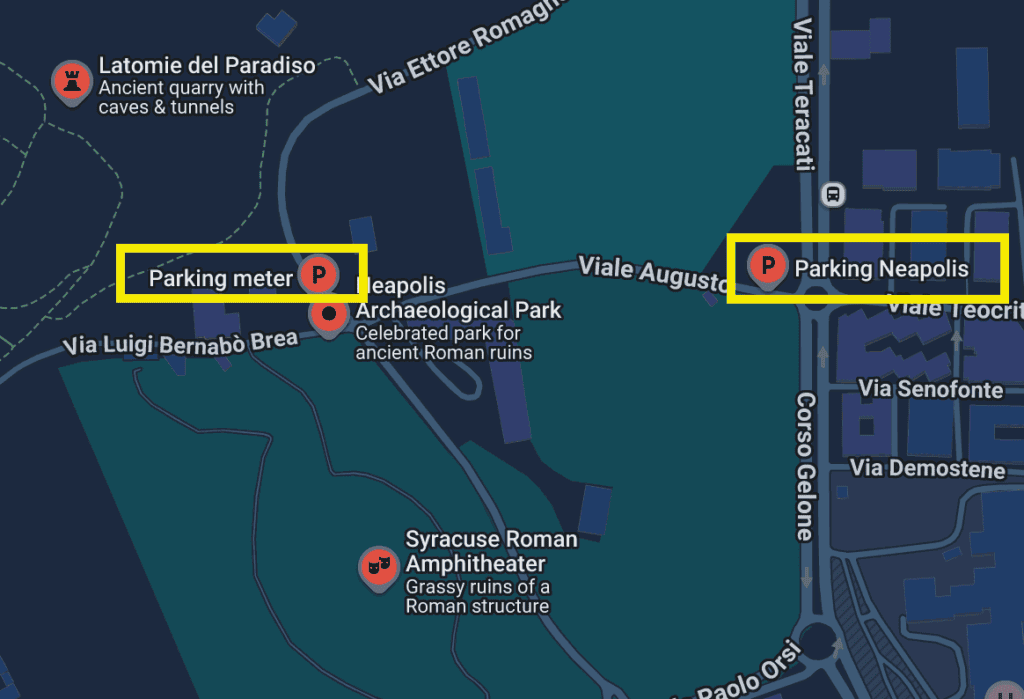
🅿️ Parking: You can park on the street right outside the entrance to the park where there are parking meters, or use the garage located nearby.
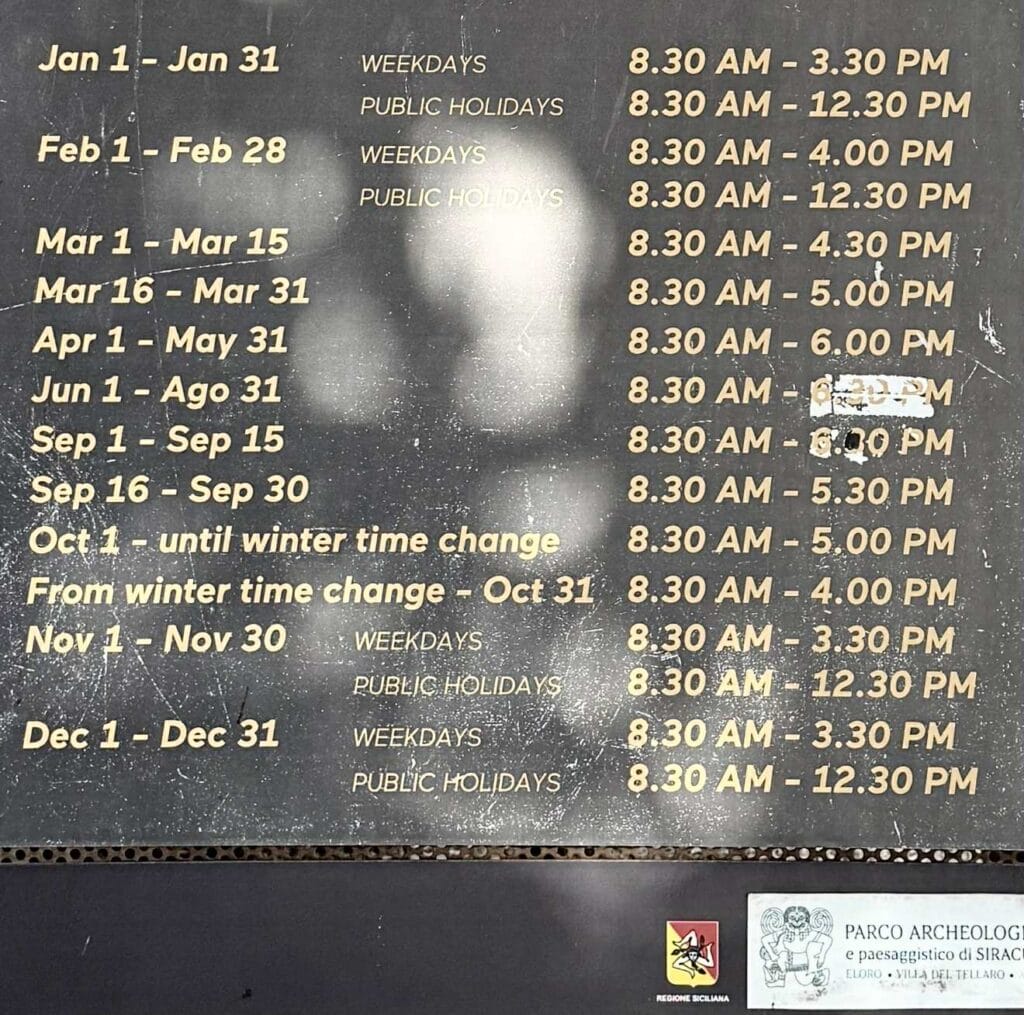
Opening Hours: Hours vary, so here is a photo of the sign by the entrance with all opening times throughout the year, on weekends, and public holidays.
The Syracuse Archaeological Park was an absolute highlight of our Eastern Sicily Itinerary: The Perfect 7-Day Route for History Lovers
The Roman Amphitheater of Siracusa

The first place you’ll come to after entering the park is the Roman amphitheater where gladiators and animals fought in contests to the death for the entertainment of the masses. Volunteer gladiators could win fame and glory with victory, and enslaved gladiators could win their freedom. The animals got the short end of the stick either way.
There’s a large pit in the center which was filled with water and had a tippy tabletop where gladiators tried to flip each other into the drink. It almost reminded me of an episode of Wipeout, only for much higher stakes.
At the end of these contests, the local authority who was sitting in the stands asked the crowd what they thought, and based on audience response the contestant got the thumbs up (celebrity) or the thumbs down (☠️).
You’ll also see a large modern bronze statue representing Icharus, whose flight too close to the sun supposedly happened near Sicily. You’ll also find copies of this iconic work next to the Leaning Tower of Pisa, and the Valley of the Temples on the West side of the island.
Sacrificial Altar of Hieron II
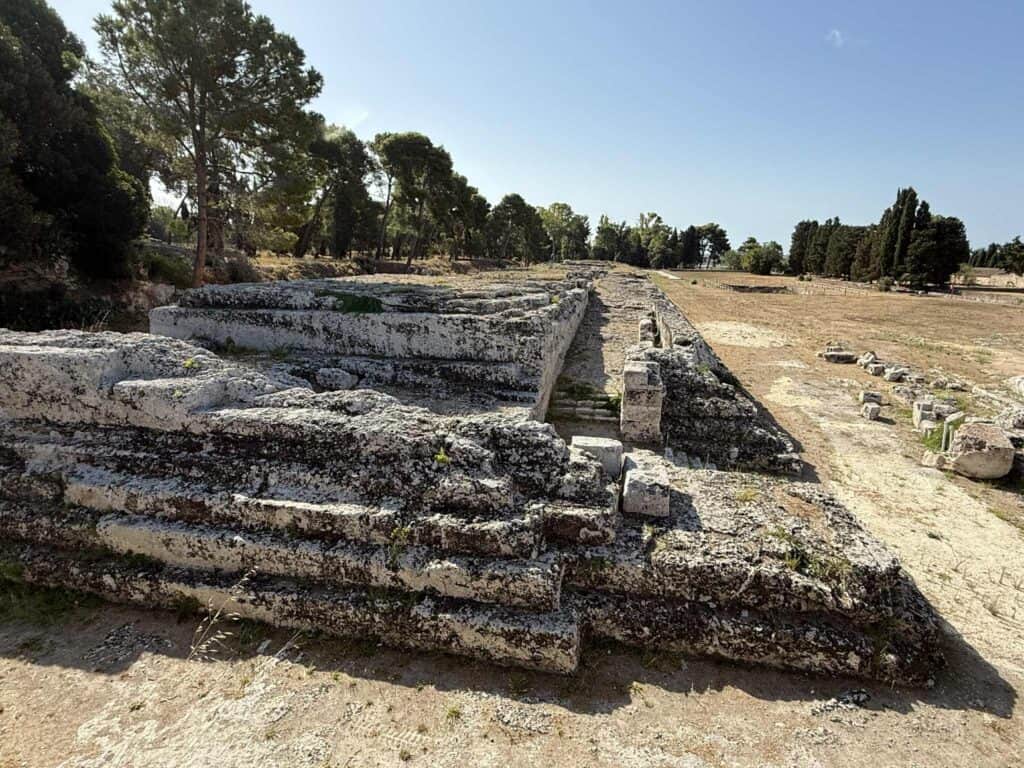
You’ll also see the largest sacrificial altar in the Greek world, an incredible 190 meters (623 feet) long!
Twice a year, 450 oxen were led to their deaths here. (Our guide pulled her finger across her throat and made a CHHHH sound). After they met their fate, they did not go to waste – they were roasted for a huge community feast.
The blood ran down a trough and into the ground as a sacrifice to the earth, the smoke from the cooking smoke rose as a sacrifice to the heavens, and the people feasted on the oxen as one of their only two times a year of eating meat. The rest of the year they ate vegetables, fruits, fish, and grains. Hey, the Mediterranean diet!
King Hieron II built the altar in the 3rd century BC and it was dedicated to Zeus Eleutherios, the god of freedom. It’s hard to imagine what a huge undertaking and wild celebration this must have been.
Ancient Stone Quarry in Syracuse Archaeological Park
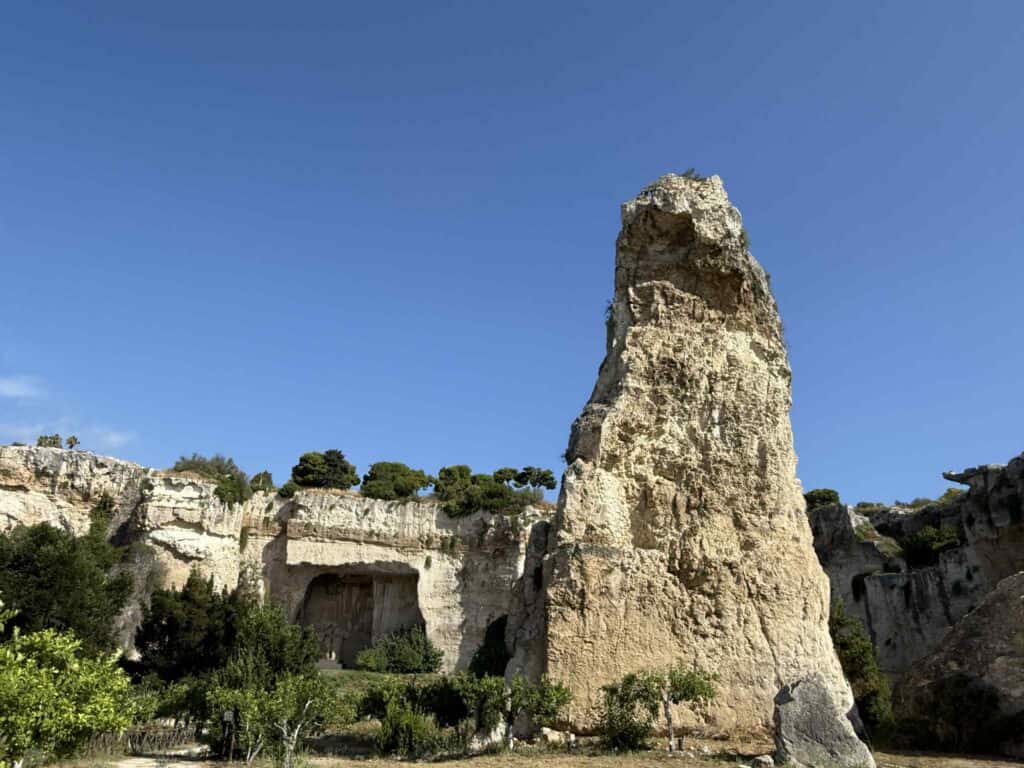

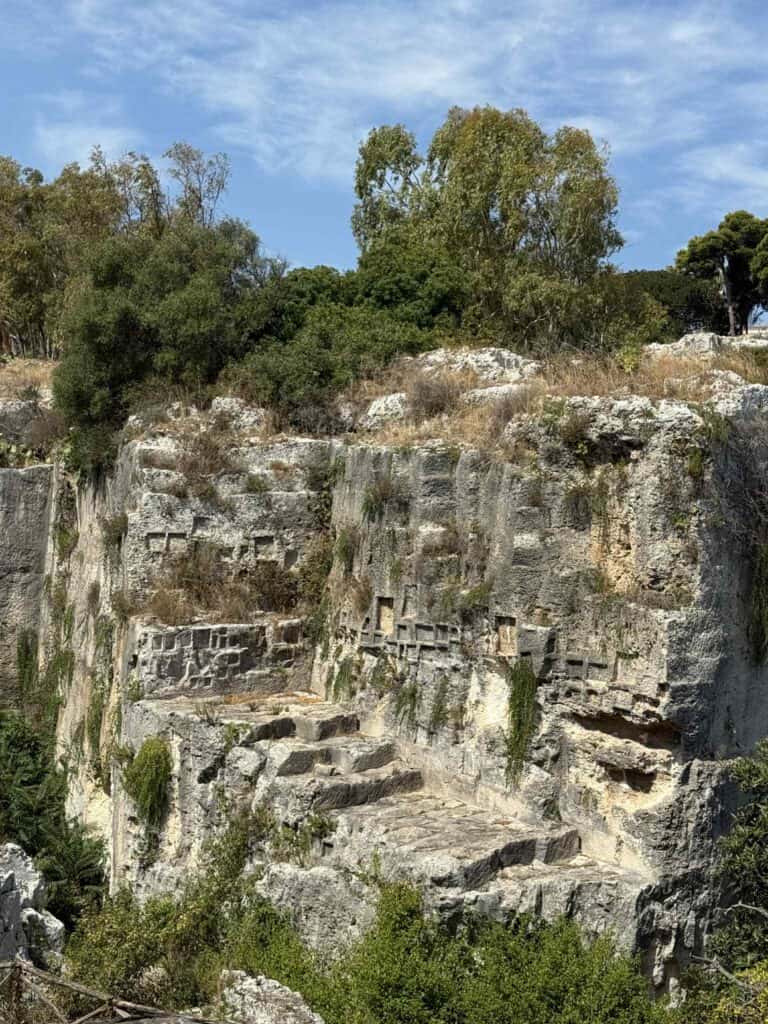
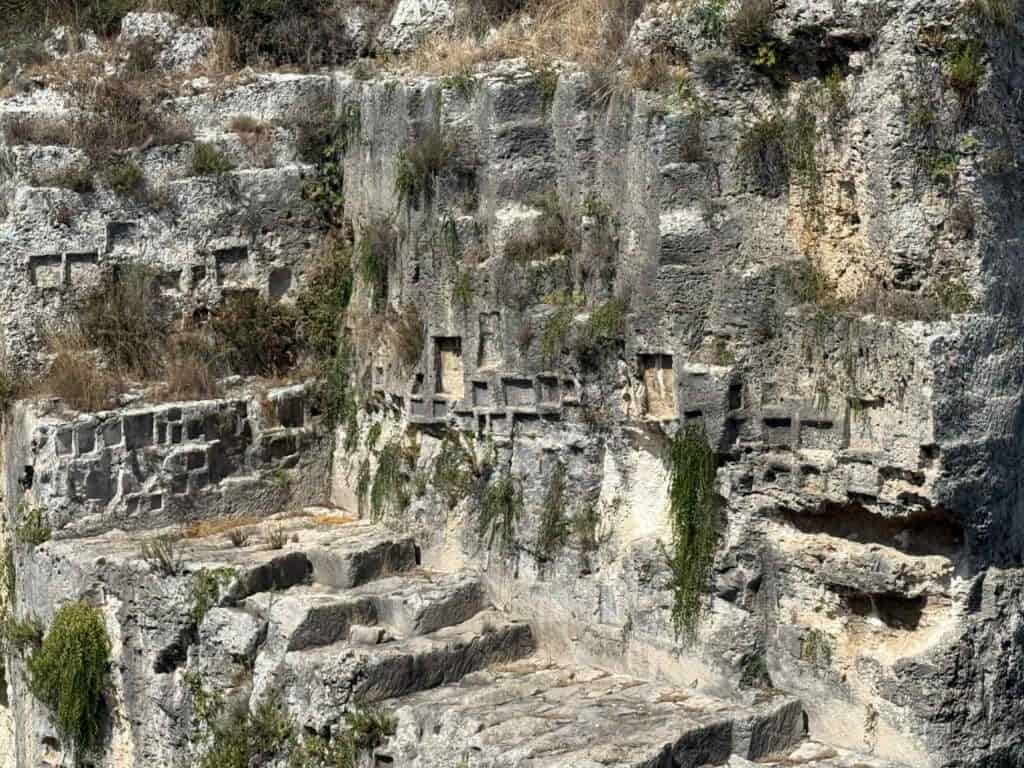
Originally I thought this quarry must just have been an open pit. But our guide explained the original configuration which was wild! The huge pillar that sticks up and forms the most iconic landmark of this area was actually a support pillar located in an underground mine!
The whole system has collapsed due to earthquakes, but you can see the huge chunks of limestone that made up the roof just lying around in an orchard of lemon and orange trees. It’s really a spectacular and surreal site that made me pull out my camera immediately.
These huge limestone caverns were carved out in the beginning of the 5th century BC, and blocks of stone were used to build the temples, the altar, the theatre, and the city walls of ancient Syracuse.
Eventually they were put to use as prison quarries where thousands of defeated Athenian soldiers were sentenced to hard labor after their defeat by the Romans in 413BC.
Its name today, ‘Paradiso’ (Paradise) definitely refers to the present-day peaceful orchard, blue sky, birdsong, and dramatic rock formations. It definitely doesn’t feel like a prison camp anymore.
The Cave of the Ropemakers
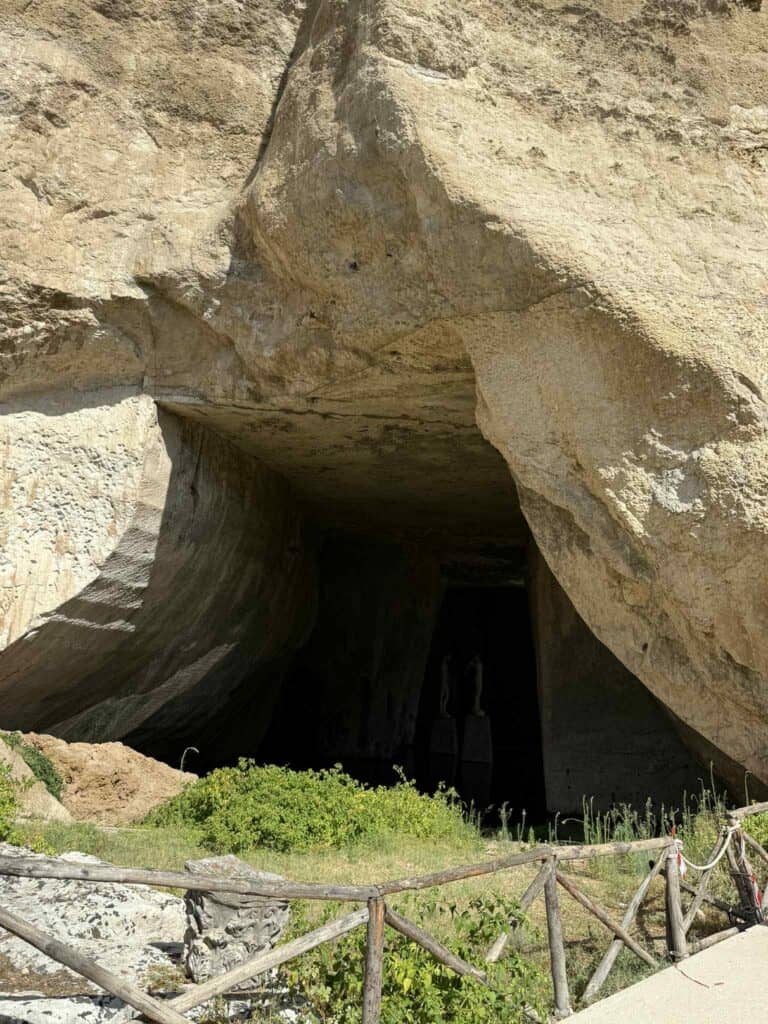
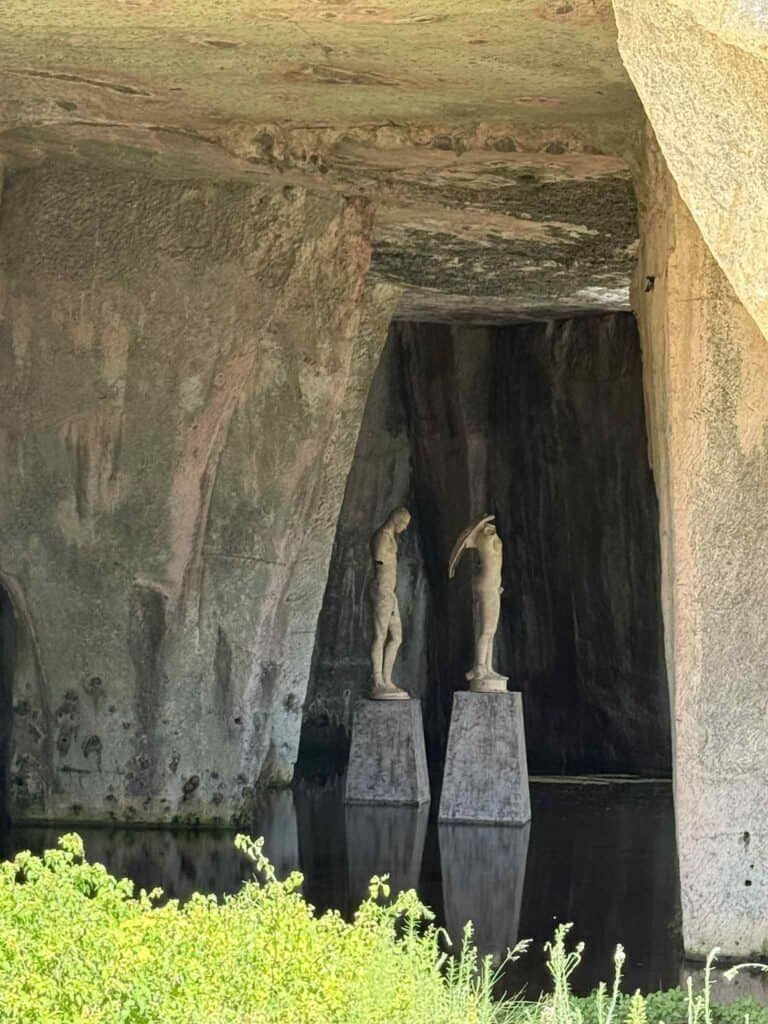
Just past the orchards of Paradiso, you’ll see an intriguing cavern carved into the rock. This quiet and serene spot is known as the Grotta dei Cordari (the cave of the ropemakers). The name comes from a much later period of history in this place. In the middle ages, this large, cool, sheltered and most importantly wet space was perfect for the craftsmen who worked here stretching and spinning hemp ropes all the way up until the 20th century.
You won’t be able to go inside the cave for safety reasons, but you can peek into it as you pass along the lower path through the quarry.
Ear of Dionysius (Orecchio di Dionisio)

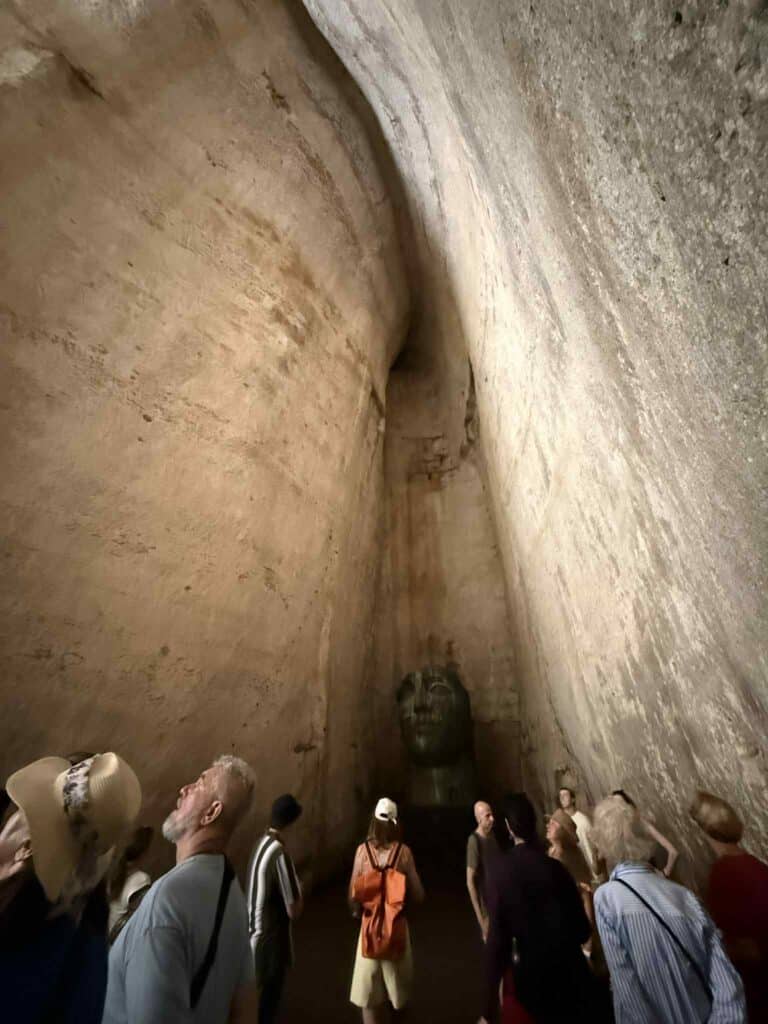
Perhaps the most legendary feature in the Syracuse Archaeological Park, is the Ear of Dionysius (Orecchio di Dionisio). Don’t confuse this with Dionysus (the god of wine, theater, and ecstasy), this is the ruler Dionysius, a cruel and intolerant tyrant.
The cave is man-made with an uncanny acoustic secret. Carved into the limestone, the cavern was used to extract building material as part of the quarry system. It stretches about 23 meters high and 65 meters deep, tapering like a human ear. The name was coined by the painter Caravaggio in the 17th century, because Dionysius I of Syracuse kept political prisoners in the cave, and then sat at the very top, where the sound would be amplified by a small opening, listening for plots against his life or other political information he could use against his enemies.
Whether the story is true or myth, the acoustics are undeniable. Even a soft voice can carry eerily across the space, making it easy to imagine how such a tale took root.
We were lucky enough that one member of our tour group was a singer. Our guide asked if she would sing something and the echo throughout the cave made the hair on my neck stand up – magical and eerie and beautiful.
The Greek Theater at Syracuse Archaeological Park

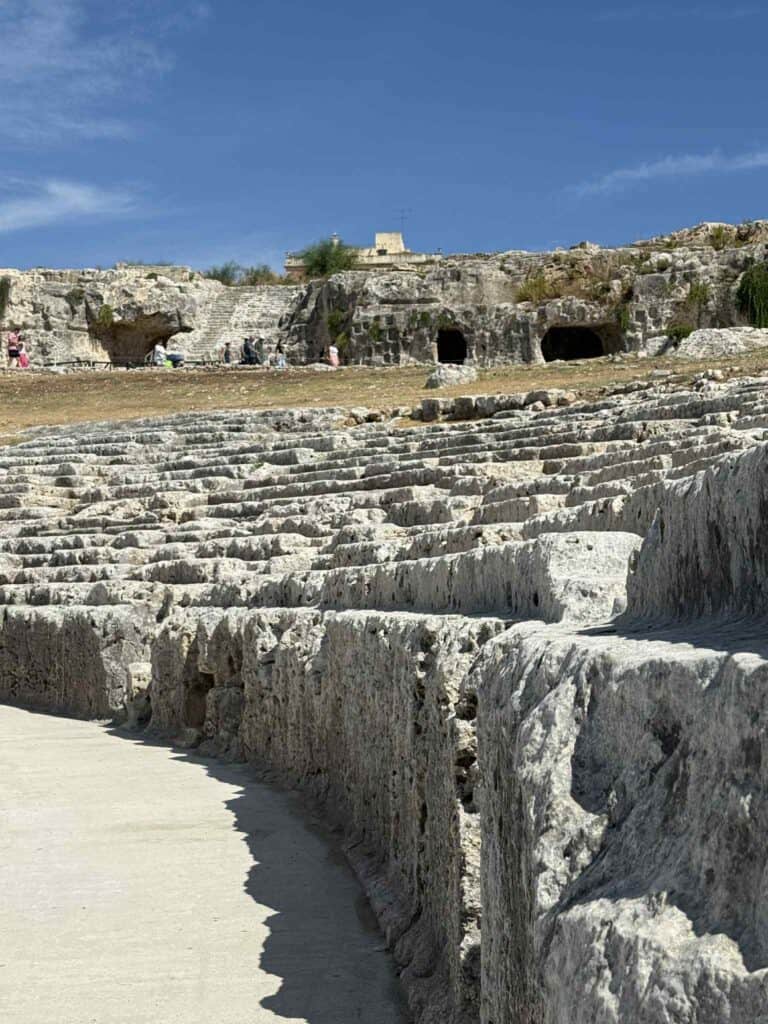
The Greek Theater of Syracuse is the standout of the park. Here, comedies and tragedies were the entertainment of the day, rather than the brutal gladiator matches of the Roman amphitheater. Much more my style!
This actual theater hosted the debut performance of Aeschylus’ The Women of Aetna. AESCHYLUS. And Plato attended shows at this theater, undoubtedly sitting in the good seats. Absolute goose bumps.
The theater is enormous. At one time, Syracuse was even bigger than Athens in the Greek world, with a staggering population of 300,000 people! Amazingly the theater, with a capacity of 15,000, still hosts performances during the annual summer Greek Theatre Festival of Syracuse which brings ancient dramas by Euripides, Aristophanes, Sophocles and more to life in the same venue where some of them premiered 2400 years ago!
This is also the hottest and brightest part of the park. You’ll want to have sunglasses and water!
Early Byzantine Christian Tombs
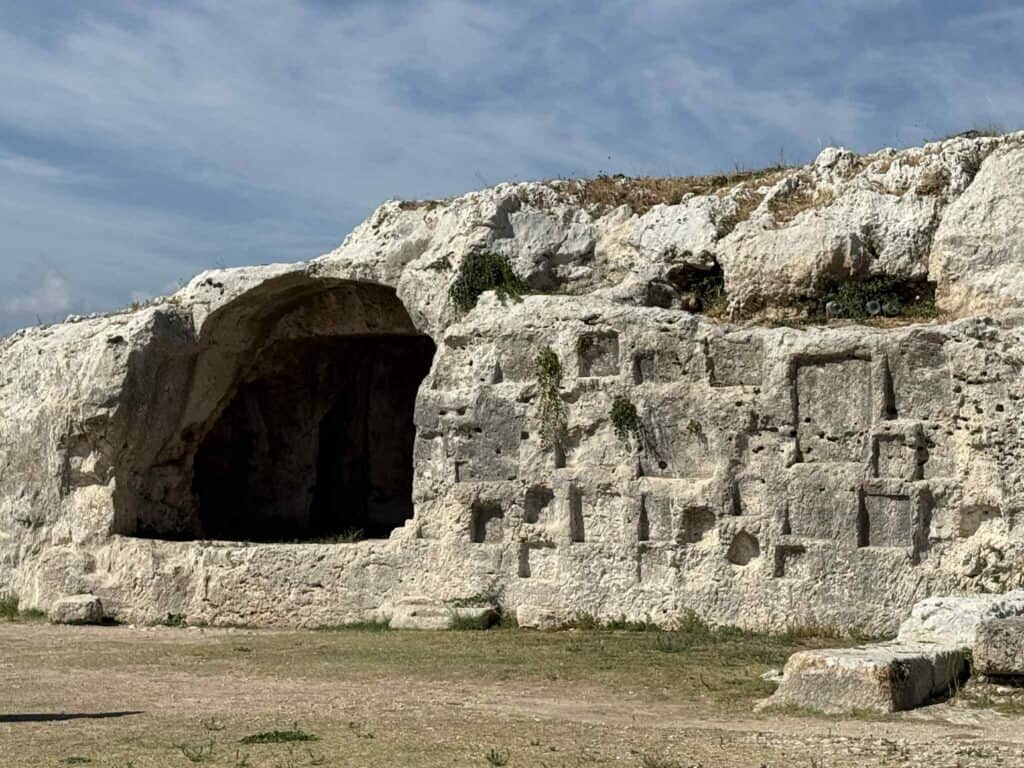
Along the top of the Greek Theatre, a row of Byzantine tombs seem oddly out of place. Carved into the limestone during the Byzantine period (6th–7th centuries CE), these small, arched Christian burial chambers were reused from earlier Greek and Roman structures.
The tombs are simple rock-cut niches, and outside the tombs are a series of even smaller niches that were used as mini-altars to memorialize the dead.
The tomb caves are empty now, and they serve as the only place to get relief from the pounding sun in the theater area, and we definitely took advantage of that. It was here that our organized tour ended so we cooled off for a bit and explored several of the tombs before heading out.

The So-Called “Tomb of Archimedes”
Just beyond the main archaeological park but still within its boundaries lies another of Syracuse’s most enduring legends: the so-called “Tomb of Archimedes.” The brilliant mathematician, engineer, and native son of Syracuse was killed during the Roman siege of 212 BCE, despite orders from the Roman leadership not to harm him.
The Roman statesman Cicero is the only one to have seen his tomb and written about it. He said that the tomb was marked with a sphere and a cylinder to mark his greatest mathematical accomplishments. He lamented that the tomb had not been kept in good repair, and said it was located near the gate of Agrigentum – nowhere near the park, and lost to time.
The tomb identified with him today is a rock-cut chamber with a distinctive pyramid on the façade, in the Grotticelli necropolis. It isn’t Archimedes’ actual grave but it has been called this and has now become a traditional place to pay homage to one of the greatest mathematicial and engineering minds who has ever lived.
Is it worth going to see? I say yes, although if you’re too hot and tired or running out of time you’ll get the idea of what this necropolis is like from the tombs you will have already seen at the Greek theater.
The Plants of Syracuse Archaeological Park
Beyond the iconic architecture and archaeological sites, we also learned a lot about the local plants. Our tour guide also does food tours in Ortigia and was a wealth of fascinating information!
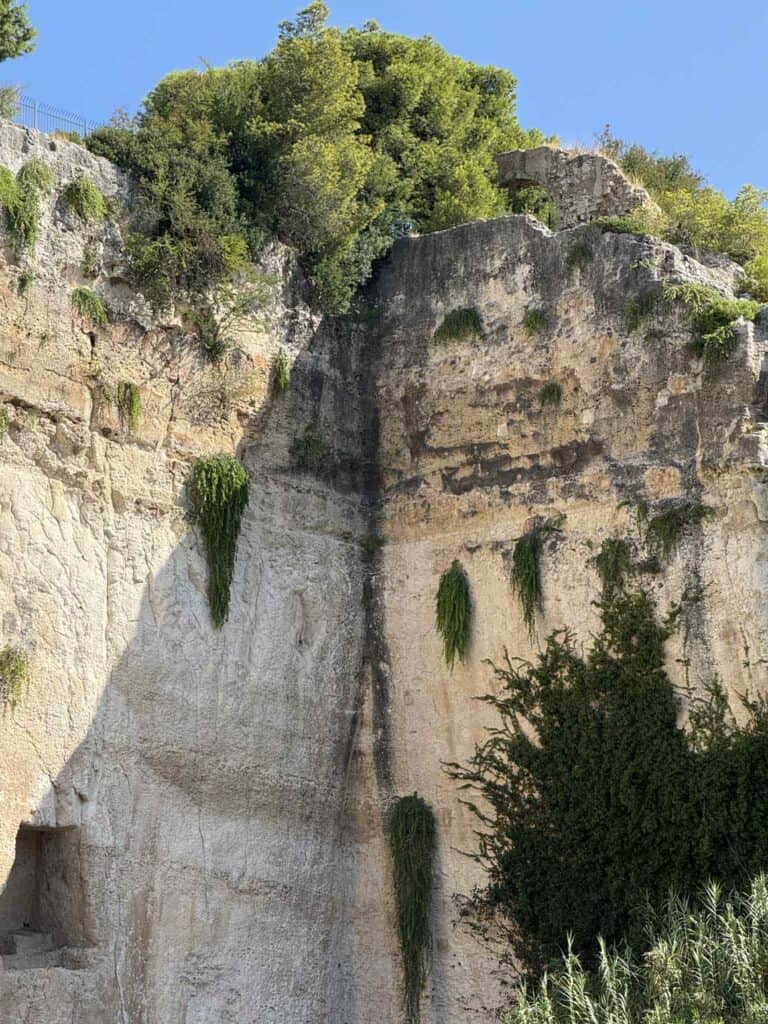
We saw a peppercorn tree which I’d never seen, and also capers were growing in little cavities in the rocks, gracefully hanging down. I don’t know how I expected capers to grow, but it wasn’t this!
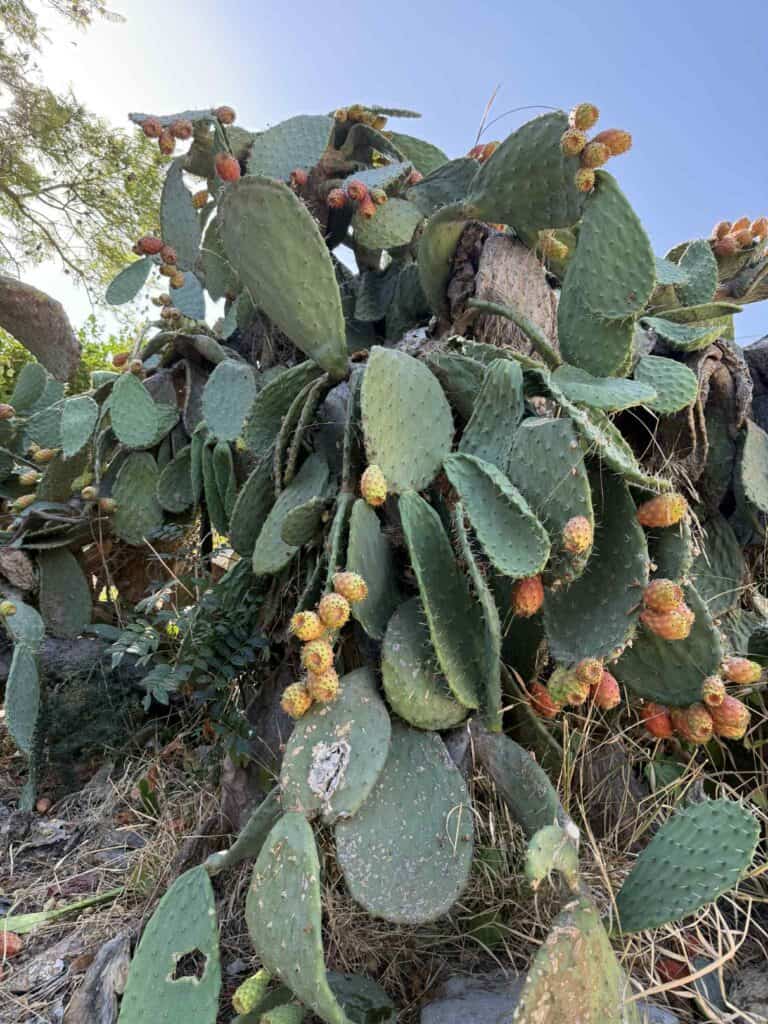
She also told us about the prickly pears, which were confusing me because I thought they were native to the southwest US. Apparently the Spanish brought them from Mexico which answered my question! And like us, Sicilians make a jelly out of the prickly pear fruit. UNlike us, they also make a liqueur like limoncello out of it! A pricklypearcello, as it were! We didn’t see it on our trip, but it’s on my list to seek out the next time we’re in Sicily.
⭐️ Take the Same Awesome Guided Tour We Took to Explore the Park! ⭐️
How to get to Syracuse Archaeological Park
From Ortigia
🚖 5 minutes by taxi
🚶♀️ 27 minutes on foot
From Catania
🚗 51 minutes by car
🚌 1 hour 22 minutes by bus
🚉 1 hour 30 minutes by train
From Palermo
🚗 3 hours by car
🚌 3 hours 45 minutes by bus
Other Locations
Enter your departure point and destination at the link to find the best way to get to “Neapolis Archaeological Park” in Syracuse.
Nervous About Driving in Sicily?
If the idea of renting a car in Sicily makes you hesitate, you’re not alone. We felt the same way before our first trip. But after several road trips across the island, we’ve learned that having a car is definitely the best, and often the only way to reach Sicily’s most fascinating ruins, and that driving here isn’t nearly as intimidating once you know what to expect.
If you’re wondering whether renting a car in Sicily is worth it, how the roads really are, or what to watch out for, we put together a practical guide based on firsthand experience to help you decide with confidence.
🐾 Are dogs allowed at the Syracuse Archaeological Park?
Unfortunately there are no dogs allowed in the park, except for service animals. For us it was just as well since we went on a hot day, and our girl was quite happy to snooze in the air conditioned hotel room until we got back.
✅ Tips for Visiting Syracuse Archaeological Park
See how to integrate Syracuse Archaeological Park into a larger Eastern Sicily Itinerary: The Perfect 7-Day Route for History Lovers
Don’t Miss the Gift Shop
There’s a small gift shop just before you enter the park. It has lots of the usual kitschy tourist fare, but we found a couple things we couldn’t live without. We bought local salted capers, and a pair of glazed ceramic comedy/tragedy masks to remember the incredible theater and all the history that had taken place there.
Don’t Forget to Bring
Sunglasses, sunscreen, water, comfortable shoes, a fully charged phone!
Hit the Café Before You Enter the Park
There’s a café and quite a few nice outdoor tables right at the entrance. Definitely pick up a couple bottles of water if you didn’t bring your own. There are snacks as well, and since the tour (or a DIY visit) will take a couple hours, I’d also suggest eating a little something beforehand so you can fully enjoy your experience.
🚻 Restrooms
There are restrooms located right by the entrance and also within the park close to the Greek theater which are both clean and well managed.
⭐️ Take a Guided Tour!
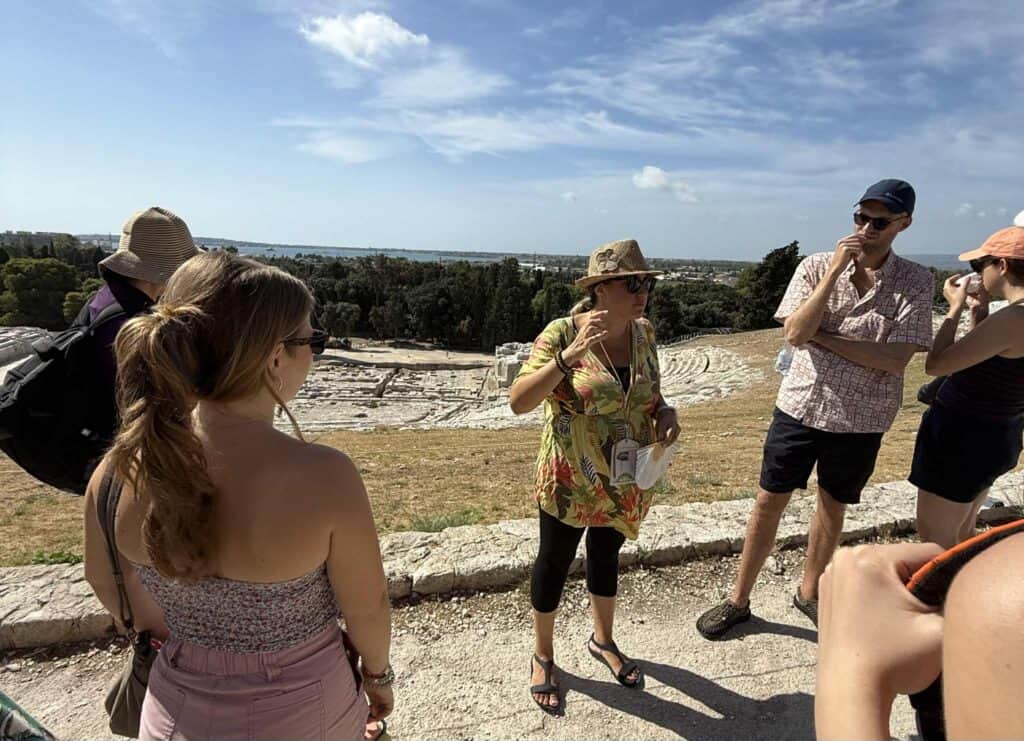
If you found this article useful or interesting, I highly recommend taking a tour. We took this tour and could not have been happier. Our guide was incredibly knowledgeable, enthusiastic, and turned what would have been a good experience into something truly amazing. I was riveted by her tales of the sacrificial altar, life in the quarries, and the spectacles of the amphitheaters. The added value to the experience was well worth the price.
I’m excited for you to experience this absolute must-see jewel of Ancient Greece, however you choose to do it!
To Explore More Amazing Places in Sicily, Read These Travel Guides:
One Day in Syracuse Sicily – A Stunning Historical Gem
The Best Archaeological Sites in Sicily: East to West
Eastern Sicily Itinerary: The Perfect 7-Day Route for History Lovers
Where to Stay in Eastern Sicily: Best Picks for Every Base
The Temple of Apollo in Syracuse: Quick Stop, Big History
Paolo Orsi Archaeological Museum in Syracuse: The Good, and the Ugly
