There’s a moment while traveling when a place stops being somewhere you went on vacation and becomes somewhere you spend the next several years trying to convince other people to visit.
Sicily did that to me. Multiple times. In a single week.
If you’re planning a 7-day Eastern Sicily itinerary, this is the exact route I would recommend based on what we did, what worked, and what I’d change. For a longer trip, we’ve got a 2 Weeks in Sicily guide.
I’ve now written nearly 20 articles about Sicily, which probably tells you something about how I feel about the island. The west has its own wild, windswept magic (and I have a full itinerary for that), but the east has an equally compelling concentration of history: Greek theaters, Roman mosaics, Baroque towns, and places where ancient mythology still feels tied to the landscape.
This itinerary focuses on that version of Sicily.
It’s designed for travelers who:
- enjoy history and archaeology
- prefer a slower, more immersive pace
- and want a mix of iconic sites and hidden gems
We followed this exact route ourselves, traveling with our French bulldog Helga, so you’ll find a few practical notes throughout, including what worked particularly well and what I’d do differently next time.
Below is a complete breakdown of our Eastern Sicily itinerary for one week, including where we stayed, what’s worth your time, and how to plan your route. I’ve also included a custom map below with all stops from this Eastern Sicily itinerary to help you plan your route.
This Eastern Sicily itinerary is best done as a road trip starting in Catania or Palermo and ending in Catania or Palermo.
If you’re planning your trip to Eastern Sicily, these guides will help you go deeper:
7-Day Eastern Sicily Itinerary Overview
Day 1: Palermo (or Catania) → Savoca
Day 2: Forza d’Agrò + Taormina
Day 3: Cyclops Rocks + Brucoli (resort stay)
Day 4: Ortigia & Syracuse
Day 5: Syracuse Archaeological Park
Day 6: Villa Romana del Tellaro + Noto
Day 7: Villa Romana del Casale → Palermo (or Catania)
Is This Eastern Sicily Itinerary is Right for You?
This itinerary is ideal if you:
- Love history, archaeology, and layered cultures
- Prefer slower, immersive travel over rushing between sights
- Want a mix of iconic highlights + hidden gems
- Are comfortable driving in Sicily (necessary)
It may not be ideal if:
- You want a fully car-free trip
- You prefer beach-only relaxation
- You can’t walk on uneven terrain (many historic sites require it)
Use this map to help plan using this itinerary. All the locations in our Eastern Sicily itinerary are marked.
What You’ll Need to Know Before You Go
You need a car
There is no version of this itinerary that works without one. Eastern Sicily is connected by roads, not rail, and many worthwhile places are up hills and not connected by public transport. Renting a car in Sicily has its own learning curve, but here’s everything you need to know before you pick up the keys.
Fly Into and Out of Catania If You Can
We flew into Palermo due to airline and schedule constraints.
If you have flexibility, fly in and out of Catania. It will save hours of driving.
Distances are Deceptive
Sicily looks compact on a map. It is not compact on a road. Factor in mountain passes, coastal switchbacks, and the fact that you will stop every twenty minutes because something beautiful is happening, or sheep are crossing the road, or you want to see where this little road goes, and give yourself more time than you think you need.
Day 1: Palermo Overnight → Savoca
Palermo: A Late Arrival Done Right
We landed late into Palermo and overnighted at the Mercure Palermo Centro, which turned out to be a genuinely good choice for late night weary travelers with a dog in tow. They provided a dog bed and bowls for Helga without being asked, which immediately gives them bonus points.
The real revelation was breakfast: a full Sicilian spread that included, I am not making this up, a stuff-your-own-cannoli station. If that doesn’t put you in the mood for a week in Sicily, nothing will.
For the full rundown on this hotel and everywhere else we stayed on this route, see our Where to Stay in Eastern Sicily guide.
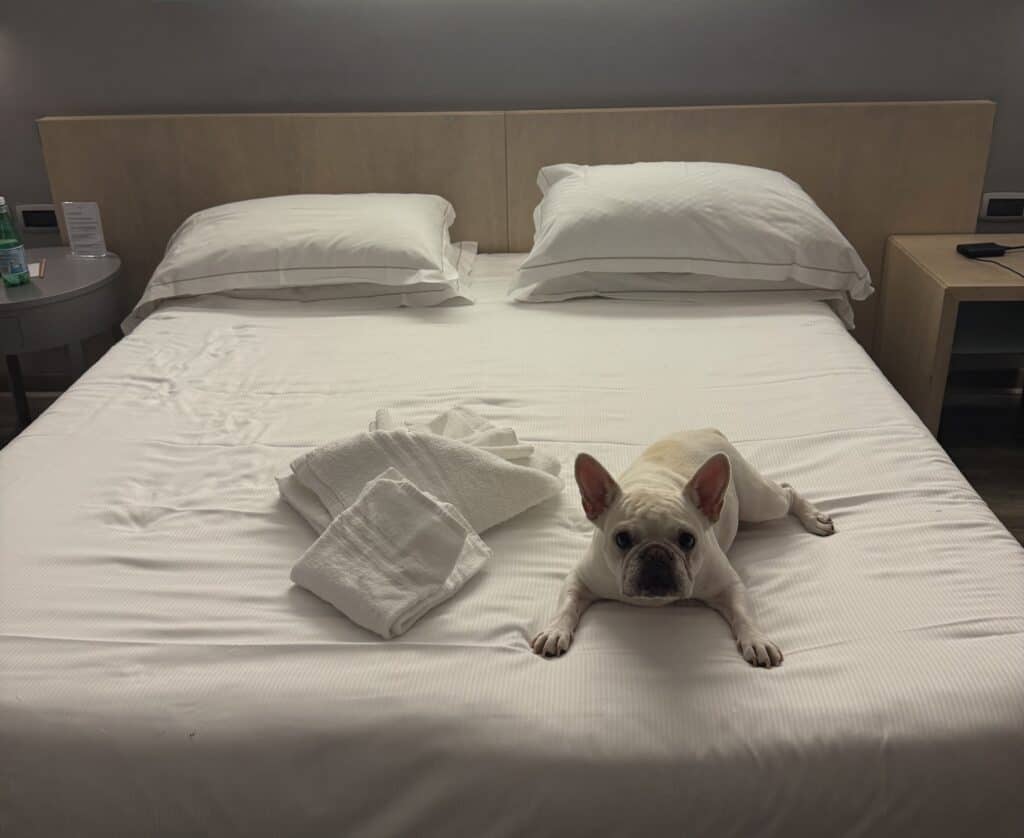
If you’re starting your Eastern Sicily itinerary with a late arrival, this is exactly the kind of easy, no-stress overnight stop you want. We didn’t spend any time in Palermo itself on this particular trip. I’ve already dedicated a full guide to Palermo, and it served as one of the hubs of our Western Sicily itinerary, so the next morning, after cannoli, we pointed the car northeast toward Savoca.
Savoca: The Godfather’s Village
Why Stop in Savoca on an Eastern Sicily Itinerary:
- One of Sicily’s most atmospheric hill towns
- Famous filming location for The Godfather
- Easy first stop close to Taormina
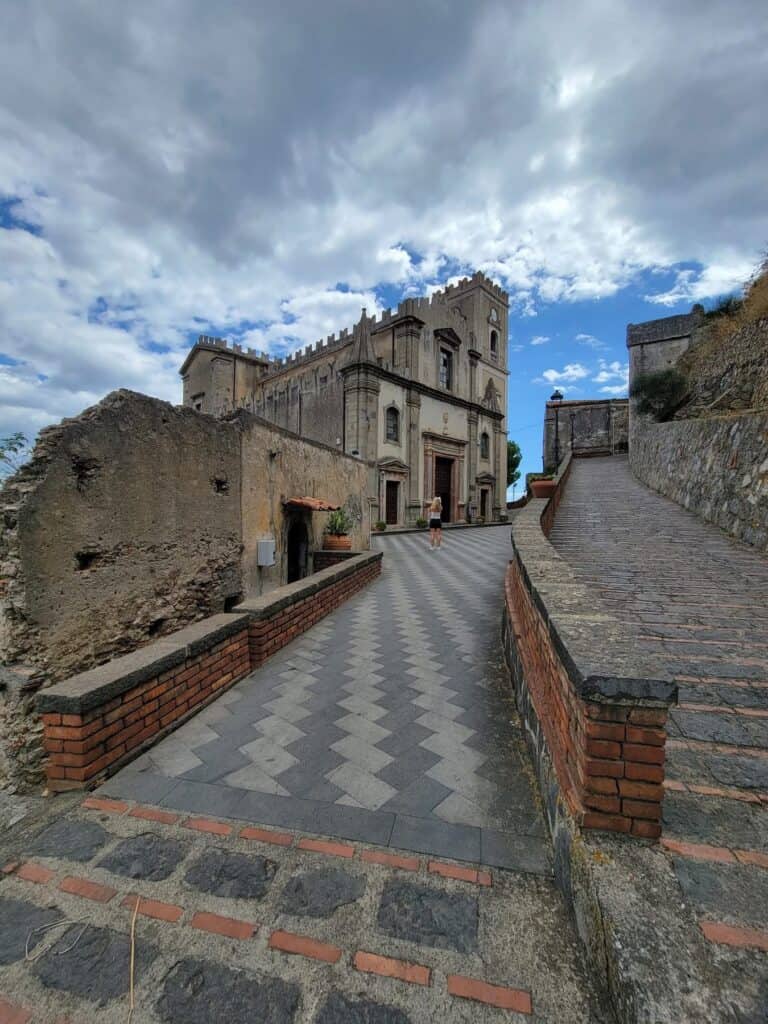
Here is something I did not know before I booked our hotel: several scenes from The Godfather were filmed not in New York, not on a Hollywood backlot, but in a tiny, ancient hill town in northeastern Sicily called Savoca. Michael Corleone’s courtship of Apollonia. The scene at Bar Vitelli. The Corleone family wedding filmed in the church at the top of the hill.
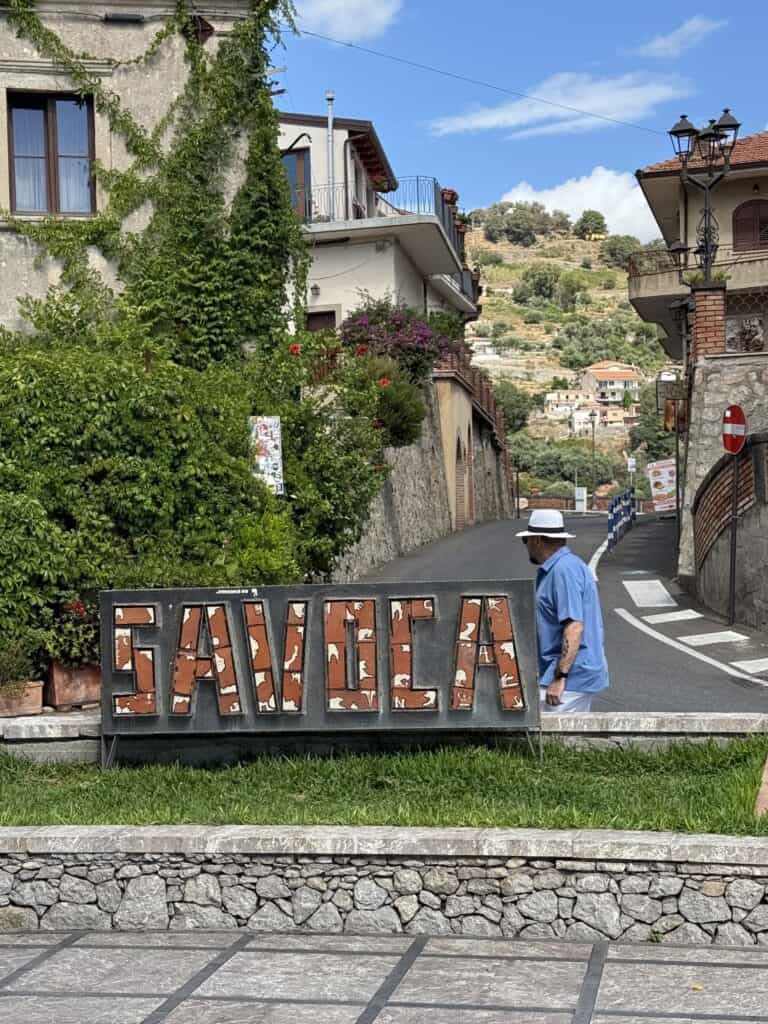
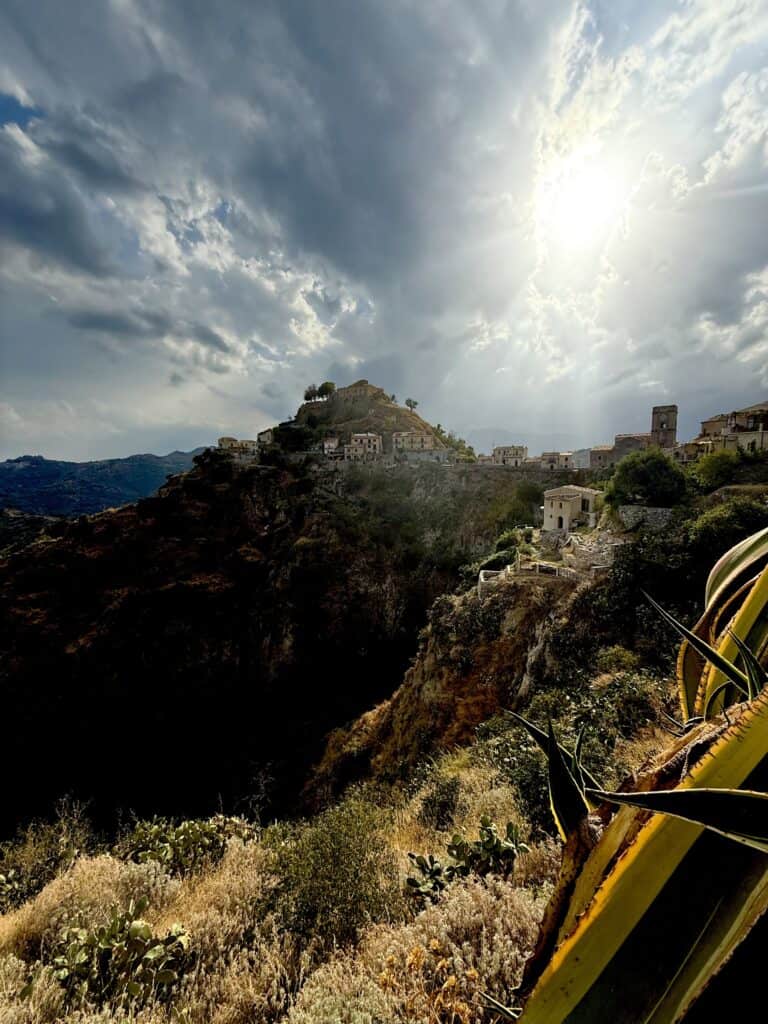
Once I learned this, the rest of our time in Savoca & the surrounding area basically planned itself.
Getting there required threading our large rental car through streets that were clearly designed for donkeys, not the humongous whatever full-size vehicle I’d somehow ended up with in my “upgrade.” It was a struggle. And it was completely worth it. If you’re planning a road trip through Eastern Sicily, this is where you’ll quickly understand why you want the smallest rental car you can get away with!
Savoca has leaned into its Godfather identity with warmth and wit rather than crass commercialism. In the small main piazza, there’s a striking mirror-like metal installation with a silhouette of Francis Ford Coppola and his film camera – a genuinely lovely piece of public art that acknowledges how much this village still owes to a movie made fifty years ago.
Turn around and you’ll find Bar Vitelli, the very bar where Michael Corleone met Apollonia and asked her father for permission to court her. You can eat and drink there today, but if you’re visiting on a weekend or during high season, make a reservation. The gift shops around the piazza sell everything from local food products and wines to cheerfully kitschy Godfather souvenirs.
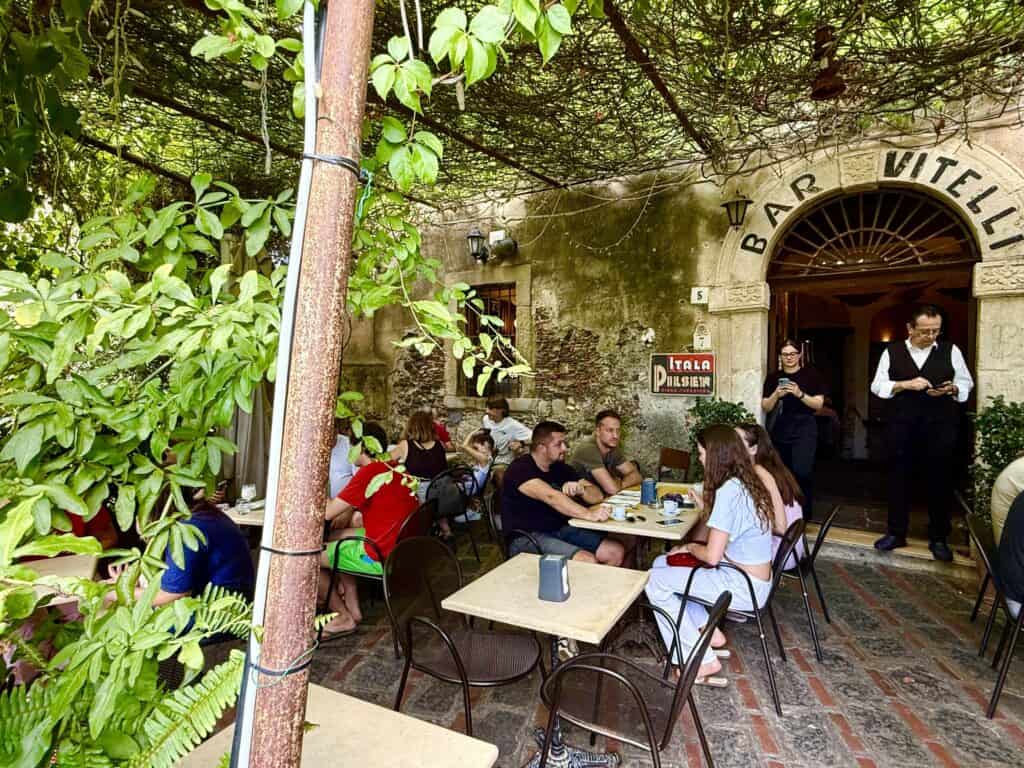
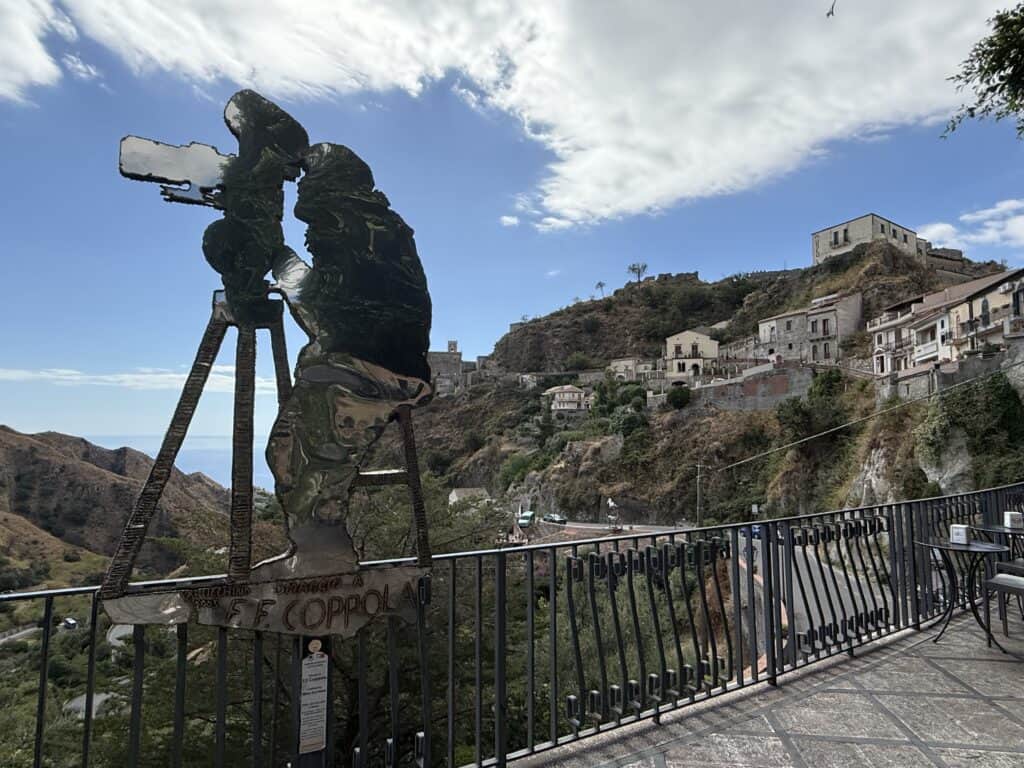
From the piazza, we hopped on a small open shuttle that climbed up the steep hill to the church where the Corleone wedding was filmed. It’s a gorgeous old Norman-era church with views over the valley that would justify the climb even without the movie connection.
What I absolutely was not expecting is that one of the side chapels in the church had been set up with a television screen playing scenes from The Godfather on a loop, alongside informational placards explaining what had been filmed where. It was definitely a unique experience, standing there watching a 1972 movie in the actual place it was filmed. *They did not show any of the many “church-inappropriate” parts of the movie.
Where to Stay in Savoca: The Borgo San Rocco
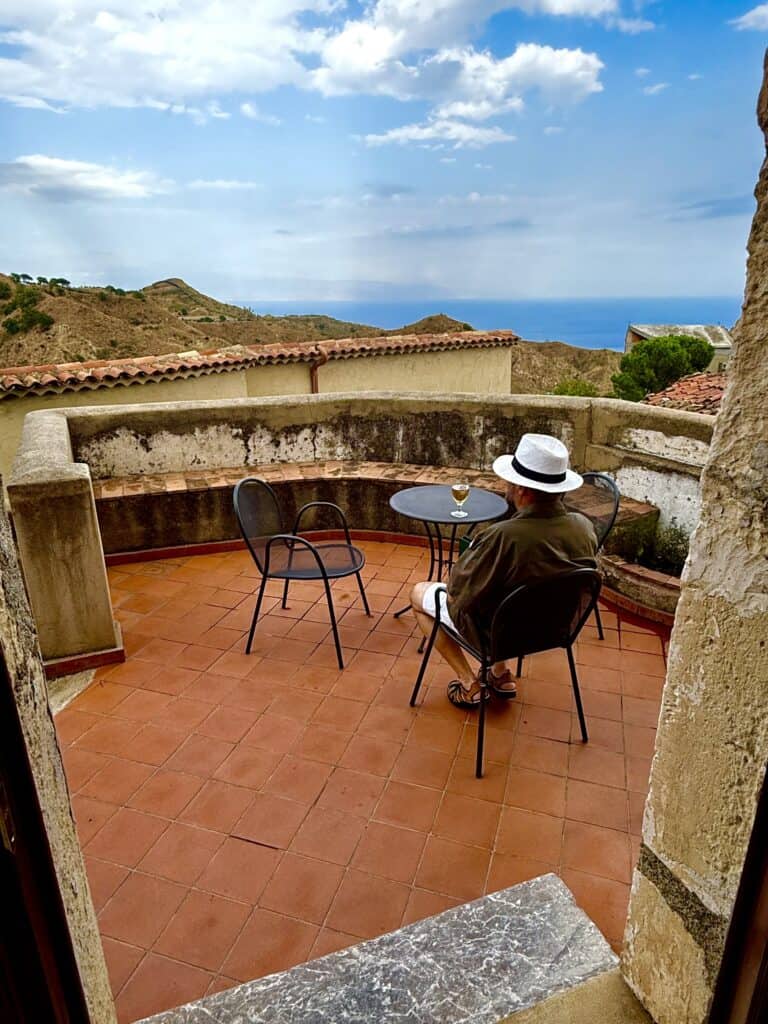
We stayed at Borgo San Rocco, and it remains one of our most memorable stays anywhere in Sicily. Full details in our Where to Stay in Eastern Sicily guide.
My Take on Savoca
- Was it worth it? Absolutely! This would have been worth the stop even without the Godfather connection.
- Time needed: 2–3 hours (or overnight, which I highly recommend)
- Best for: History lovers, film fans, and anyone who prefers a slower-paced atmosphere over checklist sightseeing
- One thing I’d do differently: Get a smaller rental car!
Day 2 of Your Eastern Sicily Itinerary: Forza d’Agrò & Taormina
Day 2 Highlights:
- Two of Sicily’s most beautiful hill towns
- The Godfather filming locations
- The iconic Greek Theater of Taormina
- Coastal views with Mount Etna in the distance
Forza d’Agrò: The Other Godfather Village
Having been thoroughly primed by Savoca, we decided to make a short detour to Forza d’Agrò, another small village that appears in both The Godfather and The Godfather Part II. Like Savoca, it has embraced the connection. There’s even an Il Padrino restaurant whose logo is a profile of Marlon Brando.
But here’s the thing about Forza d’Agrò: even if Francis Ford Coppola’s scouting crew had never found it, it would still be worth the detour. Think about it – a whole group of location scouts chose this village for its atmosphere and cinematic views.
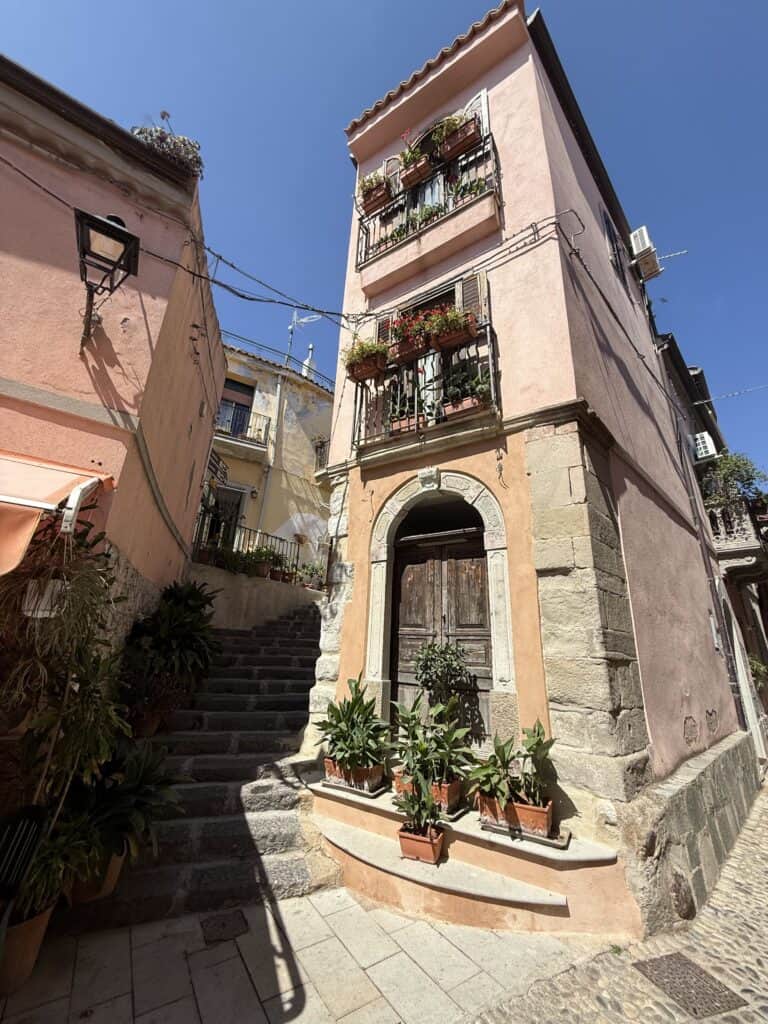
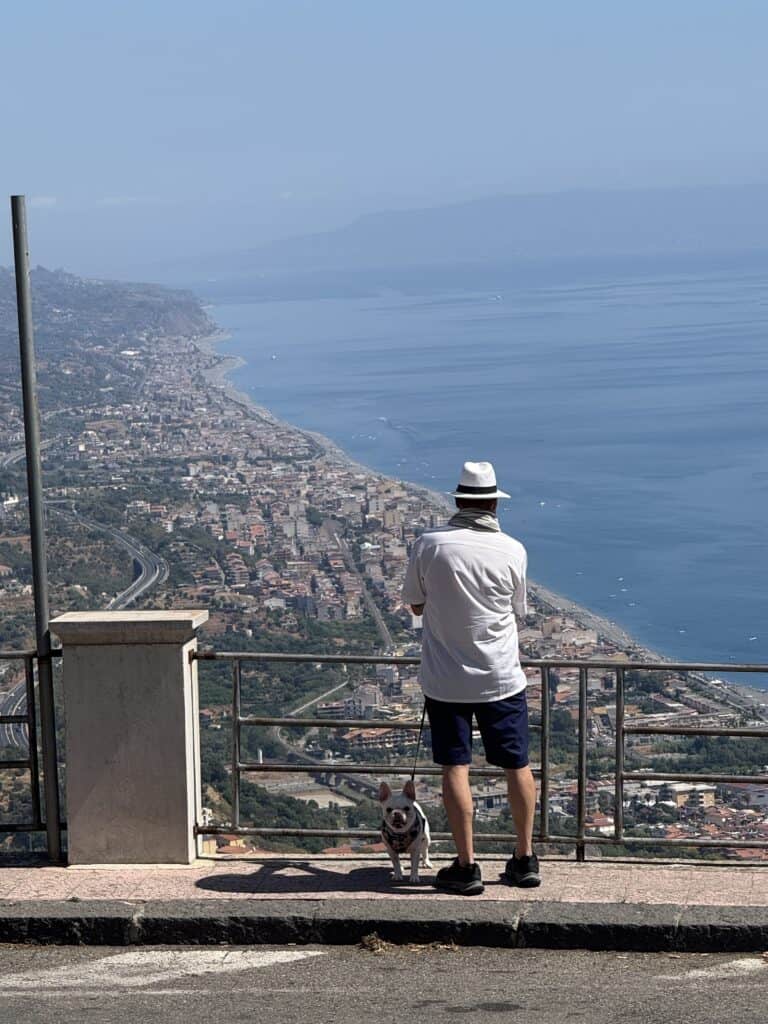
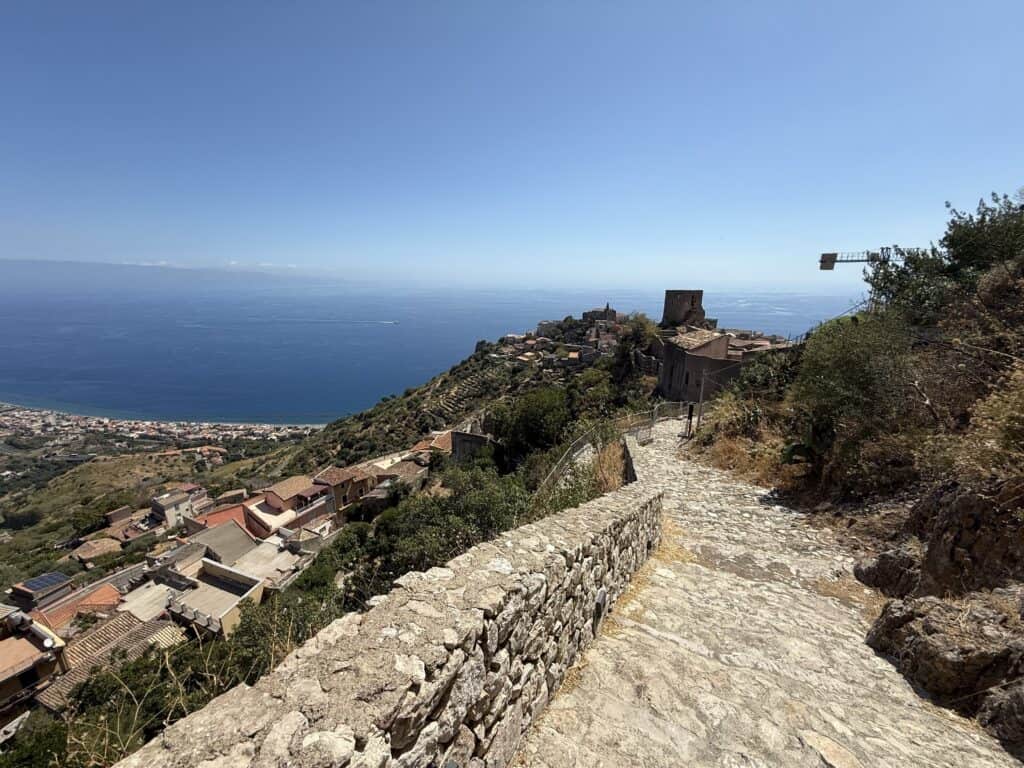
We wandered with no map and no plan, just turning corners and taking pictures and feeling, repeatedly, like we’d stepped onto a movie set – one that also happened to have real people living in it, laundry hanging between windows, ancient stone walls and wooden doors, cats napping in the sun.
We tried to hike up to the Norman castle at the very top of the hill, but the gate was locked, and access has reportedly been closed for some time (so don’t plan your visit around it). We did peer through the gate, which counts for something, and loved the views from the top of the hill.
We visited the Cattedrale Maria Santissima Annunziata e Assunta and the beautiful central piazza, which served as the backdrop for a scene in the film. It’s a short stop, but a memorable one – the kind of place where having no plan is the plan.
My Take on Forza d’Agrò
- Was it worth it? Yes, but more for the gorgeous atmosphere than a list of places to visit
- Time needed: 1 – 2 hours
- Best for: Slow travelers, photographers, film buffs, and anyone who enjoys wandering
- Skip it if: You’re short on time, and already visited Savoca
Taormina – Worth the Crowds?
Why Taormina Is a Must-Stop on an Eastern Sicily Itinerary:
- One of the most scenic towns in all of Italy
- Home to the famous Greek Theater overlooking Mount Etna
- A mix of history, views, shopping, and classic Sicilian atmosphere
Taormina is touristy. Not trying to be controversial, it’s simply true. It’s also one of the most beautiful towns I’ve been to in Italy, and there’s a reason everyone thinks so.
The views from the hilltop out over the Ionian Sea, with Mount Etna sleeping on the horizon, are the kind that make you understand why humans have been building things on this particular spot for three thousand years. If you’re someone who appreciates places where history and jaw-dropping landscapes come together, this is one of those rare locations that delivers on both.
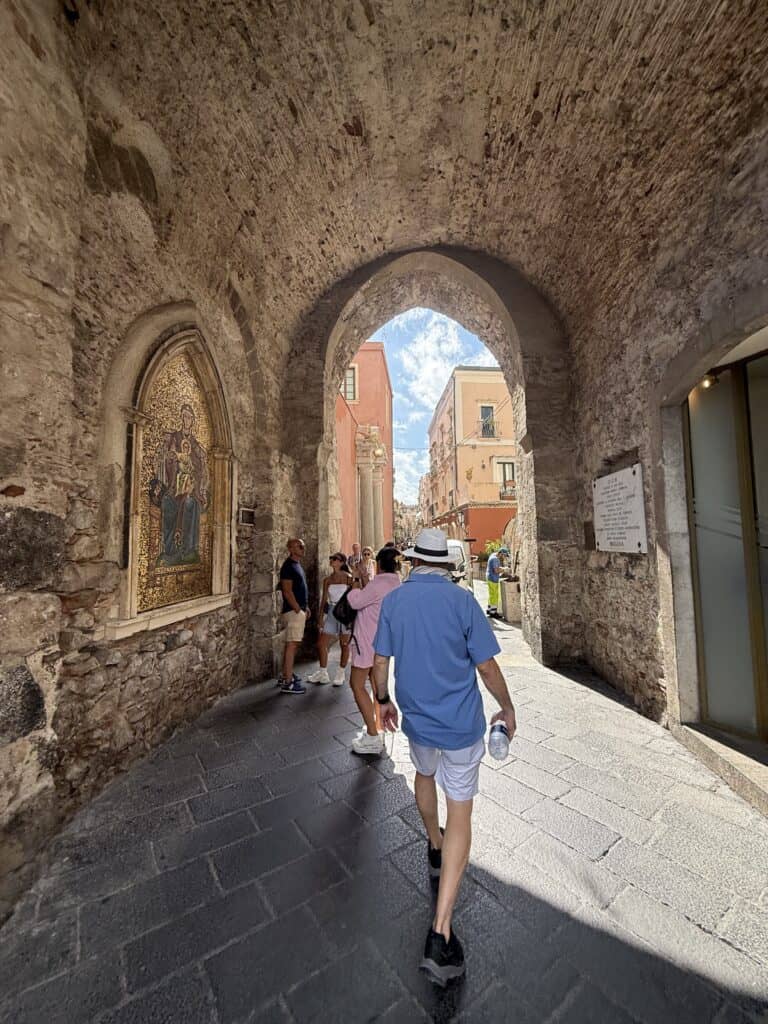
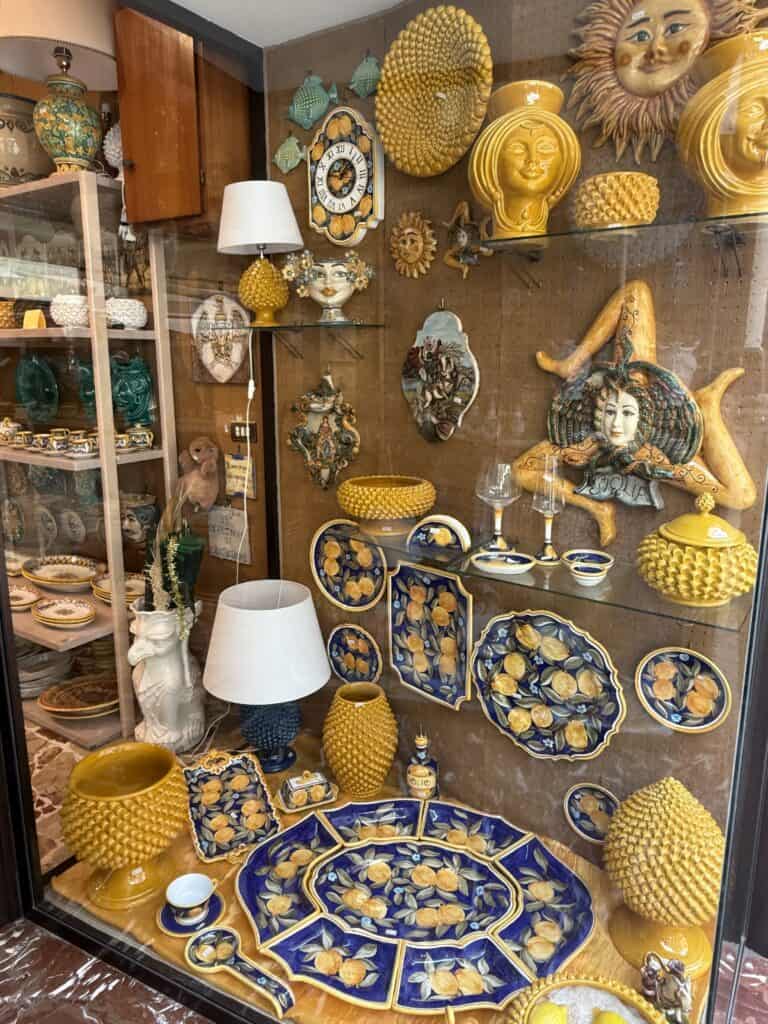
The main street, Corso Umberto, is lined with historical churches, boutique shops selling ceramics and local art, gelaterias, restaurants offering cooking classes, terraces with views to eternity, and a ton of humanity during peak season.
We wandered into the main piazza and spent a good while just standing there, admiring the statuary, the stone, the old buildings, the view of pleasure boats on the water below. It was, in the best possible way, a lot.
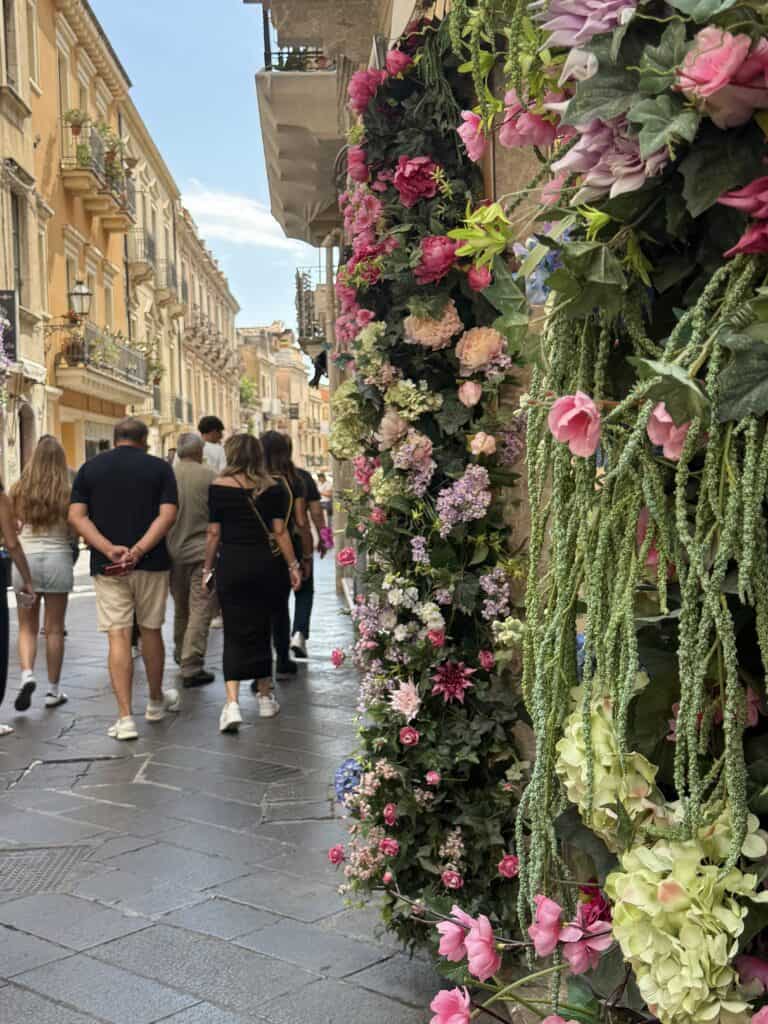
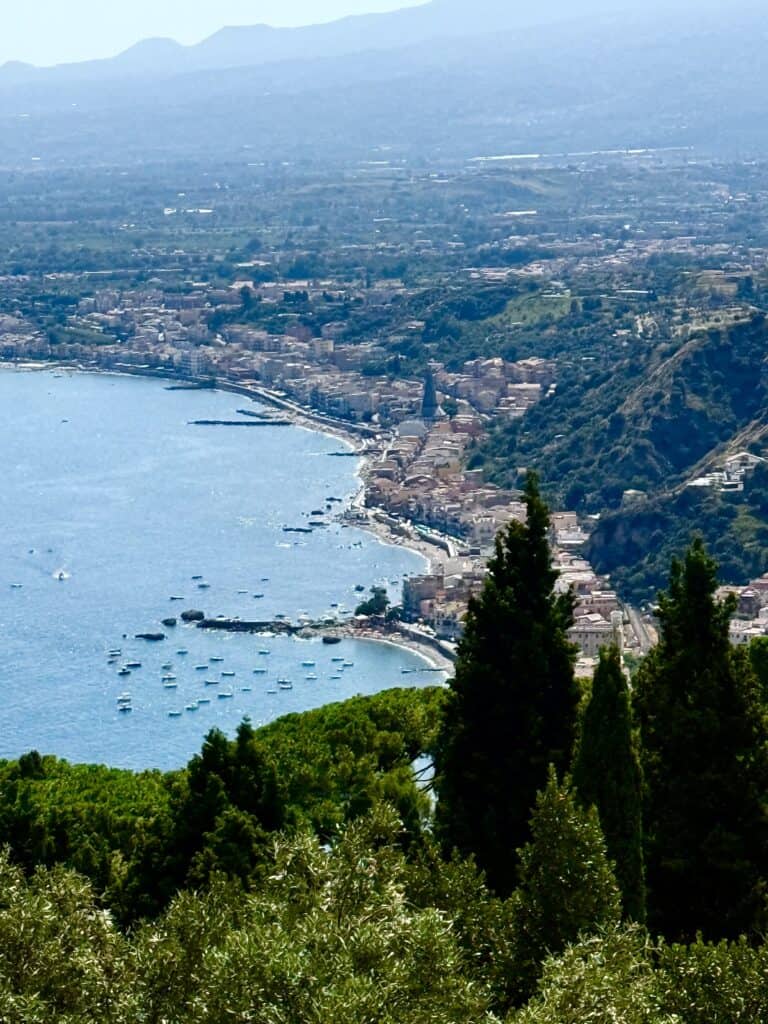
Ristorante Taormina Pizzeria deserves a specific mention: if you want a genuinely excellent pizza with what I would argue is one of the best views of any pizzeria on the planet, this is the place.
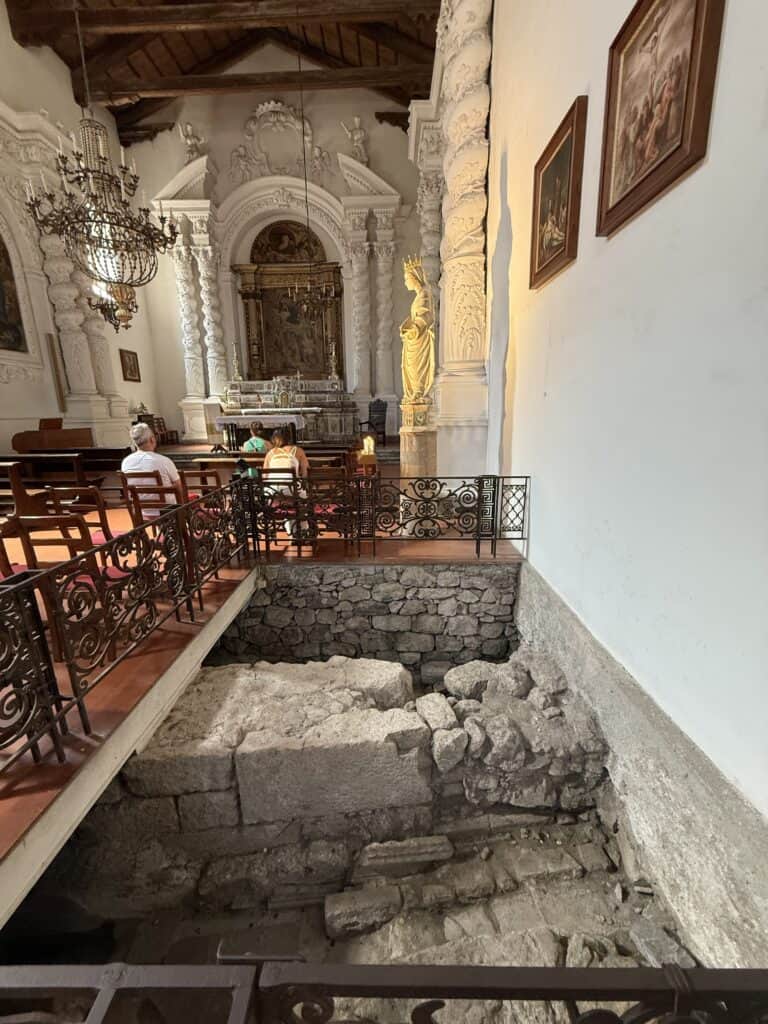
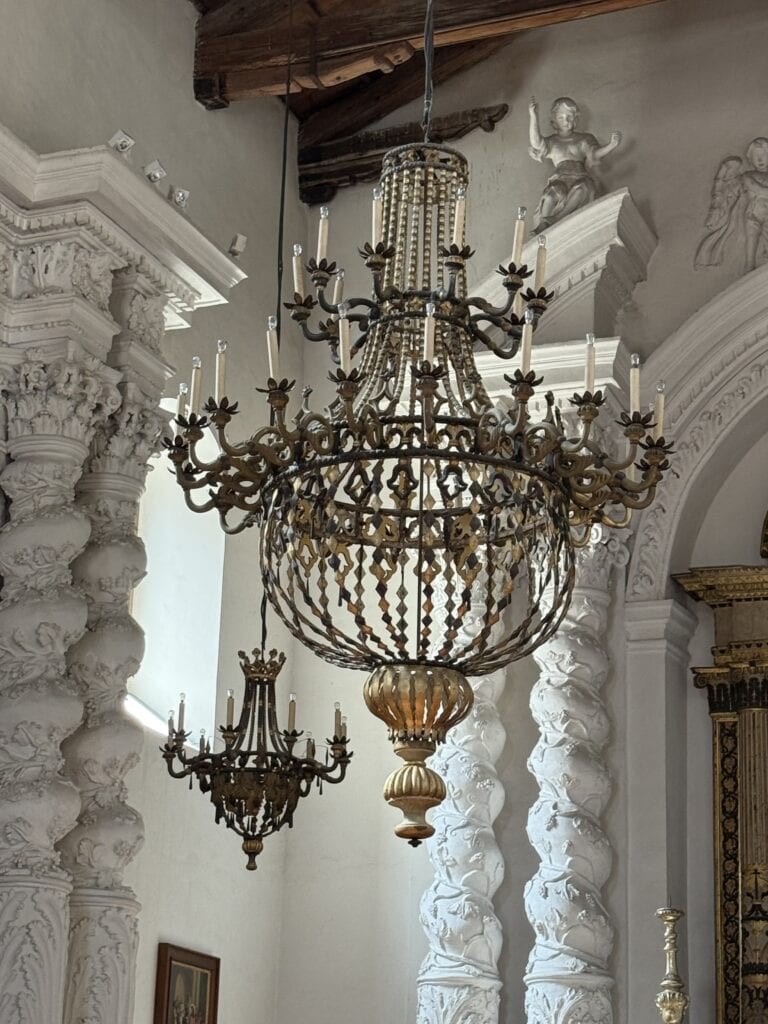
We also ducked into Largo Santa Caterina, a small square just off the Corso that turned out to be a genuinely fascinating archaeological layering. The Church of Santa Caterina, built in the early 1600s in Baroque style, was constructed on top of a Roman Odeon, which was itself built on the foundations of a Greek temple likely dedicated to Aphrodite. Three civilizations, stacked like architectural geological strata.
Restoration work in the 1970s exposed Greek-Roman wall ruins and cobblestones inside the church, now visible behind wrought iron railings, and underneath transparent floors. Before the church existed, this square was the ancient Greek agora and later the Roman Forum which was the beating civic heart of Taormina for centuries. I love a place that wears its history openly like this, letting you peer into the layers instead of leaving them covered up.
The Greek Theater of Taormina (Don’t Skip It)
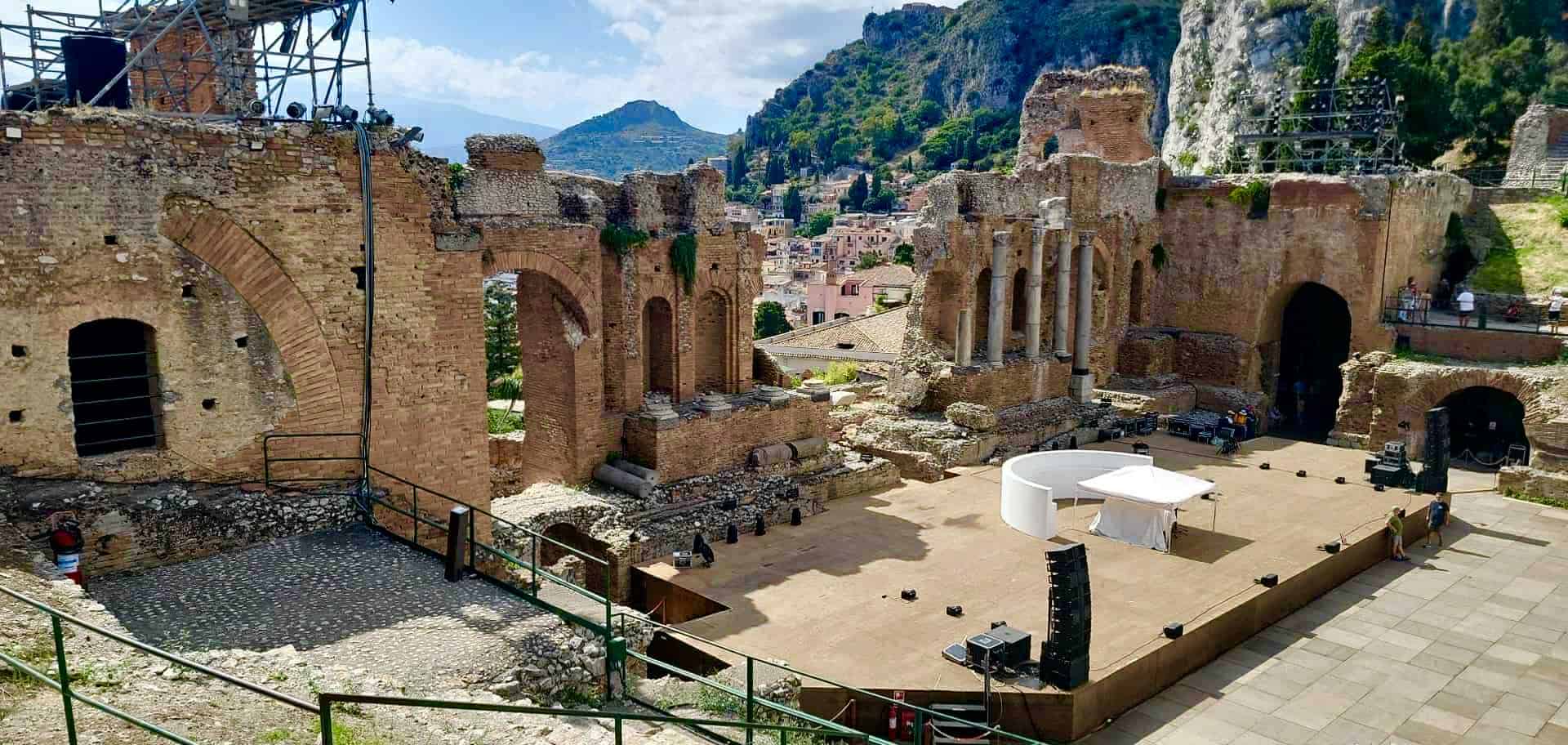
The main event at the end of the Corso is the Greek Theater of Taormina, which I loved so much I’ve written an entire dedicated post about it. Admission is 14 euros for adults, free for under-18s. Between the size of the cavea, the backdrop of Etna and the blue sea, and the knowledge that this theater dates back to the 3rd century BC, it’s the kind of place that gives you genuine goosebumps.
Even if you’ve seen Roman or Greek theaters elsewhere, this one feels different because of its otherworldly setting. It’s not just the history, it’s where it sits in the landscape. I don’t know how ancient theater-goers were able to focus on the performance with a view like that!
Afterward, we got pistachio gelato because the day had turned hot and we know the rules.

Two hotels in Taormina caught our eye for future stays, both splurge-worthy 5-star properties. If you’re planning to stay in Taormina, we’d prioritize location over price, being able to walk to the main sights early or late in the day makes a real difference. Details on both in our Where to Stay in Eastern Sicily guide.
My Take on Taormina
- Was it worth it? Yes, even with the crowds
- Time needed: Half to full day
- Best for: First-time visitors, photographers, and history lovers
- Biggest drawback: Crowds, especially mid-day
- Tip: Go early morning or late afternoon for a different experience, or stay in Taormina overnight
Day 3 of Your Eastern Sicily Itinerary: Cyclops Rocks & Brucoli
Day 3 Highlights:
- Mythology brought to life at the Cyclops Rocks
- One of the most unique coastal landscapes in Sicily
- A slower afternoon to reset at a seaside resort
The Cyclops Rocks of Aci Trezza
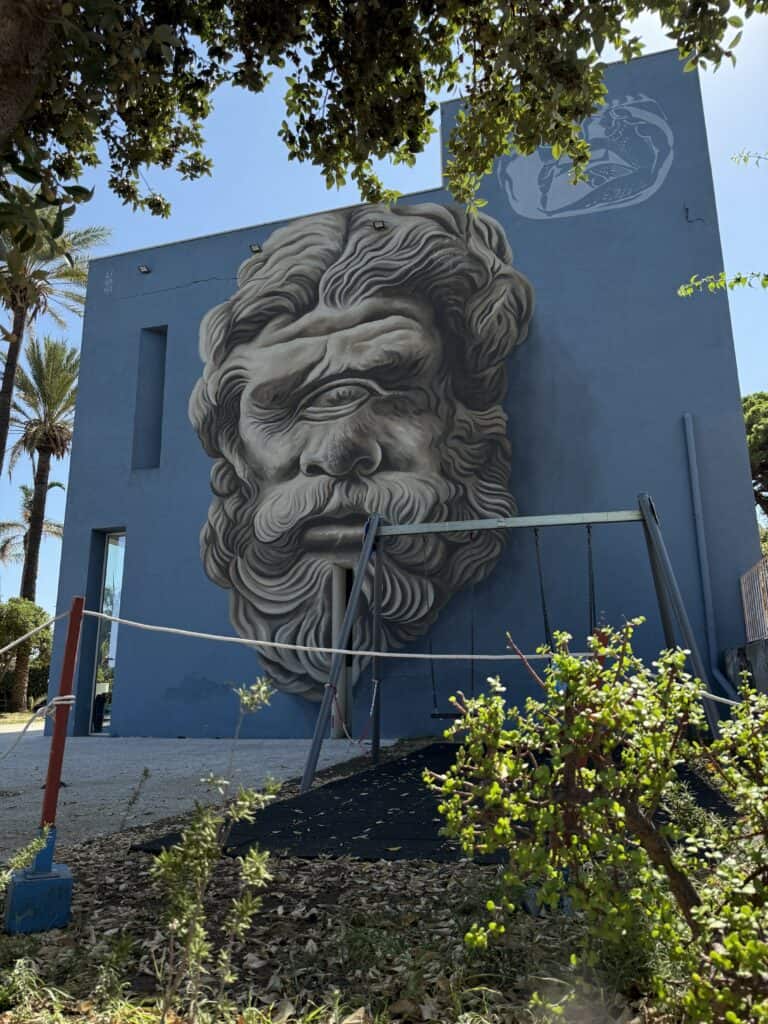
I came across the Cyclops Rocks during my planning and genuinely could not believe they were real. Off the small fishing village of Aci Trezza, a cluster of massive black basalt sea stacks jut dramatically out of the Ionian Sea. They are visually extraordinary. They also have a mythology that is, frankly, textbook perfect. You may remember this from school.
According to Homer’s Odyssey, this stretch of Sicily’s eastern coast was home to Polyphemus, the man-eating cyclops, son of Poseidon, who trapped Odysseus and his men in his cave and began eating them one by one. Odysseus’s eventual escape involved getting Polyphemus blind drunk, driving a sharpened stake into his single eye, and slipping out of the cave by clinging beneath the bellies of the cyclops’s flock of sheep.
He had told Polyphemus his name was “Nobody,” so that when the blinded giant screamed for help, and the other cyclopes on the mountain asked “Who did this to you?” all he could say was “Nobody!” As Odysseus’s ship made for open water, the enraged Polyphemus tore enormous chunks of volcanic rock from Mount Etna and hurled them blindly toward the sound of the retreating ship.
Those rocks, according to legend, are the Faraglioni of Aci Trezza, still standing in the sea where they landed.
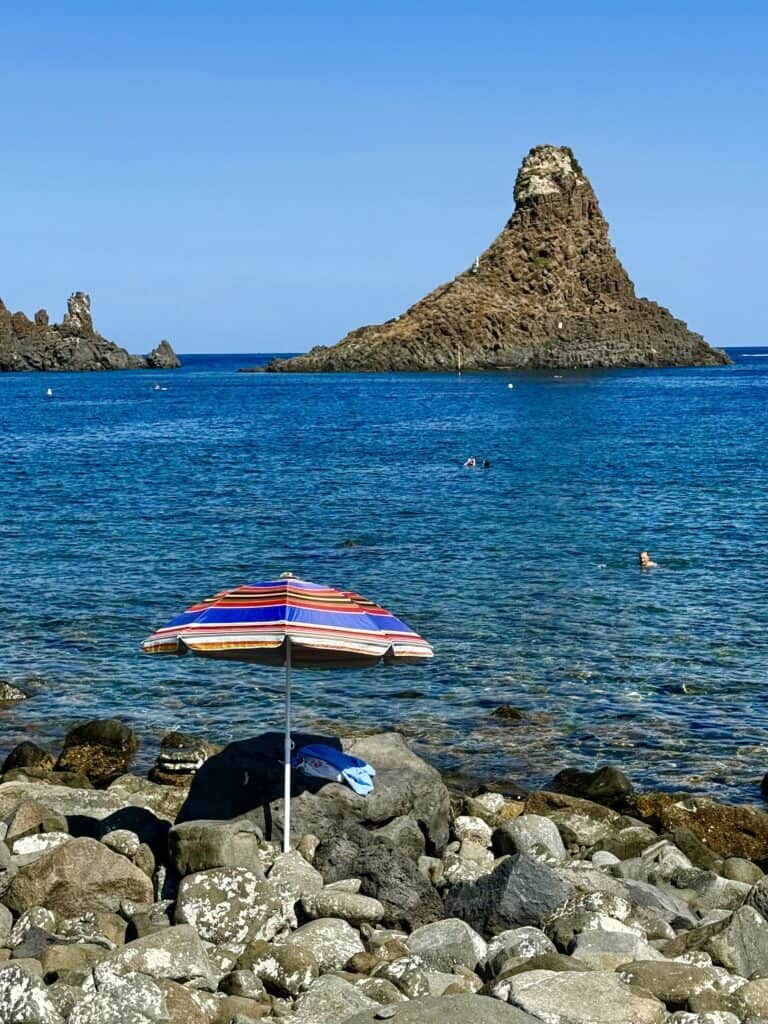
Standing there watching people swim and lounge on those ancient black rocks, torn from the volcano still visible from there, I kept thinking about Polyphemus hurling them in blind fury two and a half thousand years ago. Mythology meeting reality.
There’s no need to plan a long stop here. 30 minutes to an hour is enough, unless you want to swim or linger. I found myself wishing we’d had more time and brought a picnic.
My Take on the Cyclops Rocks
- Was it worth it? Yes! It’s completely unique, and unlike anything else on this itinerary
- Time needed: 30–60 minutes or more
- Best for: Mythology lovers, photographers, a dip in the water, and scenic stop
- Tip: Bring water and/or a small picnic and towel if you want to stay longer
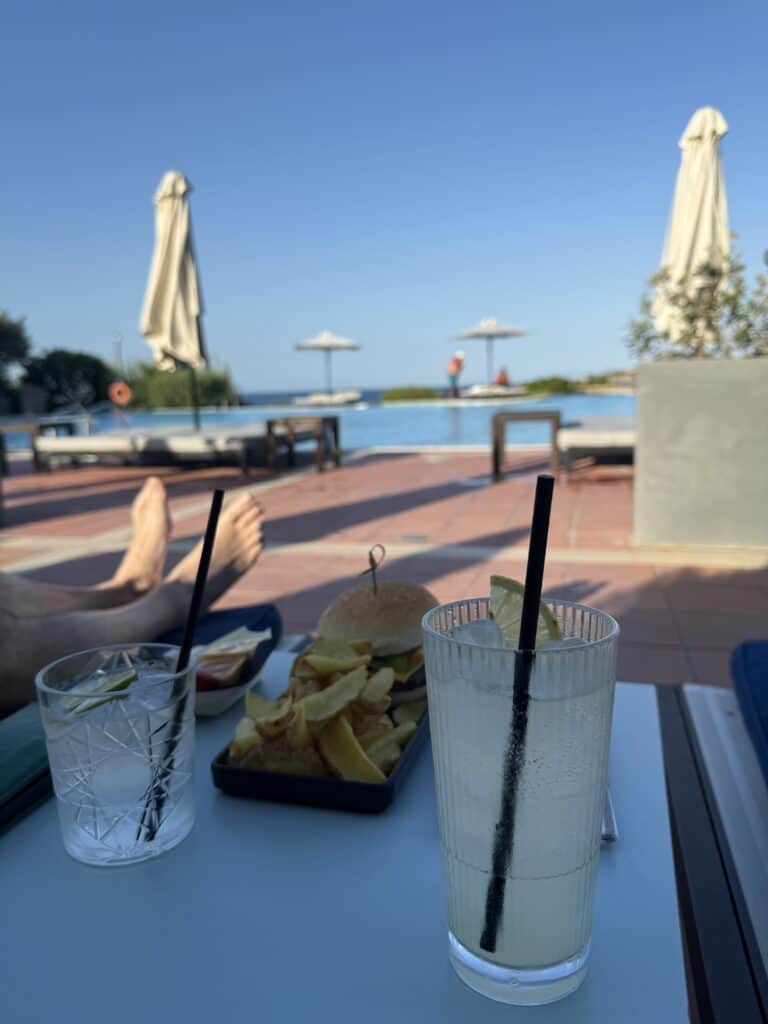
Where We Stayed on the Eastern Coast: Mangia’s Resort, Brucoli
We arrived in the late afternoon, were golf-carted to our room, and this became our base for the next few nights, exactly the reset we needed after several days of hill towns and history. Full details in our Where to Stay in Eastern Sicily guide.
Day 4 of Your Eastern Sicily Itinerary: Ortigia & Syracuse
Day 4 Highlights:
- One of the most historically significant and layered places in Europe
- Walkable old town packed with Greek, Roman, and Baroque history
- Markets, museums, and coastal views
Ortigia: The Historic Heart of Syracuse
Why Ortigia Is a Must-Visit:
- 2,500+ years of continuous history in one compact area
- Unique mix of Greek ruins and Baroque architecture
- One of the most walkable, beautiful, and atmospheric places in Sicily
Ortigia, the ancient island heart of Syracuse, deserves a full day and honestly could absorb more. We started at the morning market which was a feast for the eyes – colorful, and full of life – and browsed for souvenirs and local products before the heat settled in. From the market, we wandered without much of a plan, which, in a place like Ortigia, is exactly how you want to experience it.
We followed our noses through one of the most historically dense neighborhoods I’ve walked through anywhere in Europe. The Temple of Apollo, one of the oldest Doric temples in all of Sicily, hiding in plain sight in a piazza.

The ancient Basilica di San Pietro Apostolo. The Cathedral of Syracuse, built directly around and incorporating the original columns of a Greek Temple of Athena, which means you walk into a Baroque church and suddenly find yourself standing between 2,500-year-old stone columns that were already ancient when the church was built around them.
We explored the Museum of Archimedes and Leonardo da Vinci. Then a romantic stroll by the harbor, where we watched boats, and found the statue of Archimedes, Syracuse’s most famous son. Then we grabbed a light bite in an outdoor eatery and absorbed it all.
Finally, in the heat of the day we left the island and explored the blissfully air-conditioned Paolo Orsi Archaeological Museum. I’ve written about this treasure trove at length because it deserves it: Paolo Orsi Archaeological Museum in Syracuse: The Good, and the Ugly


We left as the museum was closing and were back at the resort for aperitivo by early evening, which felt very civilized.
If you want a deeper dive into Ortigia, check out One Day in Syracuse Sicily – A Stunning Historical Gem
My Take on Ortigia
- Was it worth it? Absolutely, this is one of the highlights of Eastern Sicily
- Time needed: Full day (minimum)
- Best for: History lovers, photographers, architecture enthusiasts, and slow travelers
- Tip: Start early and take breaks. There’s more here than it seems at first
Day 5 of Your Eastern Sicily Itinerary: Syracuse Archaeological Park
Day 5 Highlights:
- One of the most important archaeological sites in Sicily (and the entire ancient Greek world)
- Greek and Roman history in one place
- Guided tour that significantly enhances the experience (Don’t skip it!)
I have written a detailed guide to the Syracuse Archaeological Park, and I’d encourage you to read it before visiting as part of your Eastern Sicily itinerary.
But let me say this: if you are a history lover, and if you are the kind of person who has read this far in an article like this one, the park will produce a level of inner joy that is difficult to prepare for. This specific spot was my reason for wanting to visit Sicily and it absolutely did not let me down. I felt like a kid in a candy shop!
- A Roman amphitheater.
- The largest sacrificial altar in the ancient Greek world, which at 200 meters long defies comprehension when you’re standing next to it.
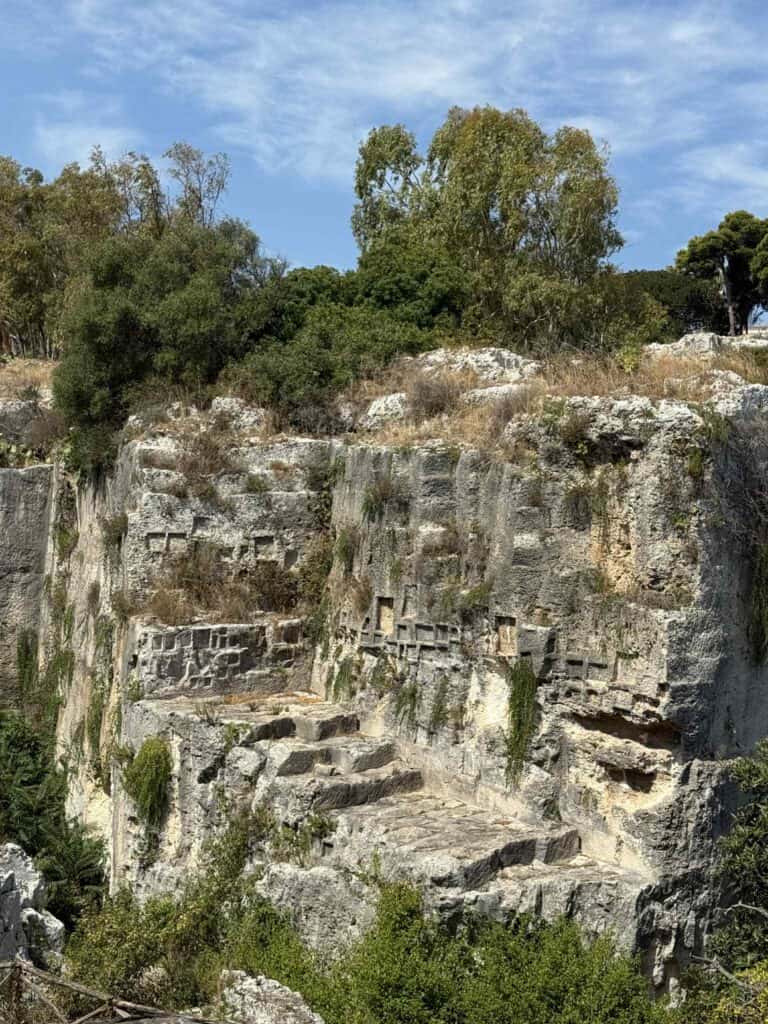
- Early Christian tombs carved directly into the rock and overlooking the sea.
- The Ear of Dionysius, a cave with acoustic properties so perfect that the tyrant Dionysius allegedly used it to eavesdrop on his prisoners.
- The Greek theater where Aeschylus himself premiered plays, and where Plato attended performances. This one, specifically, got me.

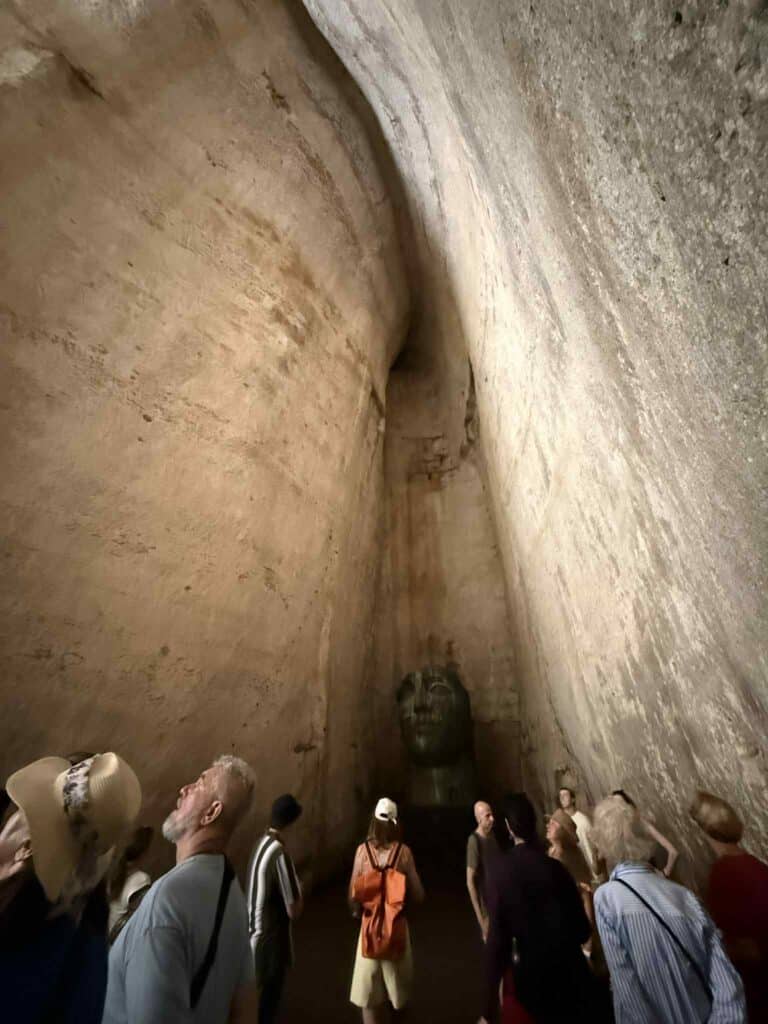
I also booked a guided tour here, and I want to stress this: it was one of the best organized tours I have ever taken. I still remember the stories. The guide gave us historical context I never would have assembled on my own, and the whole experience was richer by an order of magnitude for having it. It is a genuine must-do.
After the tour, on the way out, we passed what is locally labeled the “Tomb of Archimedes.” A small but fascinating detail that’s easy to miss – it is genuinely interesting, but it is almost certainly not the tomb of Archimedes, a renowned ancient Greek mathematician, physicist, engineer, and inventor. The structure you see is a Roman columbarium, a collective burial area, that dates to several centuries after Archimedes’ death in 212 BC.
What is historically documented is that Cicero, serving as a Roman magistrate in Sicily in 75 BC, 137 years after Archimedes died, went looking for the tomb and found the Syracusans unable to help him. They denied it existed at all, but Cicero found it himself, near what was called the Agrigentine Gate, completely covered over in brambles.
Cicero had the tombstone cleared, read the inscribed verses, and identified it by the carved sphere and cylinder on top – mathematical symbols Archimedes had specifically requested, representing what he considered his greatest proof.
After Cicero’s visit, the tomb fell back into neglect. Its precise location has never been confirmed. The structure pointed out to tourists today is, most archaeologists agree, an interesting Roman tomb with no genuine connection to the man.
My Take on Syracuse Archaeological Park
- Was it worth it? A thousand times yes! This alone justifies the trip to Sicily if you love history
- Time needed: 2–4 hours
- Best for: History lovers, especially Greek and Roman history
- Don’t skip: The guided tour – it genuinely transforms the experience
Day 6 of Your Eastern Sicily Itinerary: Tellaro & Noto
Day 6 Highlights:
- A hidden Roman villa with stunning mosaics and a great story
- Sicily’s most beautiful Baroque town
- A perfect mix of “under the radar” and iconic
Villa Romana del Tellaro
This one wasn’t even on my radar until I saw it on Google Maps the night before. I added it to the route on a whim, and it turned out to be one of my favorite discoveries of the trip.
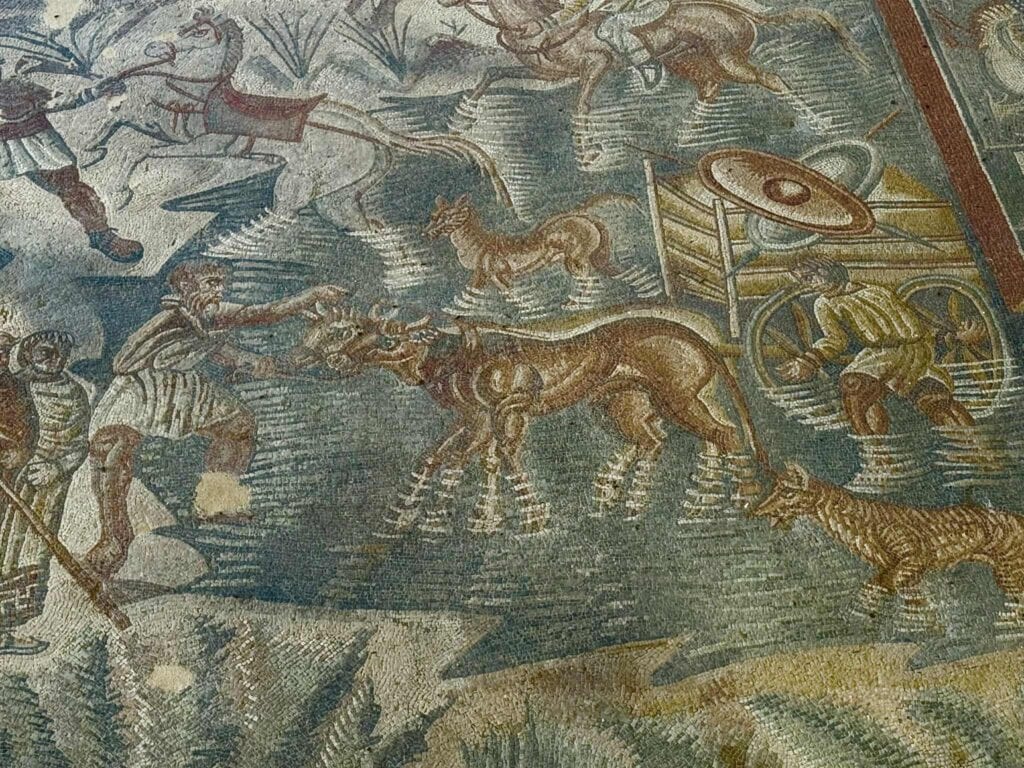
The Villa Romana del Tellaro is a late Roman villa (discovered in the 1970s) with a stunning series of floor mosaics including hunt scenes, mythological figures, figures in motion in water, that are beautiful in their own right and serve as a perfect warm-up for what’s coming the next day. The backstory is good too.


This is a place worth a dedicated post, and I’ve already written one: Villa Romana del Tellaro: Sicily’s Hidden Gem of Roman Mosaics
My Take on Villa Romana del Tellaro
- Was it worth it? Yes, especially as a quieter alternative to bigger sites
- Time needed: About 1 hour
- Best for: People who enjoy finding less crowded historical sites, perfect stop between Syracuse and Noto
- Tip: Don’t skip it just because it’s lesser known, and go before you visit Villa Romana del Casale
Noto: Sicily’s Baroque Showpiece
Why Visit Noto:
- One of the finest examples of Baroque architecture in Europe
- Completely rebuilt after the 1693 earthquake, so the main architecture is homogeneous
- Compact, walkable, and visually striking
From Tellaro we drove to Noto, Sicily’s showpiece Baroque town, and spent the afternoon and evening there. I’ve written a full article on whether Noto is worth visiting Is Noto Worth Visiting? Discover Sicily’s Hidden Baroque Gem, and the answer is yes, absolutely, but here’s the short version of how our afternoon went.
But first, if you appreciate architecture or urban design, Noto is intentional in its beauty – everything aligns, everything fits, and the result is striking without feeling overwhelming. A perfect Baroque town.


We wandered up the main street past the great Cathedral, the Town Hall, the Church of San Francesco d’Assisi, the old Porta Reale gate, and the famous painted steps of Via Corrado Nicolaci. We found the palace. We browsed shops.
Then, we stopped at Caffè Sicilia, which is not merely famous but legitimately extraordinary. Granitas and pastries here are a transcendent experience and I will not be arguing about this. If you only stop once here, make it count.This is not a “quick espresso and go” situation. You will want to linger and enjoy.

Dinner was at Modica di San Giovanni Cantina, which turned out to be one of our best meals of the trip.. Local seafood, traditional pasta, and a wine list that almost made it impossible to choose. All on a cobblestone street in the warm evening air in the shadow of the palace with the most famous baroque balconies in all of Europe. If you’re in Noto for the evening, book a table.


My Take on Noto
- Was it worth it? Yes! It’s one of the most visually cohesive and beautiful towns in Sicily
- Time needed: Half day to full day
- Best for: Architecture lovers, photographers, and relaxed evenings
- Tip: Come hungry!
Day 7 of Your Eastern Sicily Itinerary: Villa Romana del Casale & Departure
Day 7 Highlights:
- One of the best-preserved Roman mosaic sites in the world
- A final, unforgettable historical stop
- Return journey to airport in Palermo or Catania
Villa Romana del Casale: Mosaic Heaven
I saved this for last and I’m glad I did, because Villa Romana del Casale is like an exclamation point at the end of your perfect week. If you are a mosaic lover, this place is dying and going to heaven. If you’re not a mosaic lover, it will make you one.
Why Visit Villa Romana del Casale:
- The most extensive Roman mosaics still in existence
- A UNESCO World Heritage Site
- A true “finale” experience for a history-focused itinerary
The villa, a 4th-century Roman imperial country house near the modern town of Piazza Armerina, contains the most extensive and best-preserved Roman floor mosaics anywhere in the world. Room after room, corridor after corridor of hunting scenes, mythological narratives, acrobatic performances, the famous “bikini girls” mosaic of athletes in two-piece garments that look startlingly contemporary. I kept thinking it was going to end and it kept not ending. It is extraordinary.


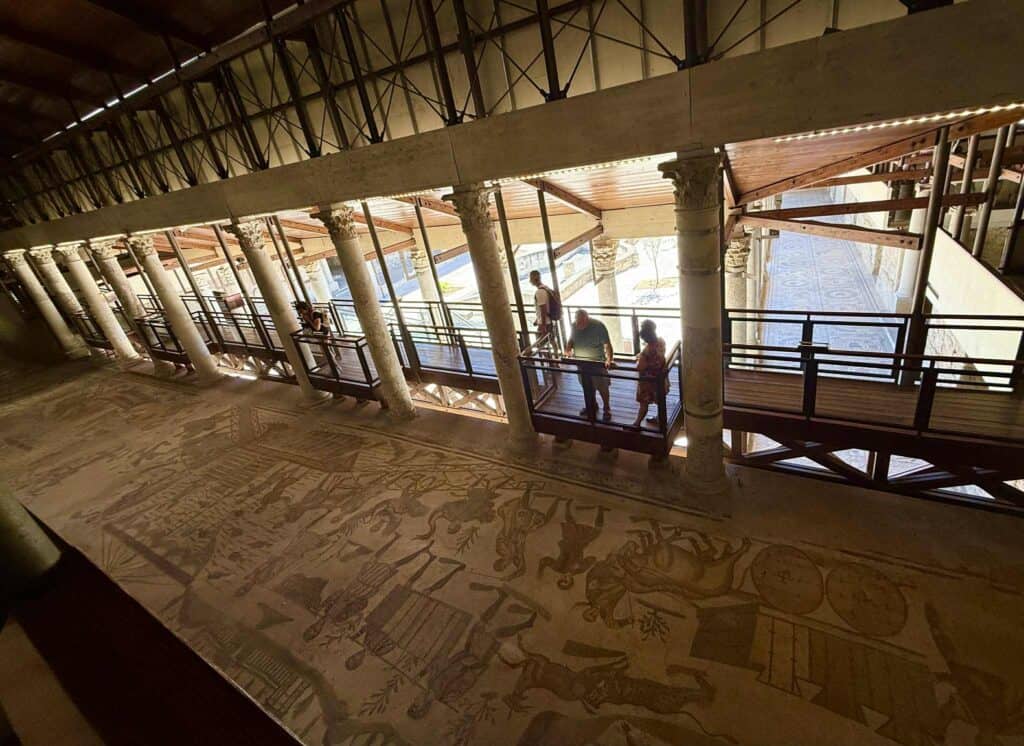
I’ve written a full room-by-room guide Visit Villa Romana del Casale Mosaics: Room by Room Guide + Photos that will genuinely improve your visit if you read it beforehand. If you have any interest in Roman history, this is one of the most impressive sites you’ll encounter anywhere in Europe.
After the villa, we faced the long drive back to Palermo for our departure flight. This is the part I’d do differently.
My Take on Villa Romana del Casale
- Was it worth it? Absolutely, this is a world-class UNESCO site
- Time needed: 2.5–3 hours minimum
- Best for: History lovers, especially Roman history, mosaic (and any other) artists
- Tip: Go early if possible because it gets crowded
What I’d Change About This Eastern Sicily Itinerary
Here is my honest note for your planning: Catania was a hole in this itinerary, and I know it.
If you take one planning tip from this entire itinerary, let it be this: Flying into and out of Catania would have changed the trip for the better. We could have spent an evening and morning exploring one of Sicily’s most underrated cities full of Baroque architecture, Etna views, an extraordinary fish market, a fascinating history as a city that has been buried by lava multiple times and rebuilt each time on top of its own ruins.
Instead, because of flights and our own date restrictions we needed to fly through Palermo, and we spent the first morning of the trip driving northeast from Palermo to Savoca, and the last afternoon driving northwest from Piazza Armerina back to Palermo. That’s a lot of car time that could have been Catania time.
If you have flexibility on airlines and airports: fly Catania both ways. Spend a night there. It will be worth it.
If you’re in our situation with a dog, needing a specific airline, Palermo required, this itinerary still works beautifully. The trip was incredible. Just know what you’re trading.
My Recommendation:
- Fly into and out of Catania if at all possible
- Add 1 night there at the beginning or end to explore
- Use Palermo only if flights require it
Practical Information for Your Eastern Sicily Itinerary
Getting Around
A rental car is non-negotiable for this Eastern Sicily itinerary. See our full guide to driving in Sicily and getting the best rental car deal before you go. If you’re hesitant about driving in Sicily, it’s worth getting comfortable with the idea, because the flexibility it gives you is what makes this itinerary work. We book through DiscoverCars because they consistently have the best selection and the most transparent pricing. They’ve also got a 24/7 switchboard with English speakers.
Best Time to Visit
Late spring (May–June) and early fall (September–October) are ideal: still warm, manageable crowds, long daylight hours. July and August are brutally hot and heavily visited. Winter is mild but some sites reduce hours.
👉 For a more relaxed experience with fewer crowds, early fall is particularly ideal.
Dog Travel in Eastern Sicily
Eastern Sicily, like all of Italy, is reasonably dog-friendly. The Borgo San Rocco in Savoca and the Mercure in Palermo were exceptional – genuinely welcoming, not merely tolerant. The Mangia Resort in Brucoli also accommodated Helga with zero issues, and we saw a couple other small dogs there, living their best lives.
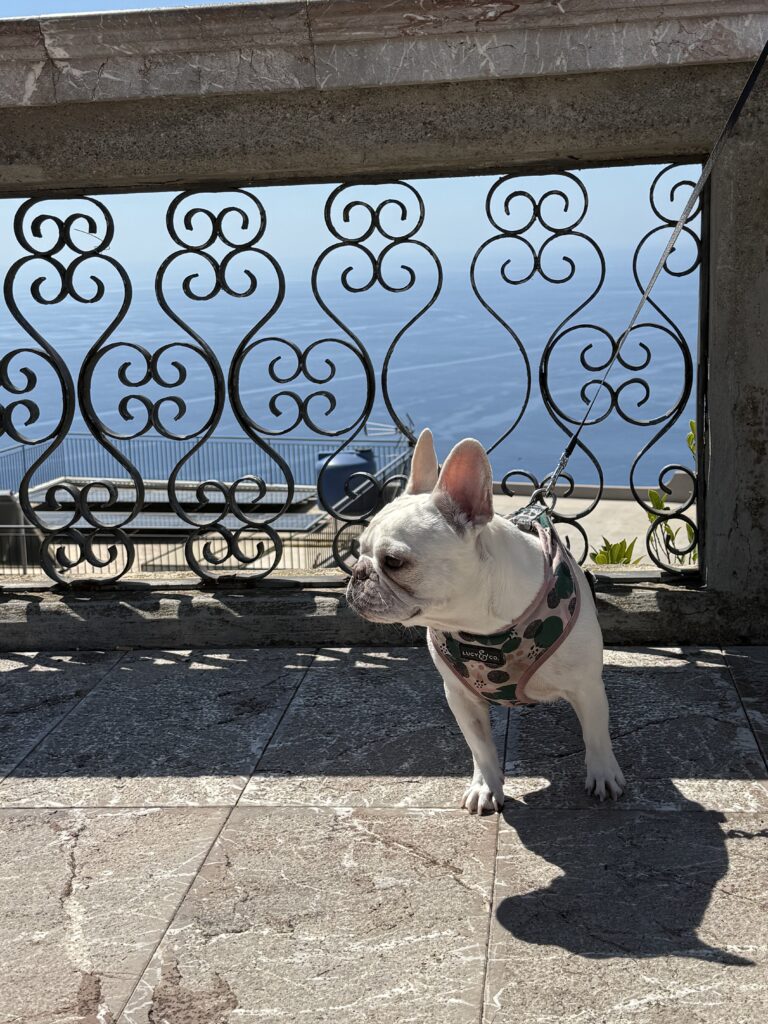
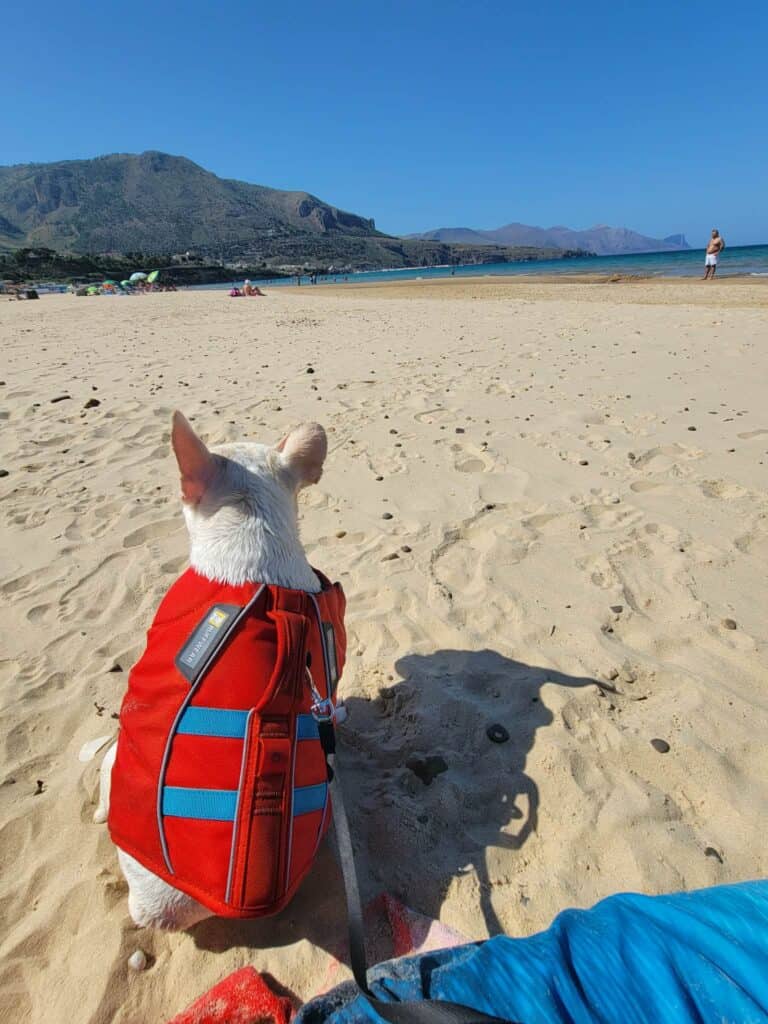
Taormina’s streets are walkable with a dog, though busy in peak season. Archaeological sites generally do not allow dogs inside, so plan accordingly. Helga spent some quality time napping in the room during those times.
👉 Plan ahead for archaeological sites, as most do not allow dogs inside.
Where to Stay
These are the stays that worked well for this exact route: Palermo for arrival night, Borgo San Rocco in Savoca, and Mangia’s Resort in Brucoli. For full details on all of them, plus our picks in Taormina, Ortigia, Noto, and Catania, see our complete Where to Stay in Eastern Sicily guide.
Quick Tips for a Smooth Eastern Sicily Trip
These are the small things that made a big difference on this trip:
- Book Bar Vitelli in Savoca in advance for weekends or high season
- Book a guided tour at Syracuse Archaeological Park I know I sound like a broken record but it is not optional, it is transformative
- Stop at the Cyclops Rocks even if you only have 30 minutes, and bring a picnic if you have more
- Caffè Sicilia in Noto – Go for granita and pastries, not a quick espresso, and give yourself time
- Villa Romana del Casale deserves at least 2.5 hours, ideally more. Read the room-by-room guide before you go
- Teatro Greco in Taormina: 14 euros adult, under 18 free, and one of the most iconic views on the island
- Forza d’Agrò: the Norman castle at the top is currently inaccessible, but the village is utterly charming and worth the stop regardless
As You Plan This Eastern Sicily Itinerary
This itinerary works because it doesn’t try to do everything.
It focuses on:
- the most meaningful historical sites
- places with a strong sense of atmosphere
- and enough breathing room to actually enjoy them
There’s a balance here between structured time and unplanned discovery, between planning and wandering, that, at least for me, made this one of the most memorable trips I’ve taken. If you’re a planner, just think of it as planned free time, because one of the most memorable things about Sicily travel is that the best things just happen. When you least plan for them.
If you’re the kind of traveler who prefers depth over speed, and places that need you to explore slowly rather than jam in as much as you can, Eastern Sicily delivers in a way that’s hard to replicate elsewhere. I hope your Eastern Sicily trip is everything you dream. And if you have any questions, leave them in the comments because I read them all!
Plan the Rest of Your Sicily Trip
If you’re planning a longer trip or want to go deeper into Sicily’s history and culture, these guides will help.
Two Weeks in Sicily: Itinerary for History Lovers
The Best Archaeological Sites in Sicily: East to West
Where to Stay in Eastern Sicily: Best Picks for Every Base
Our Western Sicily Itinerary: The Perfect 8-day Route for History Lovers
Driving in Sicily: Best Rental Car & Travel Tips
Visit Villa Romana del Casale: Room by Room Guide
Syracuse Archaeological Park Guide
The Temple of Apollo in Syracuse
Paolo Orsi Archaeological Museum, Syracuse
