
Idstein Germany: The Perfect Fairytale Day Trip
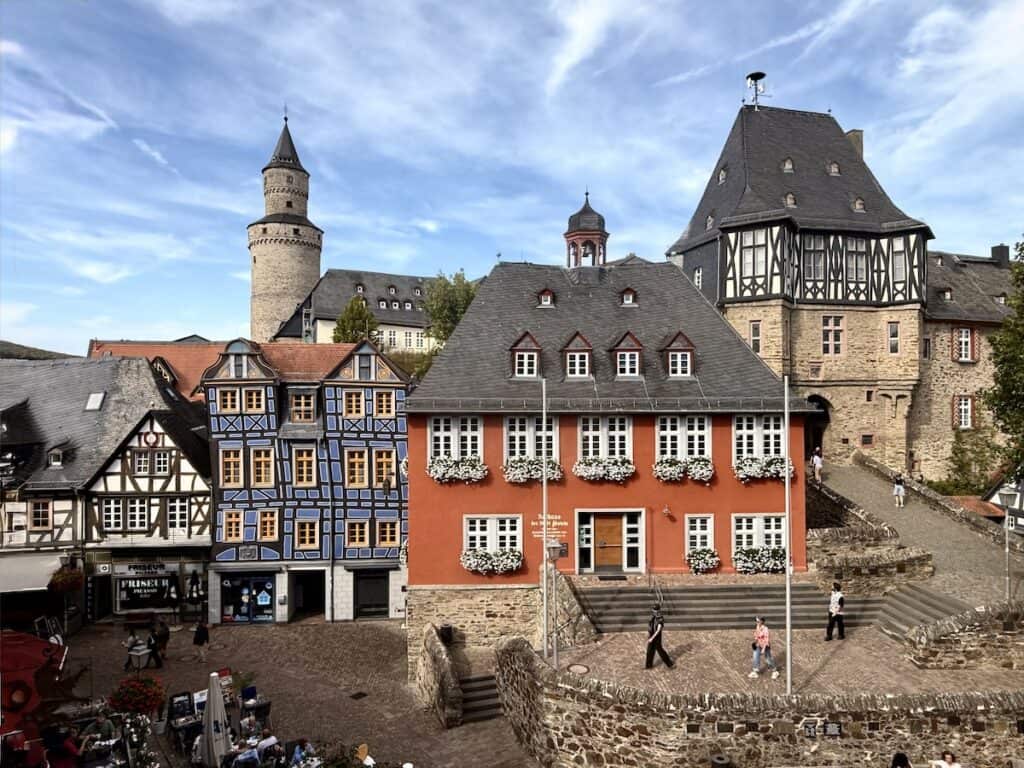
Idstein was exactly the place I’d pictured it would be. It’s one of those impossibly quaint, half-timbered medieval German towns that you see pictures of, but hardly believe it could actually be real. I couldn’t find a sign of modern life anywhere in the old town. It truly looks like a place that escaped the passage of time, and all the fires, wars, and bulldozers that took out so many towns like it.
Even the shops fit the picture. We found a toy store selling wooden toys, with nothing electronic in sight. There was a liquor store (Der Weinladen) stocked with local products, from herbal liqueurs and wines to jams and jellies, with schnaps displayed in huge glass flasks. There was also a cute gift shop where the owner makes most of what she sells by hand. I fell in love with this little town.
The whole historic center is very compact and easy to walk, so you can see every major sight in one day without feeling rushed. In this post you’ll find out what to see, how to get there and where to park, how to see all the main sights in one day (with a map), and all the tips I’d tell a friend before they go.
Idstein Germany – What You Need to Know
- Drive time: 25 minutes from Wiesbaden, 45 minutes from Frankfurt, 1 hour 40 minutes from Kaiserslautern.
- Parking: Parkplatz am Hexenturm, Am Hexenturm 5, 65510 Idstein.
- Time needed: Half to one full day
- Best tip: Be at the Tourist Info when it opens so you get the Witches’ Tower key first
- Don’t forget: Wear good walking shoes for cobblestones and stone stairs
🅿️🚗 Driving/Parking in Idstein
We decided to overnight in nearby Wiesbaden and drove into Idstein for a day trip, which was an easy and relaxing drive through rolling green hills and farm country. We parked at Parkplatz am Hexenturm. It’s a covered lot within easy walking distance of everything in the old town. The upper deck has a one-hour limit. The lower deck doesn’t, so head straight down if you’re staying the day.
Parking is generally free on Sundays, and it was also free when we visited on a Saturday, but bring coins and/or a credit card just in case.
Best Things to Do in Idstein Germany (In the Order We Did Them)
1. Start at the Killingerhaus and Get the Witches’ Tower Key
The Tourist Information Office is inside the Killingerhaus on König-Adolf-Platz at the center of the Old Town, just a few minutes walk from the Hexenturm Parking. You can’t miss it. Every building around the square is covered in elaborate timber work, but this one is the most over-the-top of them all. It’s green, ornate, and has carved faces you’ll see as you get closer.
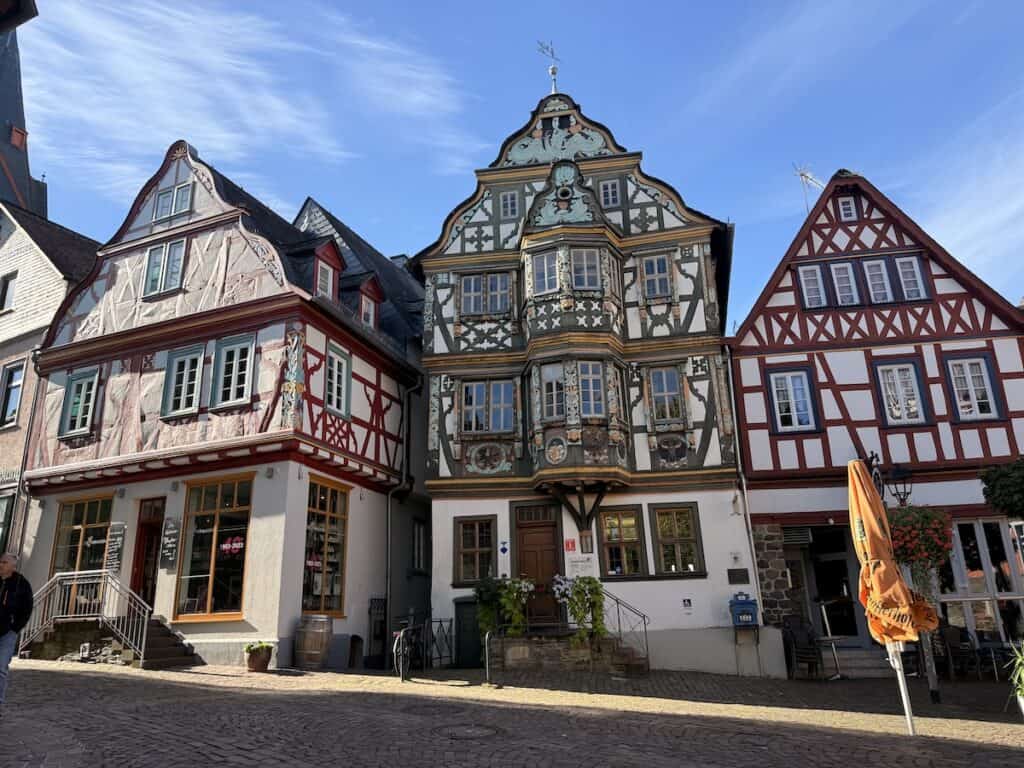
Killingerhaus was built in 1615 by Johann Conrad Killing, the count’s court clerk. There’s a legend that says Killing had the house taken apart in Strasbourg, moved and rebuilt here to please his wife. But the town’s own historical research has never confirmed that story. So as far as we know, the spectacular Killingerhaus has always stood in Idstein, and here’s where to start your day.
Tourist Information Center hours: Tuesday through Friday, 8-noon and 2-5. Saturday from 11-4, and Sunday from 2-5. CLOSED ON MONDAYS.
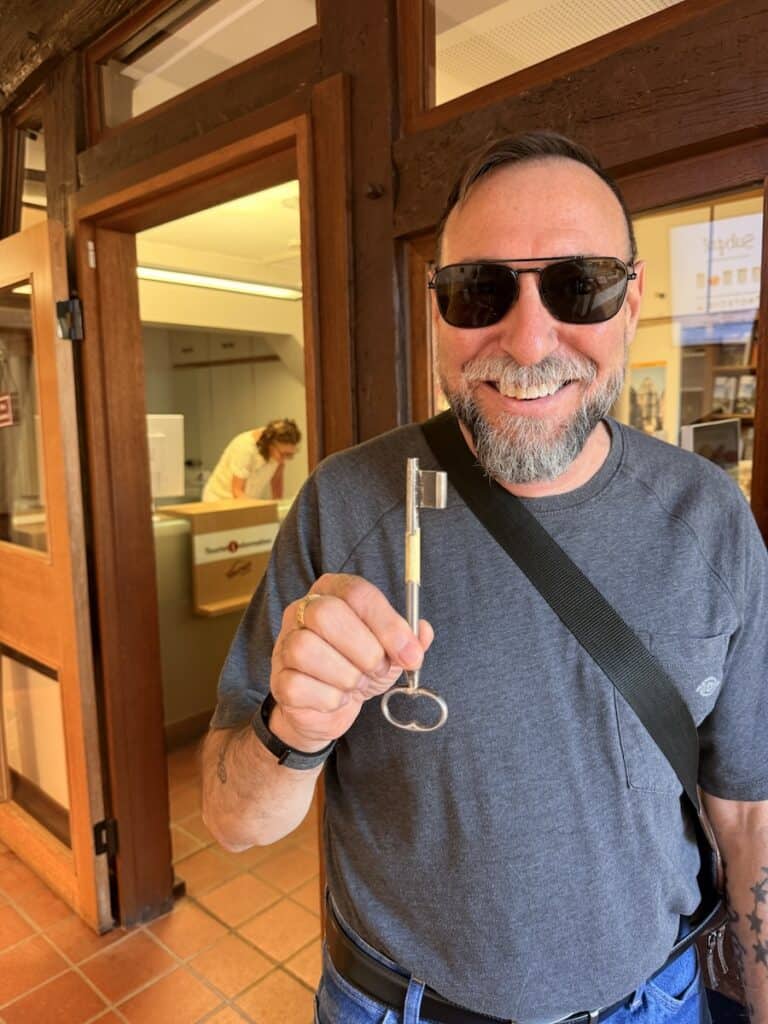
We were on a mission and arrived right as the office opened. We were the first ones in because we wanted to make sure we got the key to the Witches’ Tower. Yes, you have to go to the Tourist Info desk (where they speak English) and leave your keys or a form of ID as collateral to get your very own key to open the door of the town’s iconic tall watchtower, the Hexenturm. You’ll be given instructions about how to open the door, how to lock it behind you, and not to let anyone else inside. This was definitely a new kind of tourist experience for me! It felt like a fairytale already.
2. Walk Through the Kanzleitor (Chancellery Gate)
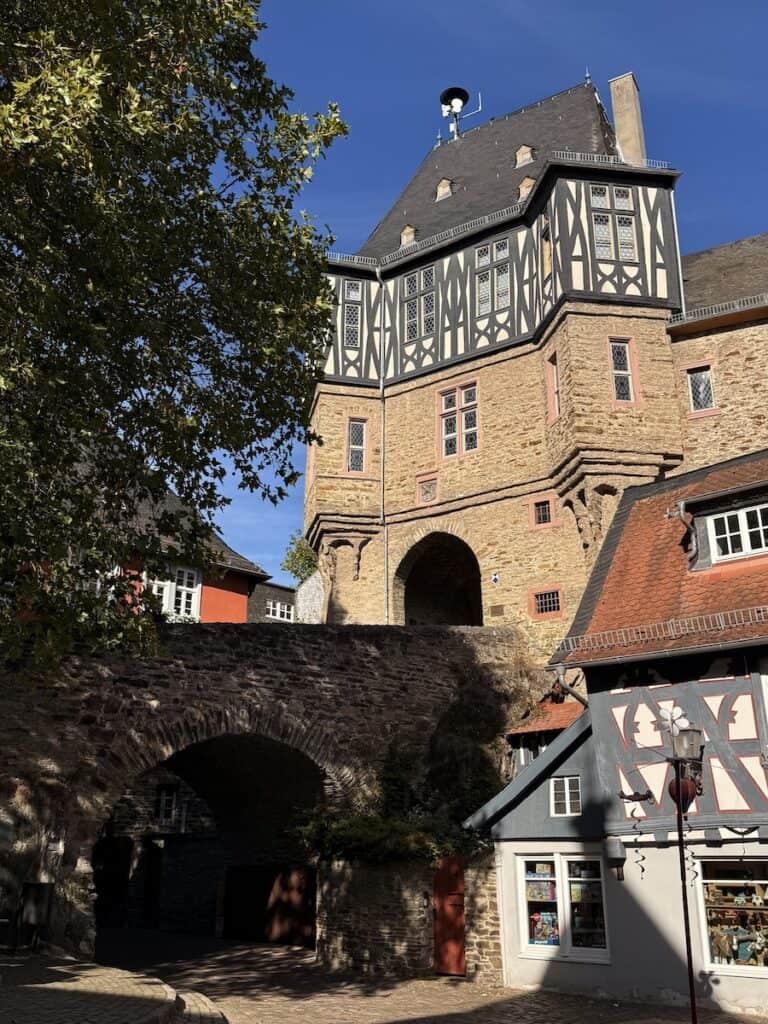
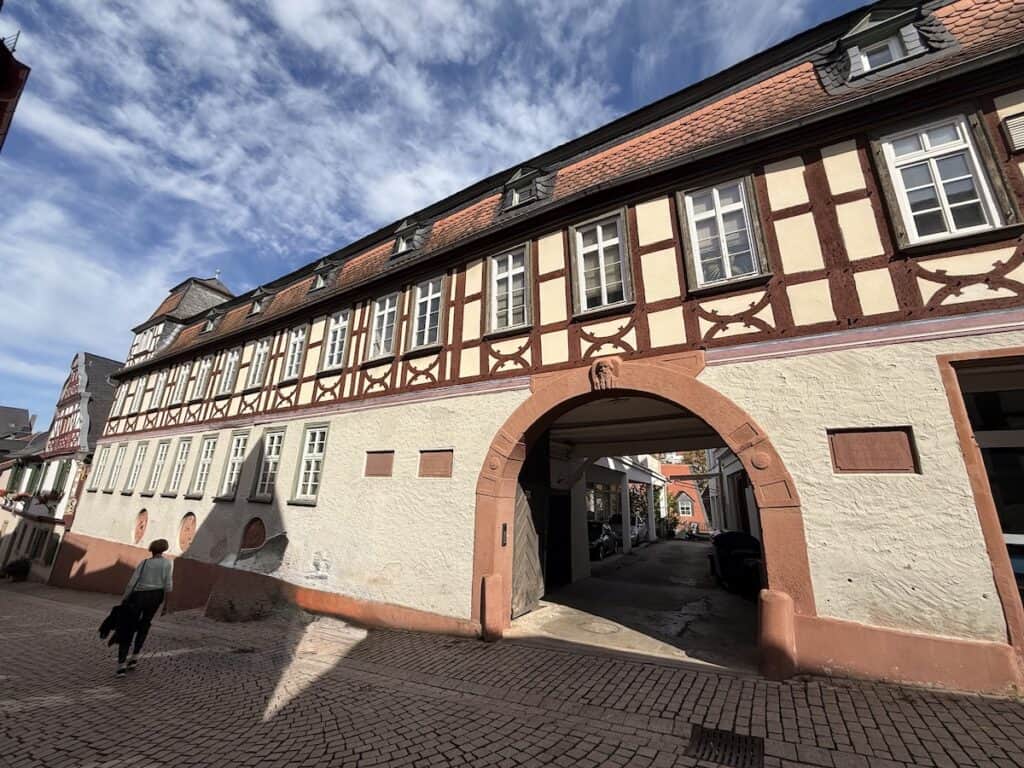
On the way to the Witches Tower, you’ll climb stone steps and pass through the photogenic Kanzleitor. This massive gatehouse once divided the Count’s lands to the north from the town to the south, and access to the castle side was closely guarded.
Look for the date carved in Gothic numerals: 1497, inside a coat of arms with the Nassau lion. Over the centuries the gate served as the count’s chancellery, a granary, a guardhouse, and a jail. It also held a torture chamber used during a dark period of the town’s history.
There’s still a holding cell in the archway passage. On the back of the gate are two doors: a small one for bringing prisoners in, and a grander one for officials. The grand door leads to what is now a room which acts as a wedding room.
The beautiful half-timbered upper floor was covered with slate for more than 300 years. When it was uncovered in 2012, the original timbers underneath were in surprisingly good shape, and this building is one of the more striking building in a town full of striking buildings!
3. Climb the Witches’ Tower (Hexenturm)
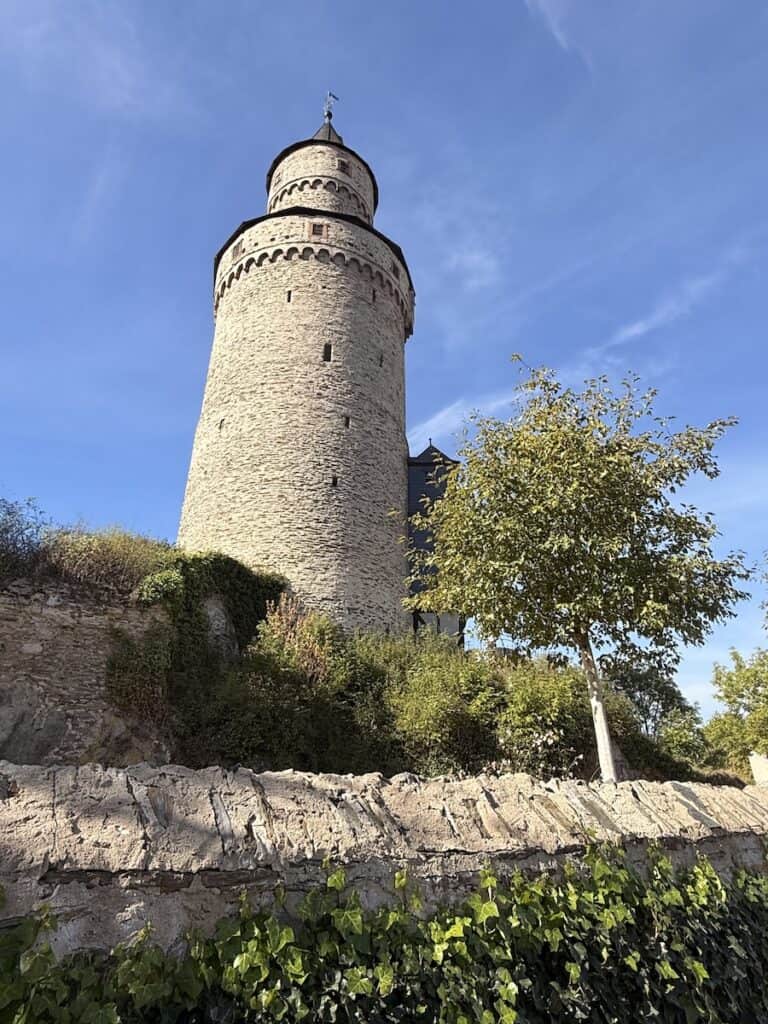
Once you walk through the gate, you’ll see the Witches Tower. Mind your footing on the stairway (and I use that term loosely) on the way up to the door. The stairs are stone, eroding, and extremely uneven.
The key they hand you is huge and looks centuries old, which already makes it feel like a fairytale. It took us about three minutes of fiddling before the creaky old tower door finally opened.
The staff gave us clear rules. Lock the door behind you, and don’t let anyone else in with you. They keep strict count of how many people are in the tower, and you get 40 minutes inside, which was more than enough. When you’re done, you unlock the door from the inside, let yourself out, return the key, and collect your ID at the desk.
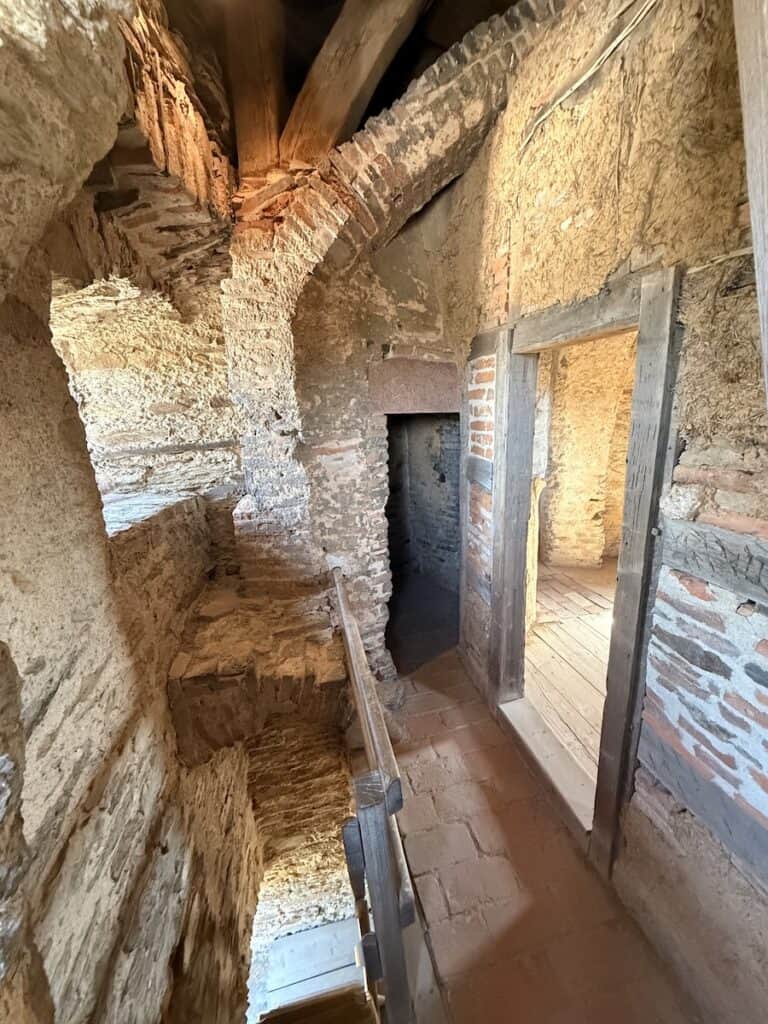
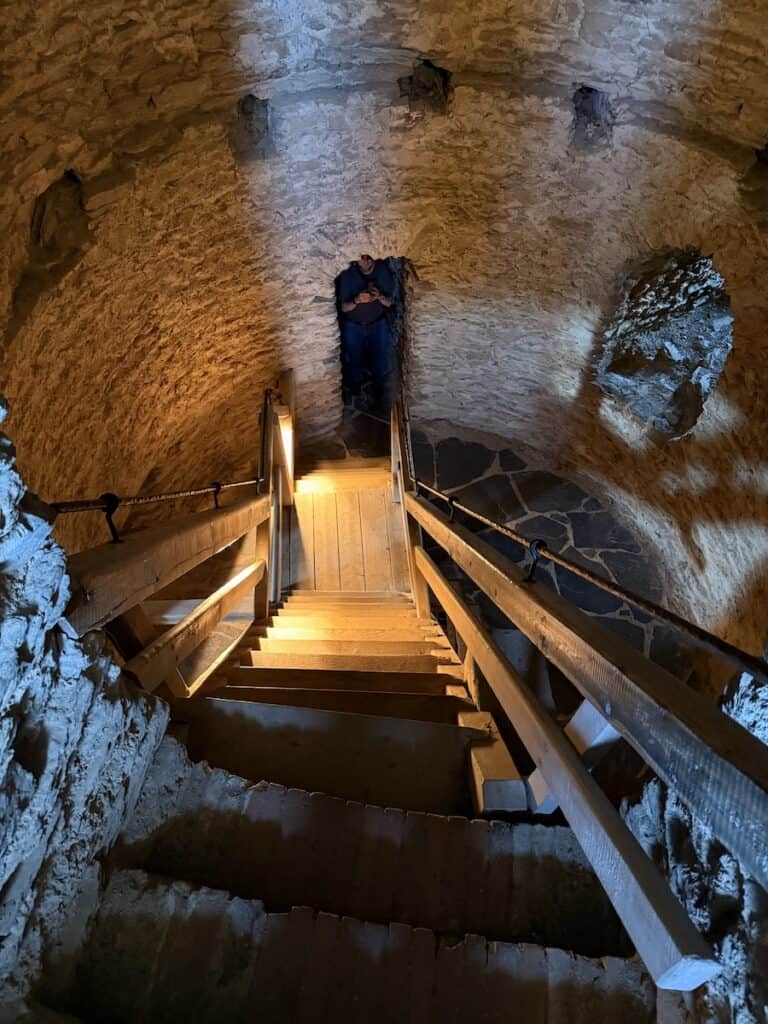
The tower itself is wild. Every time you think you’ve reached the top, another flight of stairs appears around the corner. The higher you go, the steeper the stairs get, until the final flight to the very top is an actual ladder. There are more than 200 steps in all. There’s nowhere to sit, but a few larger rooms and passages give you a spot to catch your breath and take in the views before you continue climbing.
Having the whole tower to ourselves was truly special. I think there may be more than one key, so you might not get that every time, but it’s a really fun and unique experience. If you want the tower without a wait, be first in line when the office opens at 11:00. By the afternoon the town had filled up, and I’m sure the wait was long.
The tower is 42 meters (138 feet) tall and is the oldest surviving structure in Idstein. It was built in stages around 1170, 1240, and 1500, and has barely changed since 1810. Despite the name, it has nothing to do with those who were tried as witches during the dark days of Idstein’s witch trials. The “Witches’ Tower” nickname came from a popular 19th-century trend.
4. The Witch Trials Memorial
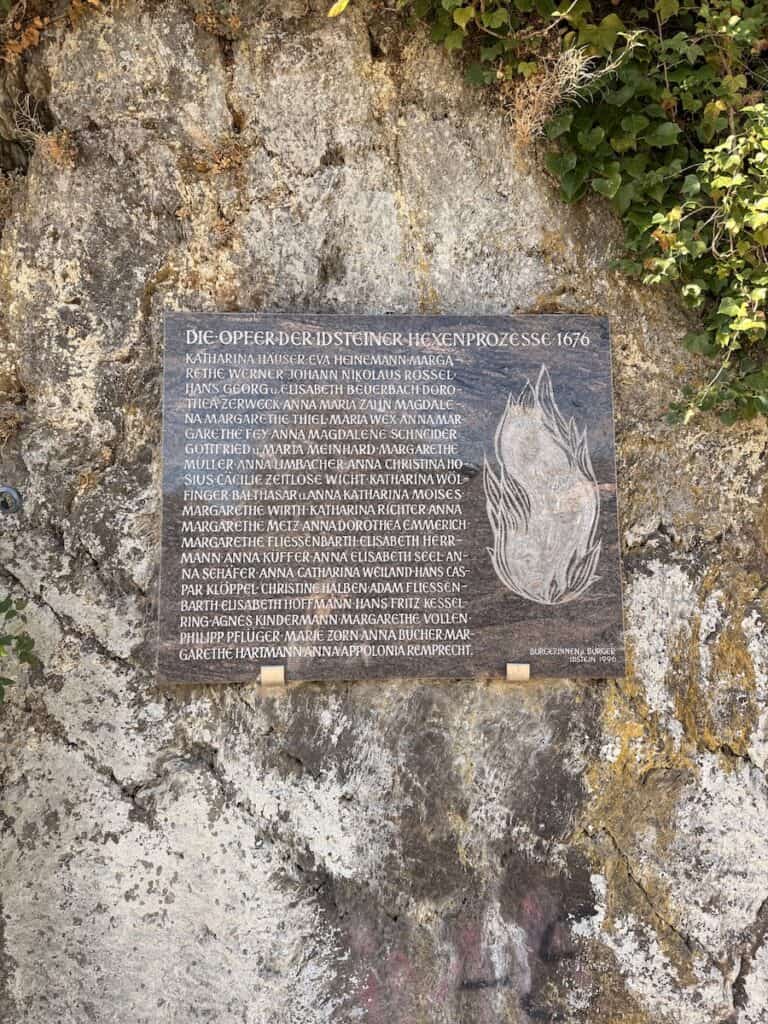
Nevertheless, at the base of the tower you’ll find a plaque with the names of the women and men who were tortured (many in the Kanzleitor) and put to death as a result of those witch trials. In 1676 and 1677, the wave of witch trials in Idstein was driven by the same Count Johannes who rebuilt the palace and commissioned the beautiful church ceiling in town. Contemporary accounts say he believed witches caused the deaths of his second wife and several of his children, along with some livestock.
In the space of only about a year, 39 people were executed for supposed witchcraft: 31 women and 8 men. Four more women were banished. The victims came from Idstein and the surrounding Nassau villages, including Wiesbaden. The nightmare ended only when the count died in 1677.
It took centuries for the town to reckon with the injustice. In 1986, a local book, Den Hexen auf der Spur (On the Trail of the Witches: Witch Trials Using the Example of Idstein, 1676) by Gilla Flothmann, Hilke Müller, Ilse Schollmeyer, and Maria Stoltefaut researched the victims’ individual stories for the first time. About ten years later, a memorial plaque with the names of the victims was placed below the Witches’ Tower. In 2014, Idstein’s city council finally formally declared them innocent.
5. See Idstein Palace and the Palace Garden
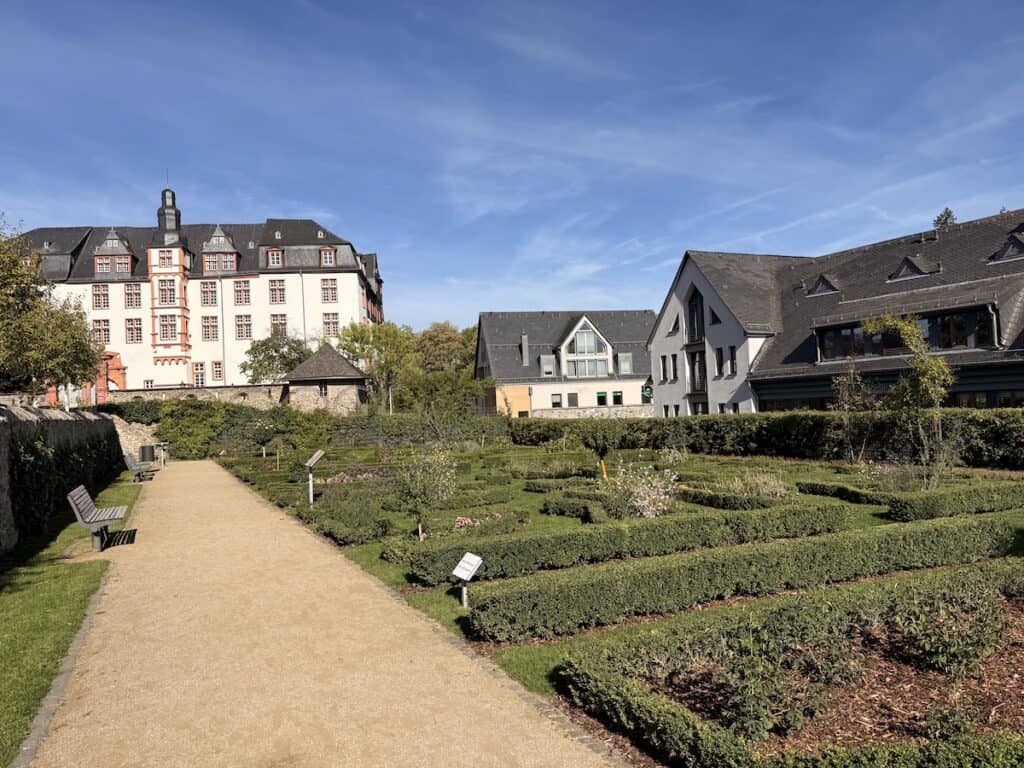
Right next to the tower is the Renaissance palace of the Counts and Princes of Nassau-Idstein, built between 1614 and 1634.
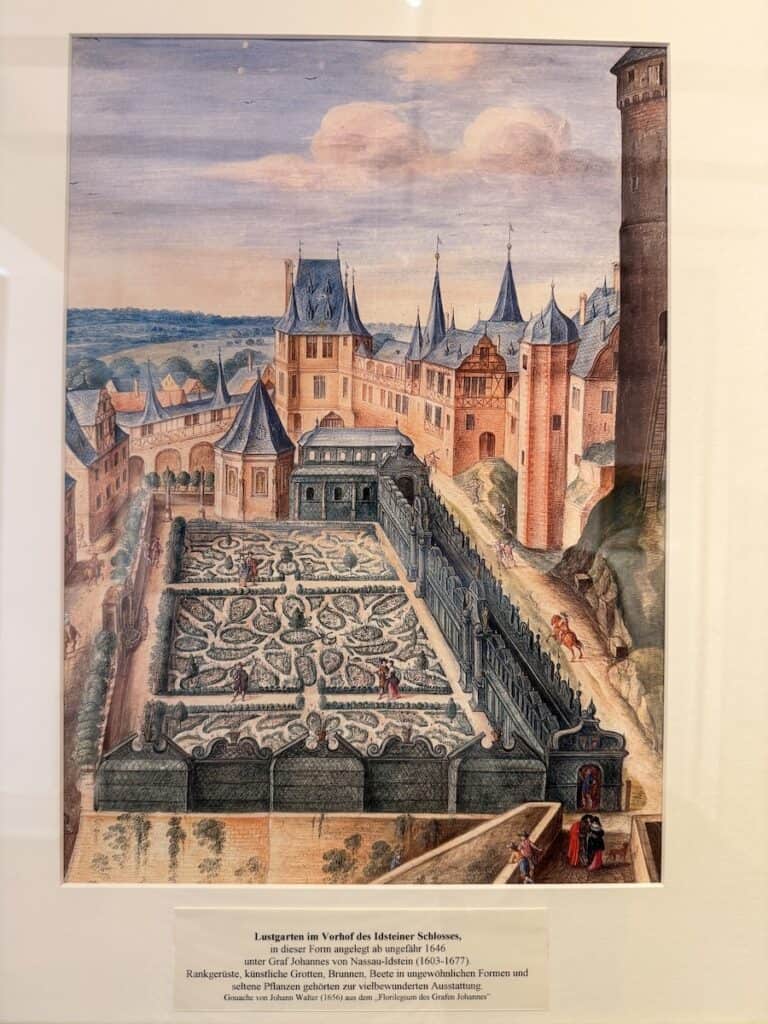
Count Johannes, who inherited Idstein in 1629 also turned a small garden on the palace grounds into quite a showpiece. By 1650 it had artificial grottoes, exotic plants, and professional gardeners. Today the same kinds of perennials, summer flowers, and roses are planted there again and it’s quite lovely. You can get a nice aerial view of it from the windows of the Witches Tower.
After the Nassau-Idstein line died out in 1721, the palace became the Nassau central archive. Later it served as a convalescent home, a military hospital, and a barracks, among other uses. Since 1946 it has been the Pestalozzi high school, which is why you can’t just walk in and look around. To avoid disrupting classes, the interior is open only on public guided tours on selected Sundays. Check with the Tourist Information Office or idstein.de for dates.
6. Old County Court and the Palace Grounds
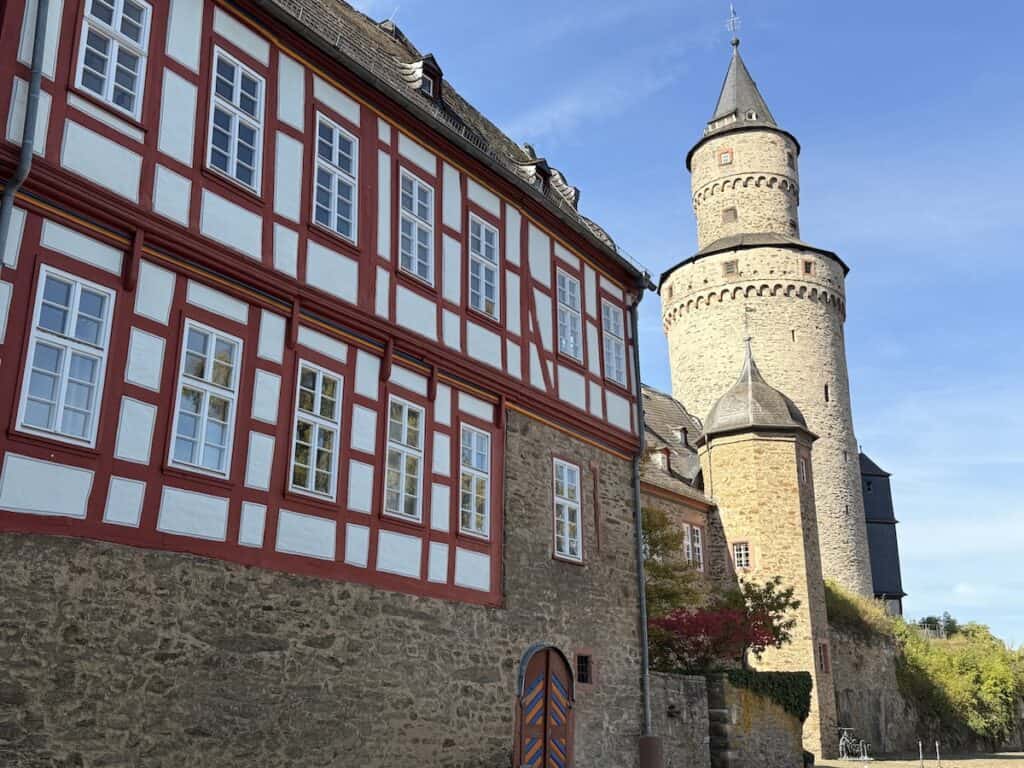
The massive stone building with the half-timbered gable and octagonal stair tower on the other side of the Witches Tower is the Alte Amtsgericht, or Old County Court. It was built in 1588 as the “New Chancellery,” because the Count’s administration had outgrown the old one in the Kanzleitor. Today the ground floor holds the town archive.
The long row of buildings nearby, begun in 1565, was once part of the palace complex. Look for the coat of arms with the Nassau lion and the date 1565 on the old administration building.
😱 Weird Fact: The man who built it met a strange end. In June 1596, during his infant son’s baptism celebration, Count Johann Ludwig I fell from a window of the castle and drowned in the moat. Historians still aren’t sure whether it was an accident or not, and whether there was, perhaps, “alcohol involved.”
7. Return the Key and Visit the Idstein City Museum
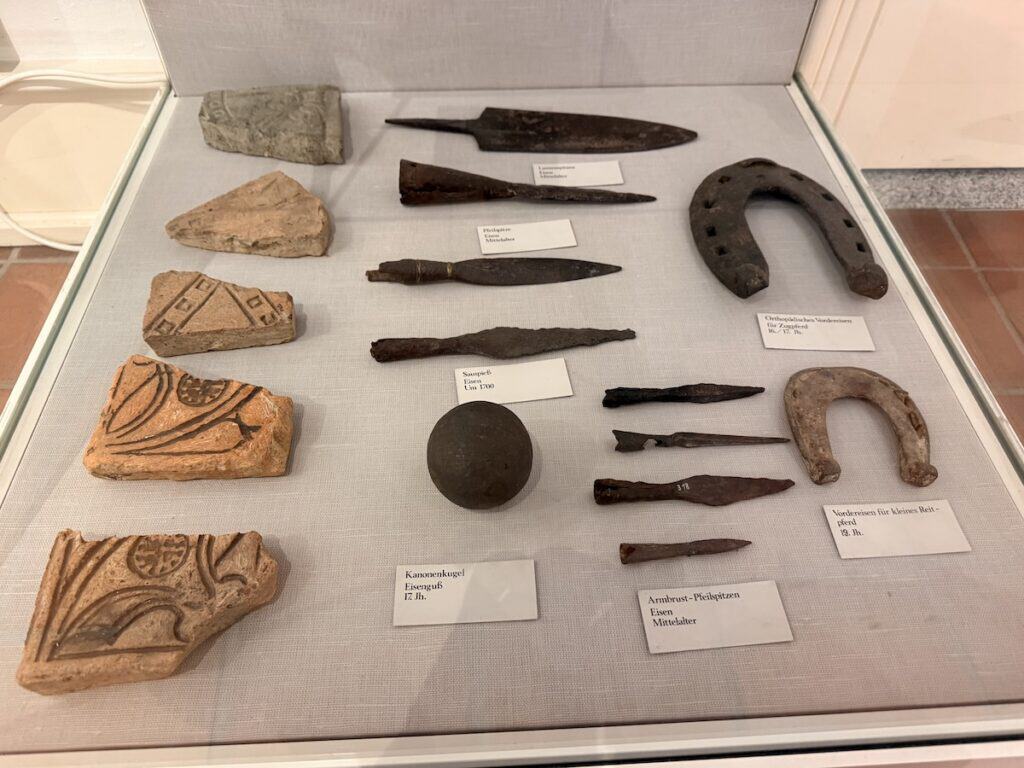
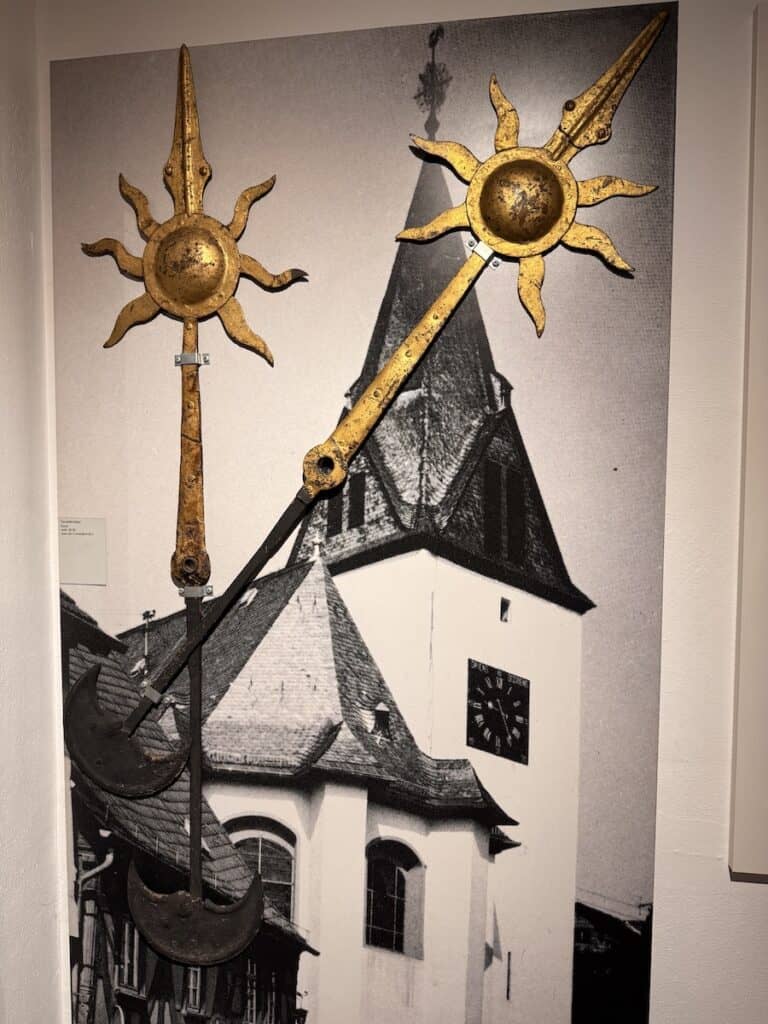
When you return the key, head to the back of the Killingerhaus for the free town museum. It covers far more than I expected. Don’t miss:
- The medieval clock hands and door handles from the Unionskirche church
- Pieces of old gravestones
- Tools and other medieval artifacts from the town
- Old church registers of births and deaths
- Images of Idstein through the centuries, from medieval engravings and early photographs to the Nazi era and the great flood of 1956
There are also exhibits honoring the town’s firefighters, brewers, cooks, weavers, and cloth printers.
📸 Save time for the top floor. From its windows you get some of the best photos of the town. On the ground, buildings often block the Witches’ Tower, but from up here the whole view opens up.
8. König-Adolf-Platz, the Crooked House, and the Town Hall
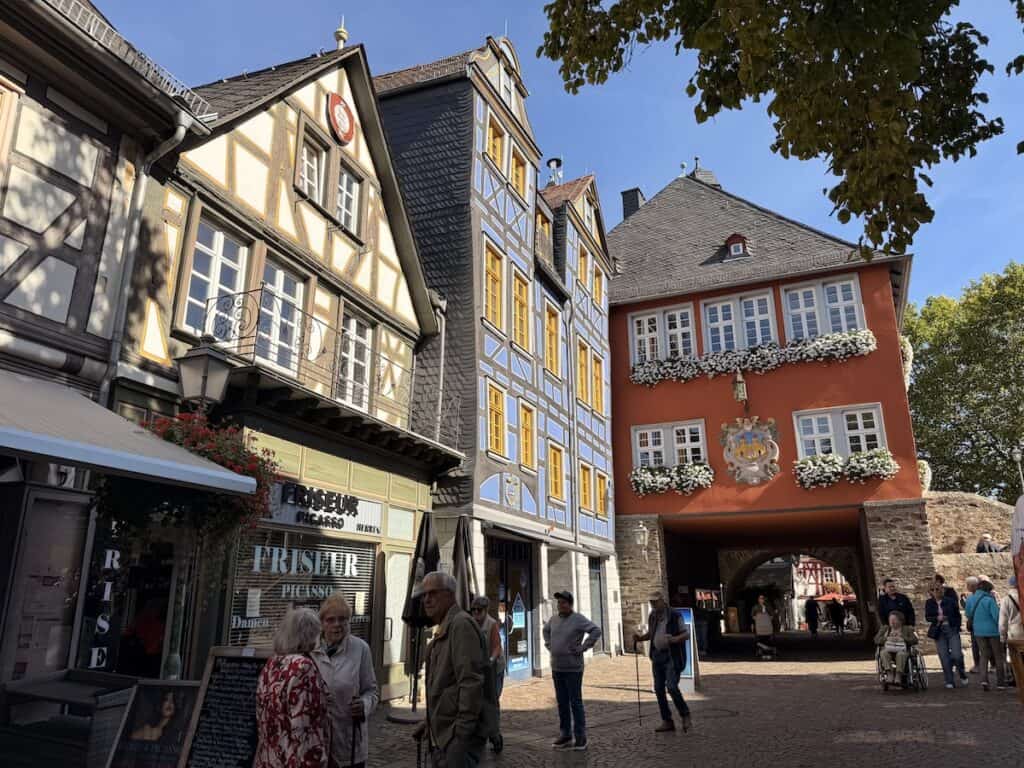
When you walk out of the Tourist Office/Town museum, you’ll be right in the König-Adolf-Platz which was Idstein’s first market square. In 1946 it was renamed for King Adolf, the only German king from the House of Nassau.
The blue building beside the town hall is called “the Crooked House.” It was built in 1727 by Johann Jacob Nicolay, the head of the town militia, and it’s unusually tall for Idstein at four stories. From 1736 to 1745 the left side housed the town pharmacy. Structural defects have caused the house to tilt. After a full renovation in the 1990s, it became part of the town hall.
The orange town hall next door was finished in 1698, with money from the ruling count. It was built as a bridge over what was then a main road, and is now a pedestrian zone.
9. The Unionskirche
The Unionskirche is just a block from the museum. You could easily walk past it, since the outside is plain whitewashed walls with not much to look at. Don’t pass it by!
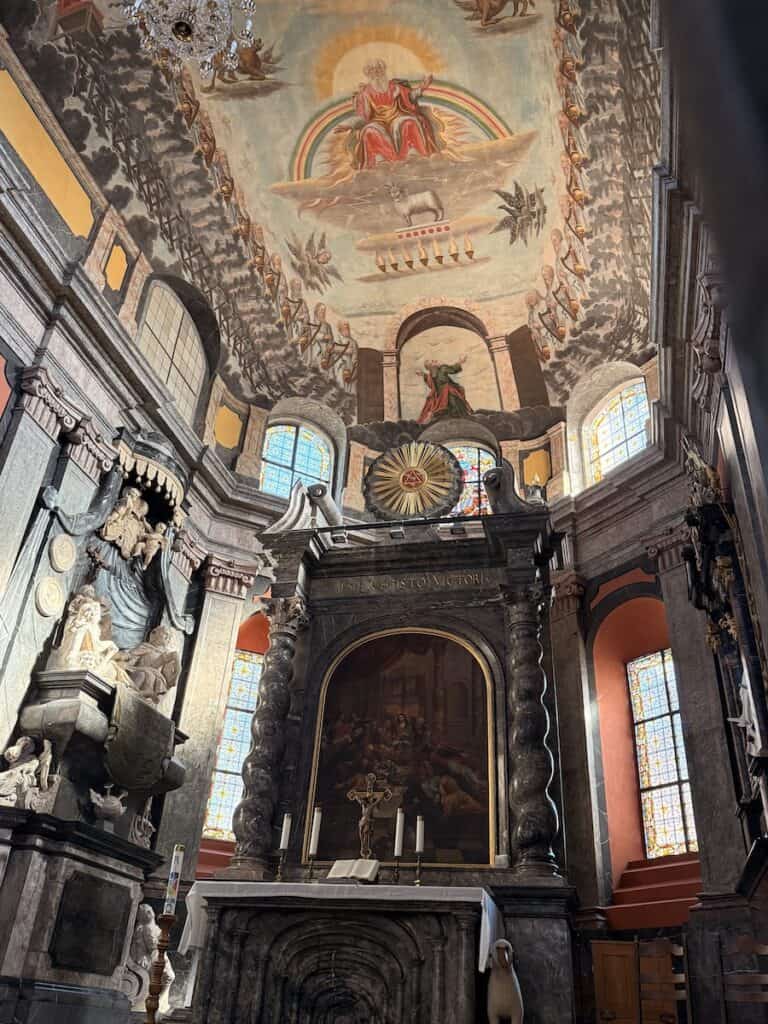
The interior blew me away. It’s far more elaborate than I expected from a church this plain on the outside, and in a town this small. Every interior surface is painted except the marble columns and pillars.
The ceiling holds 38 oil paintings of New Testament scenes, created between 1673 and 1678. Michael Angelo Immenraedt painted 33 of them and Johann von Sandrart painted five. The church’s own leaflet quotes Joachim von Sandrart writing in 1675 that nothing like it had been seen in Germany before, and I believe it.
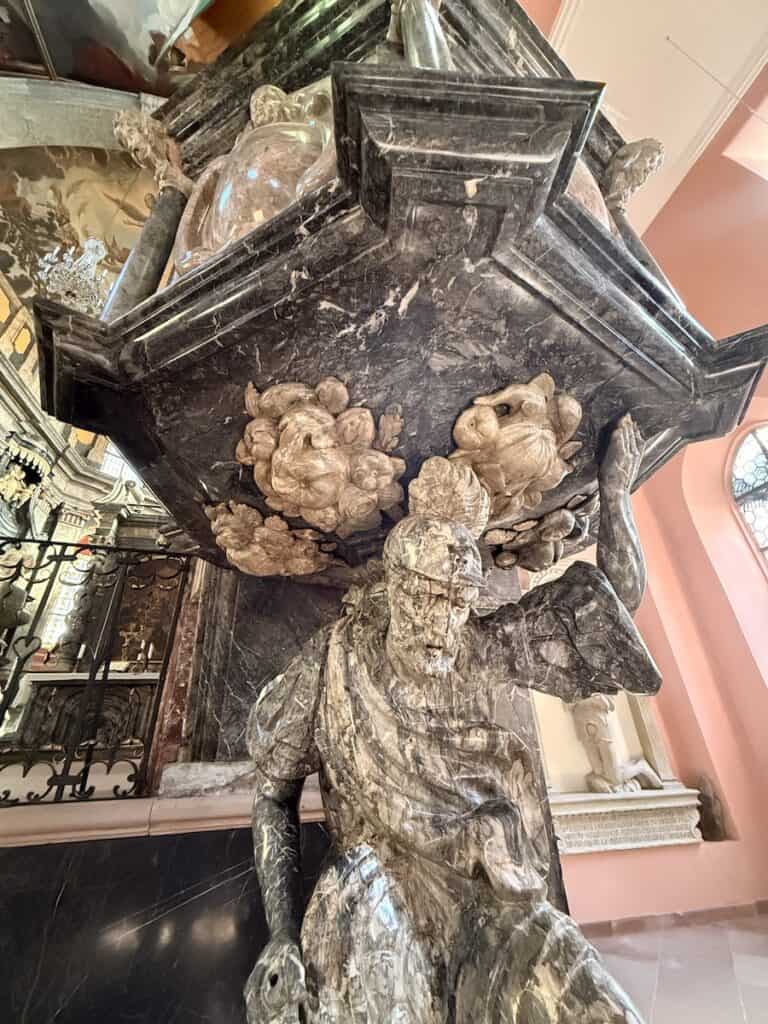
I love good marble, and the variety of colors and patterns here is striking. I assumed it was imported, but it’s actually polished Lahn marble, most of it quarried at the state’s own quarry in nearby Mudershausen. Don’t miss the pulpit, which rests on a marble figure of Samson carrying it.
Construction began in 1297, and in 1340 it became the collegiate church of St. Martin. Count Johannes transformed it into a Baroque court church starting in 1669. It takes its current name from the Nassau Union of 1817, concluded in Idstein. That was the first time Lutheran and Reformed Protestants in a German state joined into one church.
Enjoy exploring, because the church is filled with great small details to find. Look for carved and painted faces, old carvings of names in the wood, and the palm trees by the entrance. Those palms are wooden, with metal fronds, and they help hold up the galleries.
There’s also a tiny crypt behind the pulpit. Inside are the plain pewter sarcophagi of Prince Georg August Samuel of Nassau-Idstein, his wife Princess Henriette Dorothea, and other members of the princely family. Their elaborate marble memorial stands in the chancel above.
💡 Visiting tip: The south entrance is generally unlocked from morning until afternoon. There’s a switch in the vestibule, to the left of the entrance, that turns on the overhead lights. Use it, because the ceiling looks completely different when it’s lit.
10. Wander the Crooked Streets and Shop the Old Town
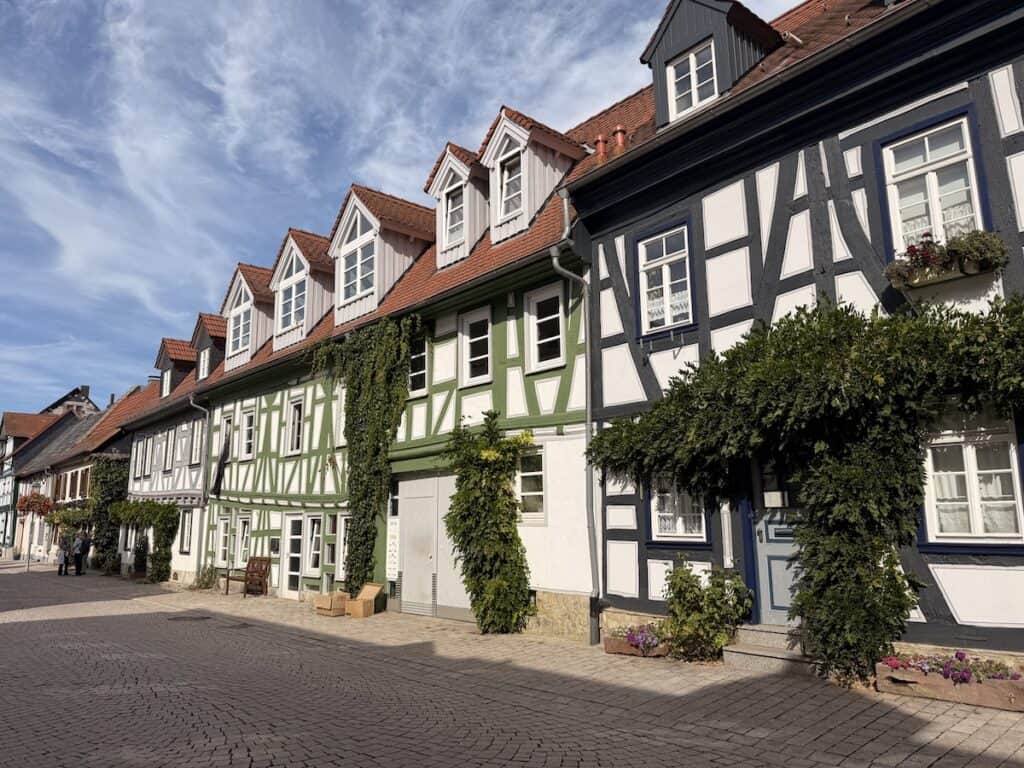
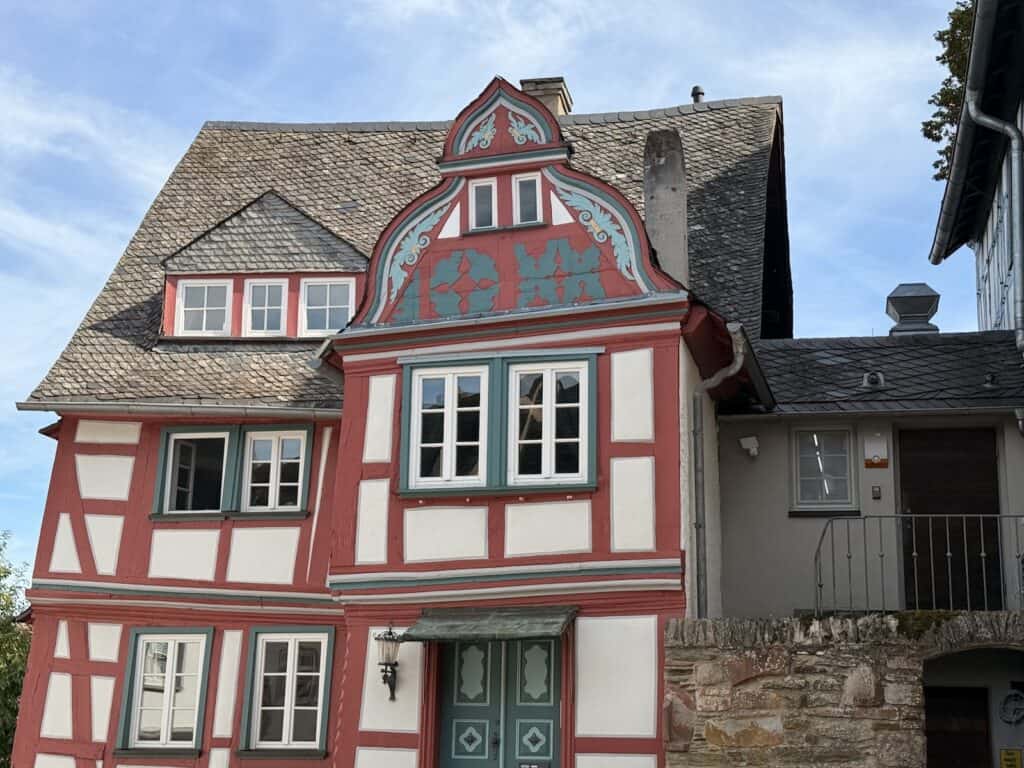
As we walked, I kept laughing at the designation of “THE” crooked house by the town hall, because Idstein seems to have more crooked houses than straight ones! Some even look like they’re melting. The old timbers have bowed so much over the last half a millennium that I’m not sure how some of these buildings are still standing. Rows of vision-bending buildings end up being the defining character of the town.
With the main sights done, give yourself time to just wander. This is as much a “thing to do” as any other in the town. The Obergasse runs from the Höerhof in the south to the town hall, and it’s lined with half-timbered houses, cafés, and restaurants. Weiherwiese is another great street to explore.
11. Other Great Buildings to See if Time Permits
Just about every building in Idstein has a history and is gasp-worthy. On Obergasse, look for the Grandpierre Print Shop from 1612 and the Höerhof, once owned by the palace’s master builder. Also worth seeking out: the Tanners’ workshop in the Loherplatz and the old Tithe Barn from 1745 on the palace grounds.
Where to Eat in Idstein: Taunushof
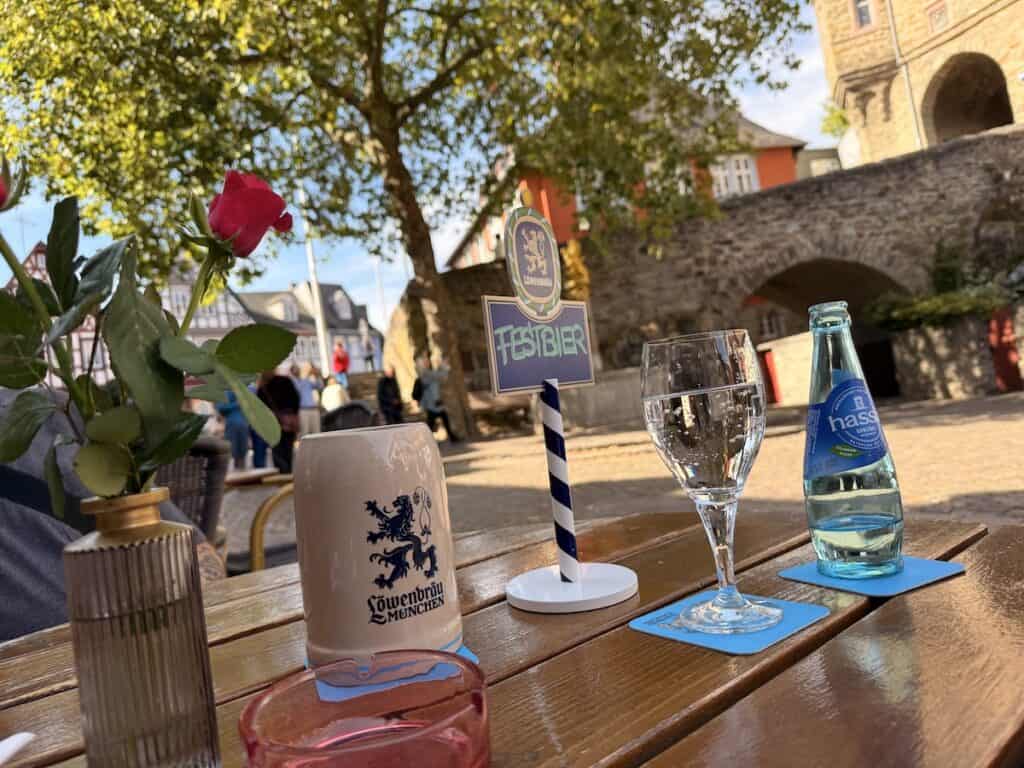
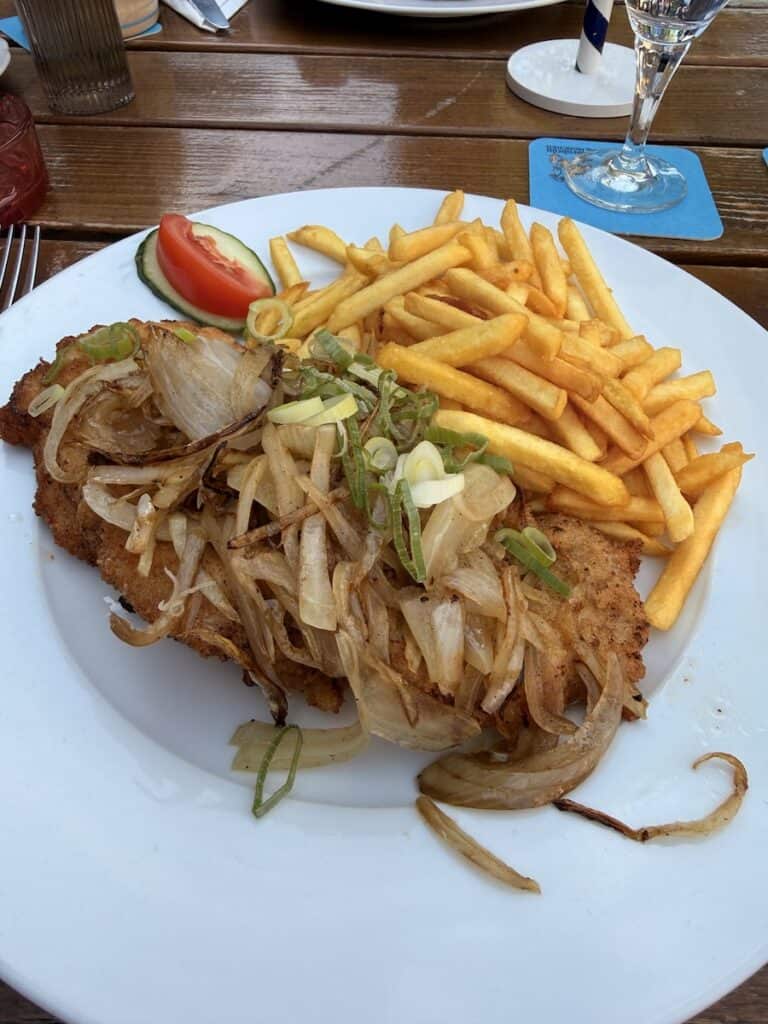
Idstein is full of enticing places to eat, including an Indian restaurant, a sushi place, and even Mexican. We chose the traditional German Taunushof purely for its location, right by the lion fountain with a view of the best cluster of buildings in the old town. We were going for atmosphere, and the food turned out to be a pleasant surprise.
We both had a salad (€6), the onion schnitzel (€16), and a Bavarian beer. The menu listed at least eight kinds of schnitzel including cordon bleu. Since we were there during Oktoberfest season, they were also featuring Bavarian specialties. The menu mentions seasonal menus for Spargel (white asparagus), goose, and other traditional dishes when they’re in season.
The service was friendly, and we ate outside. I also peeked inside, and it’s cozy and adorable – everything you’d want from a homestyle German restaurant.
Helga spent the day snoozing at our hotel in Wiesbaden. We brought her some of our enormous schnitzel, and she approved.
Tips for Visiting Idstein Germany
- Download the Idstein app at idsteinapp.de for more information on all the things to see
- Arrive before the Tourist Info opens. It opens at 11:00 a.m. on Saturdays and earlier on weekdays. On busy afternoons, you may wait for a tower key.
- Avoid Mondays. The Tourist Info is closed, so there’s no tower key and no museum.
- Bring ID. They hold your driver’s license while you have the tower key.
- Wear good shoes. The top of the tower is a ladder, the stairs to the tower are no place for heels, and the old town is all cobblestones.
- Turn on the church lights with the switch in the Unionskirche vestibule.
- Palace interior tours run only on selected Sundays and in German.
🚉 Getting to Idstein Germany by Public Transportation
Train from Wiesbaden: Take the RB 21 from Wiesbaden Hauptbahnhof to Niedernhausen. There, switch to an RE 20 or RB 22 train toward Limburg. Idstein is the next stop. The whole trip takes about 30 to 45 minutes, depending on how the connection lines up.
A few RB 21 trains run straight through to Limburg without a change, including some on Sundays. Check for “Limburg” as the destination when you look up your trip.
By bus from Wiesbaden: Bus 271 runs directly from Wiesbaden Hauptbahnhof to Idstein’s Wiesbadener Straße stop in about 50 minutes. It’s slower than the train but skips the transfer.
Train from Frankfurt: The RE 20 and RB 22 run directly from Frankfurt Hauptbahnhof to Idstein, no change needed.
Idstein’s train station is about a 20-minute walk west of the old town. Regional trains and buses are covered by the Deutschlandticket, if you have one. Schedules change, so check your connection in the DB Navigator app before you go.
Is Idstein Germany Worth Visiting?
Absolutely, a thousand times! I’d lived in Kaiserslautern for four years before I discovered Idstein and I don’t know what took me so long. This is the kind of place I’d visit more than once just for the vibe alone, and a definite top-of-the-list to bring guests coming to visit. It’s a visual delight, and it seems almost impossible that there is so much charm packed into such a little space. The history is fascinating, and it’s a perfect one day trip or a detour from a stay in Frankfurt, Wiesbaden, Mainz, Kaiserslautern or the surrounding area.
Idstein Germany FAQ
How long does it take to climb the Witches’ Tower?
You get 40 minutes with the key, which is just about what it took us including a leisurely walk back to the tourist office taking in some of the sights along the way.
Why are so many houses in Idstein crooked?
The Crooked House on König-Adolf-Platz leans because of structural defects in its construction. For the rest of the town, part of it is age, but builders of this era usually worked with freshly cut oak, which shrank and twisted as it dried in place. Add shallow stone foundations, centuries of settling ground, and generations of owners cutting in new windows and doorways, and the frames bent. Pegged timber frames flex instead of cracking, which is why these houses lean so dramatically and still stand.
How long do you need in Idstein?
If you only have half a day, absolutely go for it. It’s worth walking the streets, having a beautiful lunch, and using up your phone’s battery on photos! But, if you can manage it, allow a full day so you can really sink into the town and enjoy it all without feeling rushed.
Why Visit Idstein?
If picture perfect medieval town that you can explore in one day is what you’re going for, Idstein is the town for you. It’s quaint, quirky, romantic, filled with history, and guaranteed to be a place you won’t forget.
Related Posts You May Like:
Best Day Trips from Kaiserslautern: Europe’s Most Underrated Backyard
