
I’d seen the storybook photos. I’d watched the movie ‘In Bruges’ more times than I’ll admit. I thought I knew what to expect. And then we turned a corner into the Bruges Christmas market in the historic center, and everything was surprising and new.
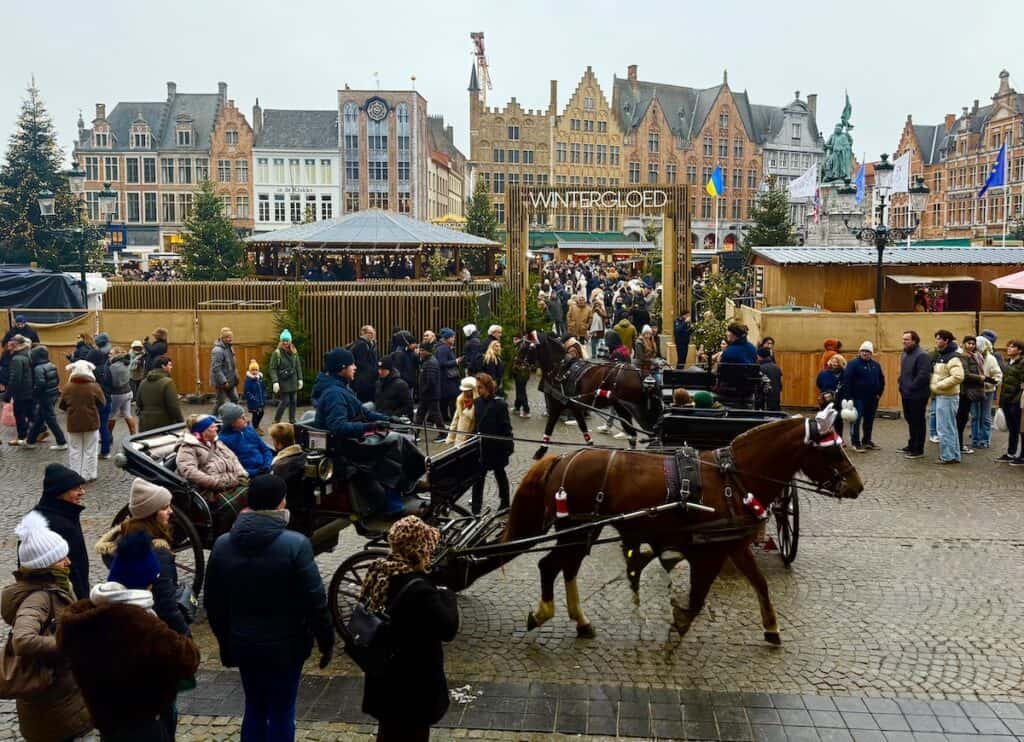
Adorable brick buildings, cobblestone streets, horse-drawn carriages with the horse wearing a Santa hat, benches sitting atop metal dragons, archways opening into hidden courtyards, and architecture so delicate it looked like someone had built sandcastles and kept them standing for six centuries. One of us said “look at that” so many times it stopped meaning anything and just became the soundtrack of the weekend.
Bruges, on any day of the year, is pure and total magic, even by European fairytale city standards. That’s because many of the buildings and most of what you see has stayed relatively unchanged since medieval times.
Bruges was one of the wealthiest cities in medieval Europe, a major center of the cloth trade and banking. When the Zwin estuary silted up in the late 15th century and trade shifted to Antwerp, Bruges essentially froze in time economically. The lack of industrial development that followed meant the medieval city was never torn down and rebuilt. What you see today is largely what was there in the 1400s. The whole city is a museum.
BRUGES CHRISTMAS MARKET INFO
📅 2026 Dates: November 20, 2026 – January 3, 2027
🕐 Hours: Sun–Thu 10:30am–10pm | Fri–Sat 10:30am–11pm
📍 Location: Markt Square and Simon Stevinplein
🎪 Winter Glow: November 20, 2026 – February 14, 2027
💡 Light Trail: 3km route with 10 light installations across the historic center
⛸️ Ice rink: Minnewater — the Lake of Love
⭐ Don’t miss: The Michelangelo in OLV-kerk, the Bottle Shop, the light show after dark
🎬 Homework: Watch In Bruges before you go
The City is the Market
The first thing to understand about the Bruges Christmas market is that the market and the city are inseparable. The official market is spread across Markt Square and Simon Stevinplein and is relatively small. But Bruges itself becomes the market. Every street, every chocolate shop, every canal-side café, every decorated archway and courtyard is part of the experience. You don’t visit the Christmas market in Bruges. You visit Bruges at Christmas.
The Winter Glow festival transforms the entire city with thousands of lights, festive stalls, and a warm Christmas atmosphere. A highlight is the Light Experience Trail, a three-kilometer route featuring ten light installations across the beautiful historic city center.
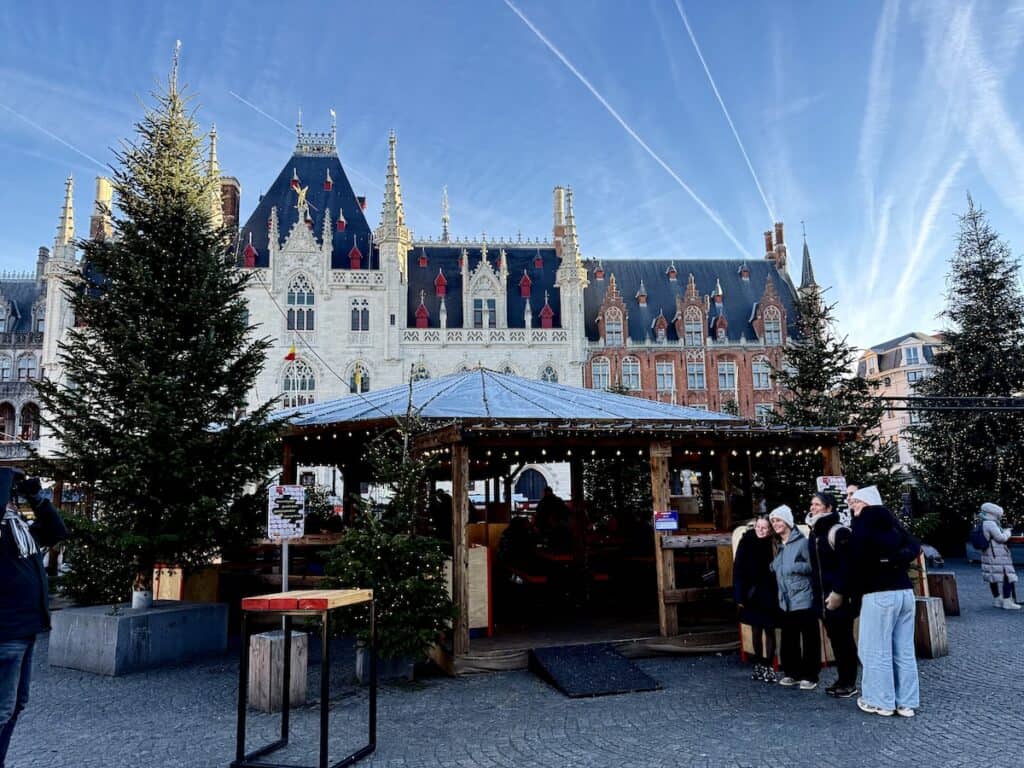
The Bruges Christmas Market
The main market stalls at Markt Square offer European classics, Christmas decorations, crafts and gifts, Belgian treats. Most stalls open around 10:30am and close around 9pm, while food and drink stands often stay open later, especially on weekends.
Simon Stevinplein, just a few minutes away, focuses on local crafts and regional delicacies and it’s worth the short walk. The craft stalls at Bruges lean charming rather than overwhelming: cute ceramics including little house incense burners that smoke out the chimney, pretty glass ornaments with scenes of Bruges, colorful trinket boxes, jewelry. Not super heavy on crafts but what’s there is lovely.
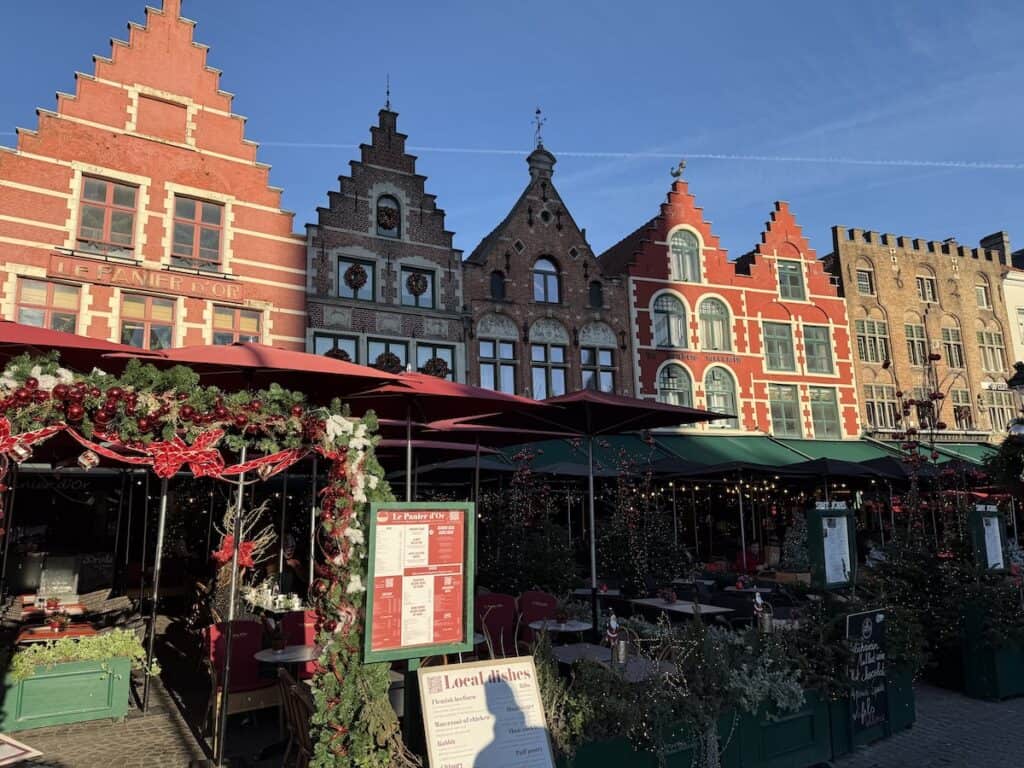
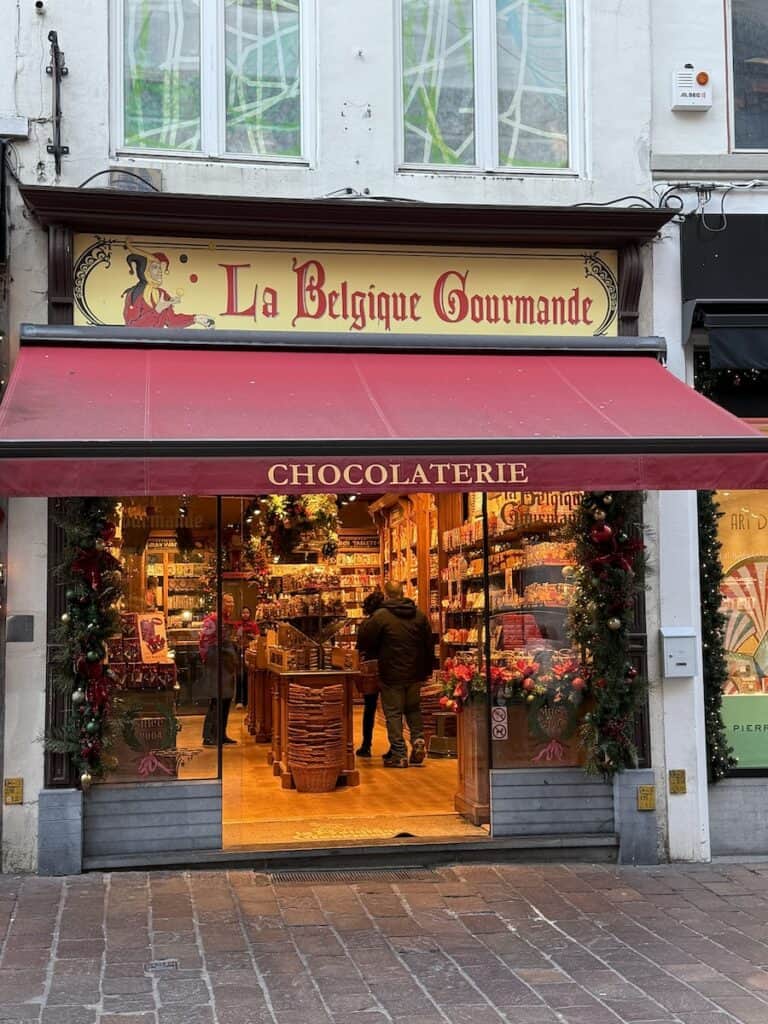
The food is where Bruges distinguishes itself. Being on the coast, and neighbors with Germany and France, the market runs the full spectrum from seafood to sausage. Escargot, mussels, fish sandwiches, and shrimp sit alongside bratwursts and paper cones stuffed with salami. On the sweet side: Belgian waffles obviously, syrup-covered fruits, enormous chocolate-dipped marshmallows, and roughly one chocolate shop per every twelve steps through the historic center.
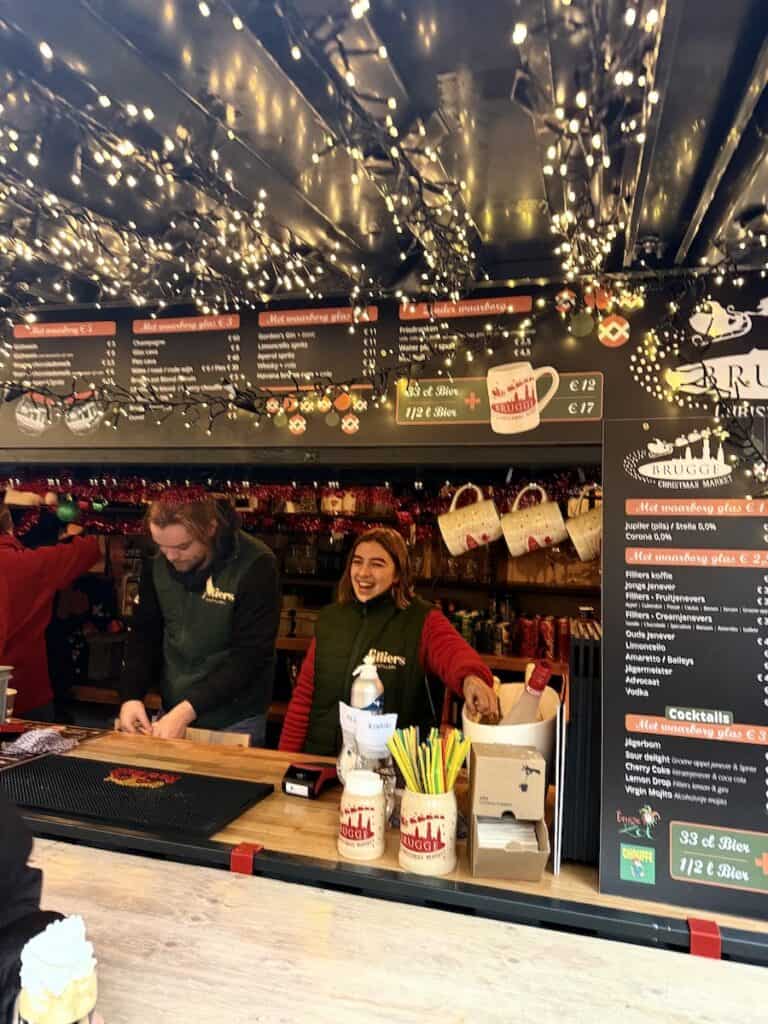
The market plays music throughout, a small detail, but I think it makes a genuine difference to the festive atmosphere. And the drinks deserve their own mention. We found enormous Christmas mugs and when asked what we wanted inside them discovered we had choices. We chose cava, a Spanish sparkling wine. Those mega-mugs now live in our kitchen for weekend mornings when neither of us wants to get up for a coffee refill.
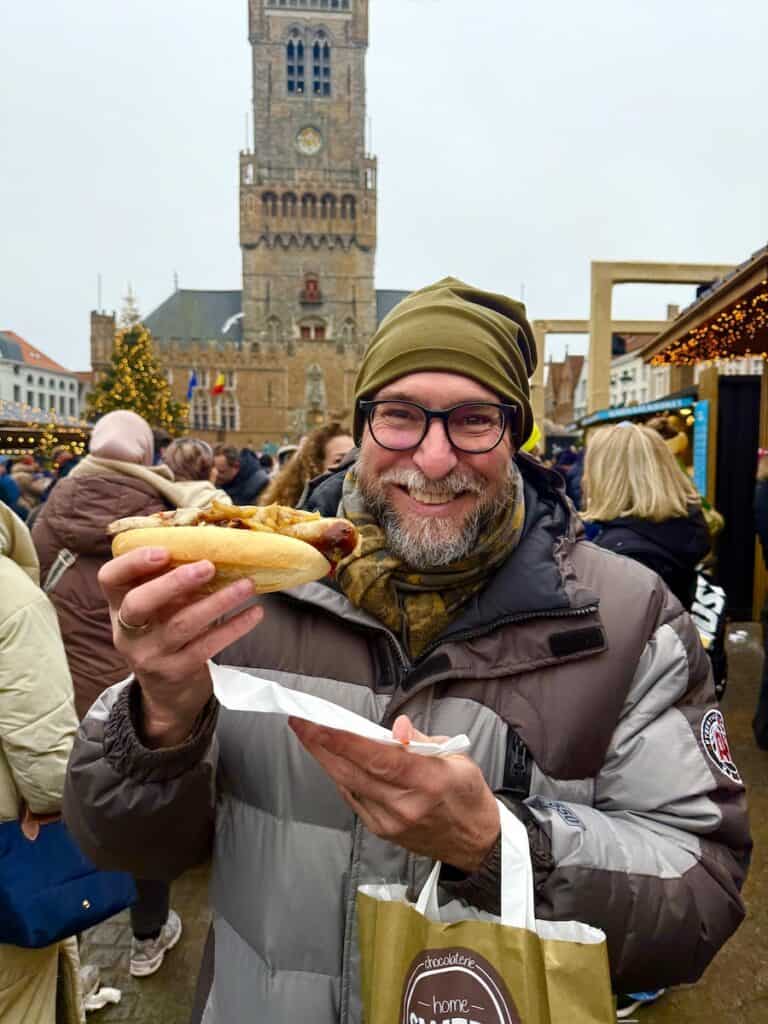
The Belfry and Markt Square
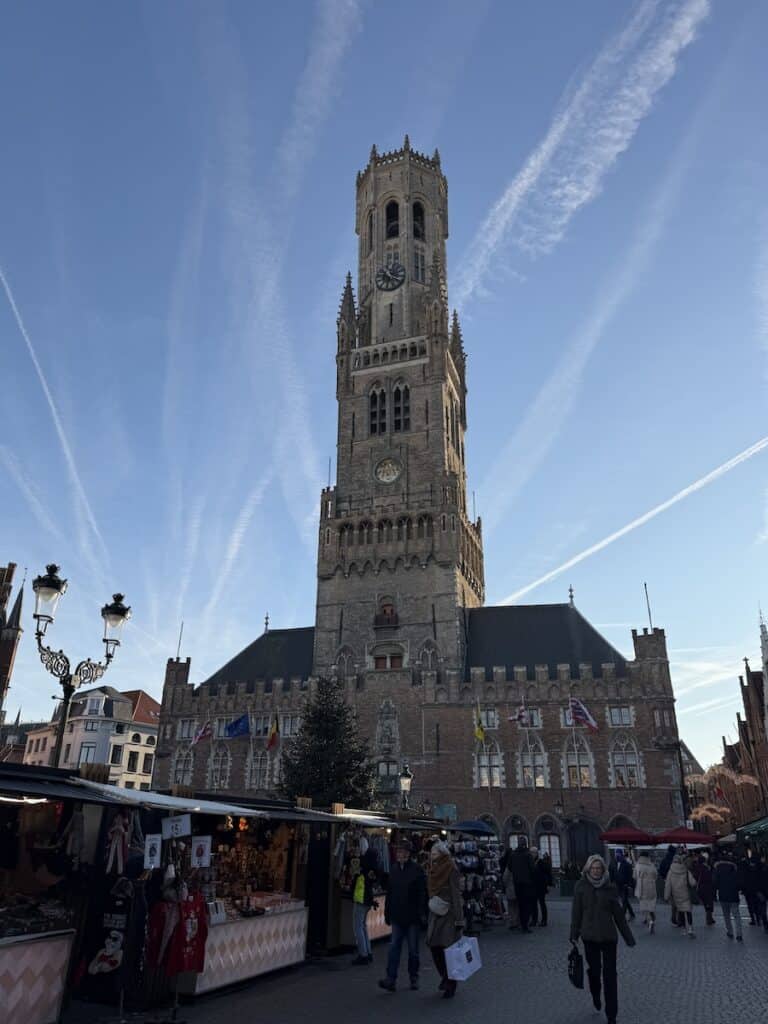
The Markt Square is dominated by the Belfry, Bruges’ 83-meter high medieval tower offering stunning views of the city below. Climb it if your knees allow. Our knees did not. A long week of stairs had caught up with us, but I have seen the movie In Bruges, so I kind of felt like I’d been up there anyway.
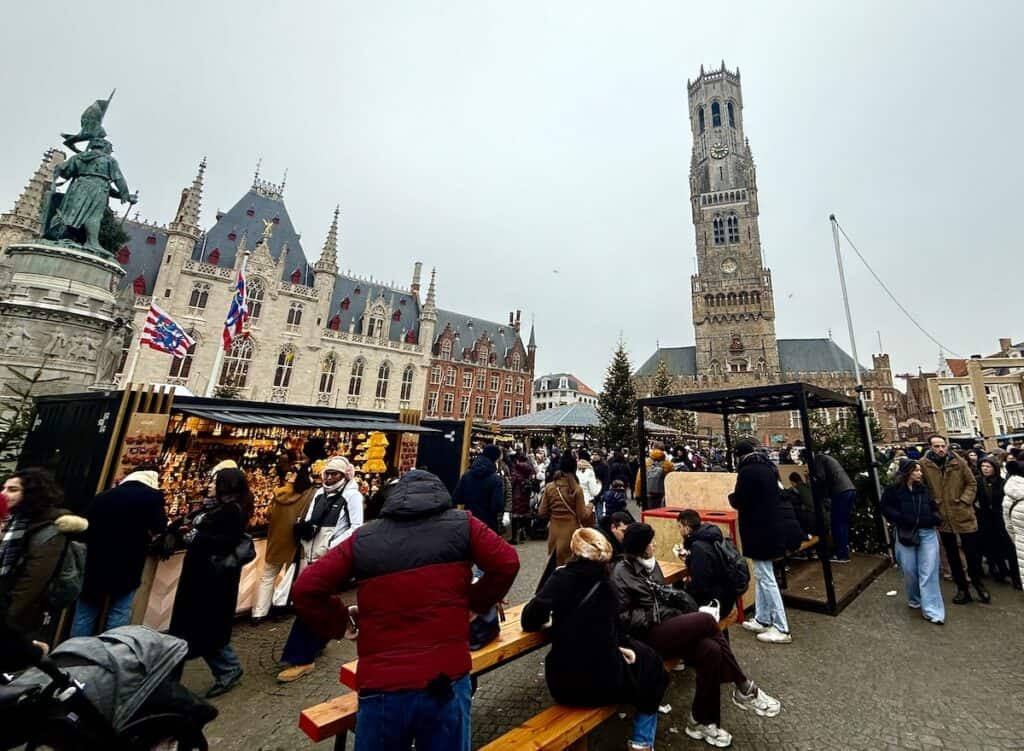
If you haven’t seen In Bruges, the 2008 Colin Farrell cult classic set almost entirely in this city, watch it before you go. I basically forced my husband to watch it before the trip. He pronounced it “kinda weird.” But once we arrived, he spent the entire visit pointing out locations from the movie with barely concealed excitement. It did its job.
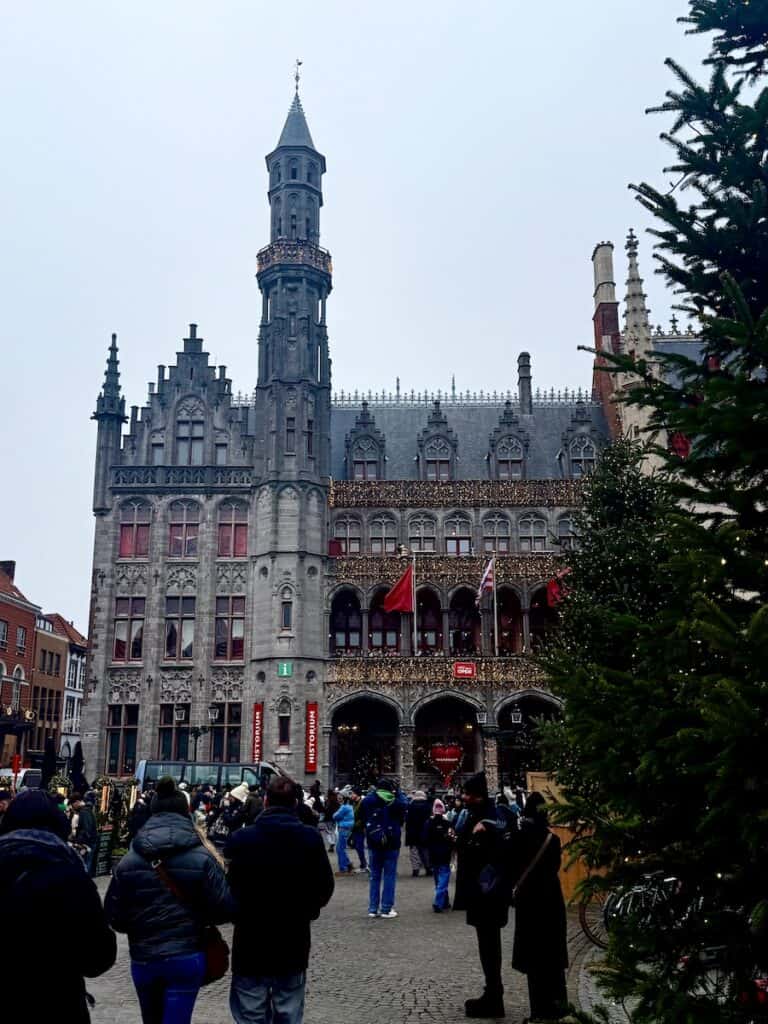
Right in the main square is the Historium, a neo-Gothic building from 1902 with an elaborate facade of turrets and decorative rooflines that looks like it was designed by someone who really loved sandcastles. It was built on the site of the medieval Waterhalle, a covered harbor where ships once unloaded goods directly into the square.
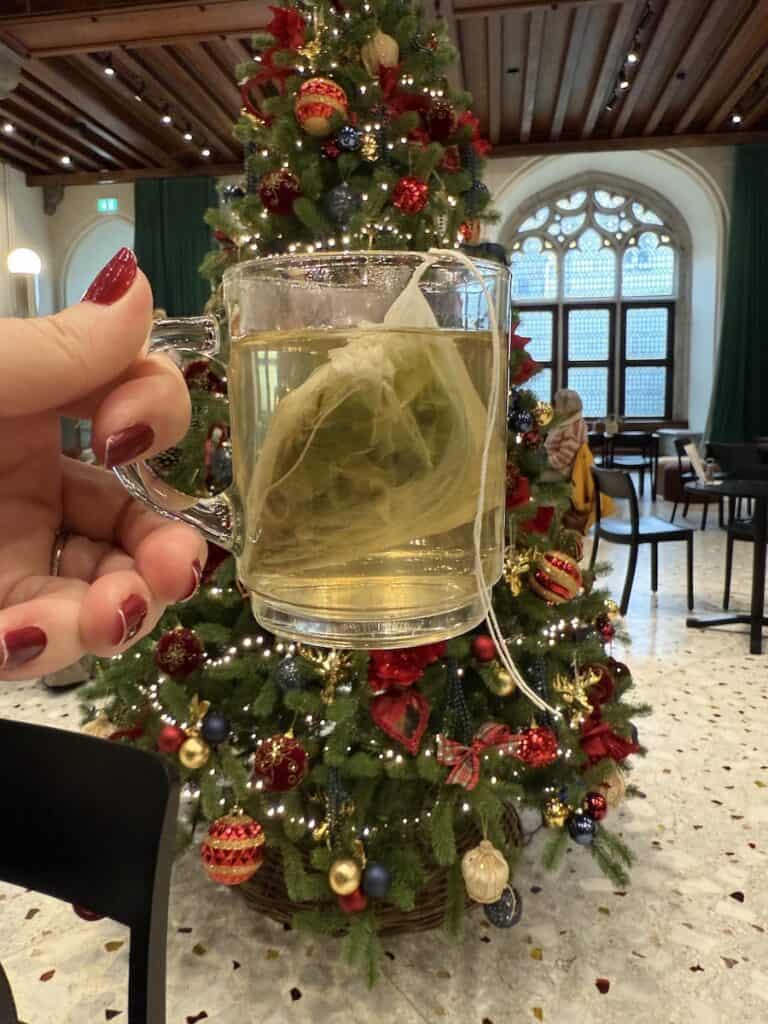
It’s worth popping inside even if you don’t visit the museum. The Duvelorium bar on the ground floor is freely accessible, and we stumbled into a beautiful room centered around a giant Christmas tree and spent a very happy half-hour thawing our feet while enjoying hot chocolate and tea. Some of my favorite travel moments happen after checking to see if a door is open.
Don’t Miss the Michelangelo
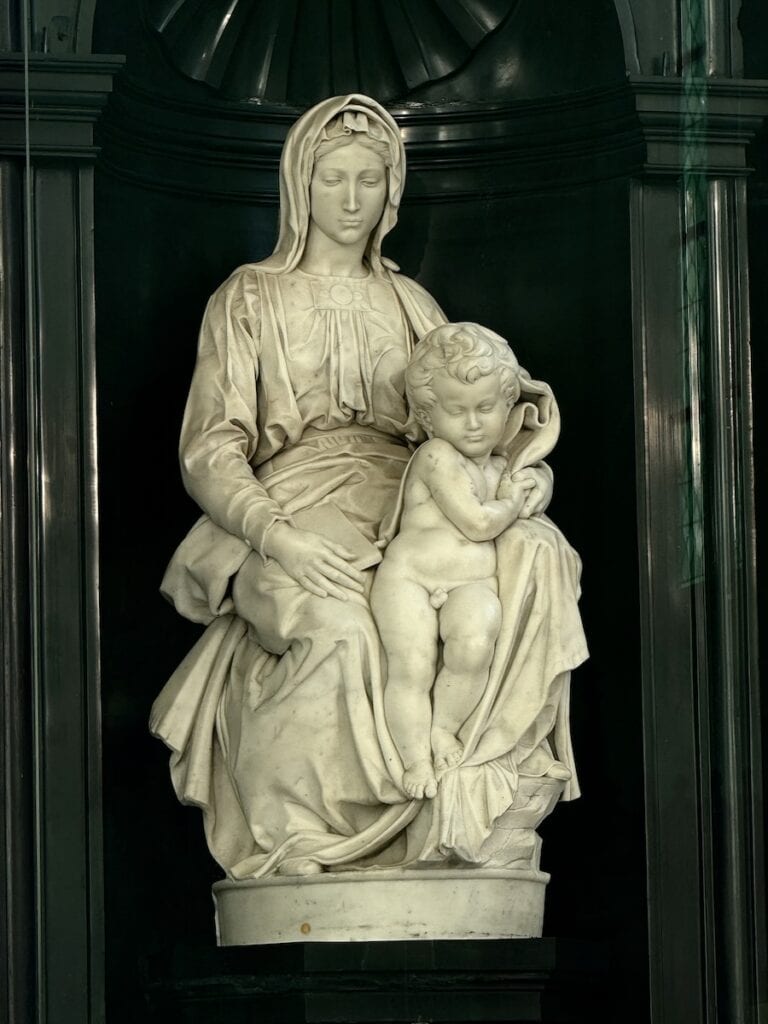
Bruges has a Michelangelo. An actual Michelangelo. Few people realize how rare of a thing that is, and they walk right past the church that houses it.
The OLV-kerk – the Church of Our Lady – houses the Madonna and Child, the only work Michelangelo sold outside Italy during his lifetime. It was purchased by wealthy Flemish cloth merchants in Bruges for the princely sum of 100 ducats, the equivalent of about $20-25,000 in today’s money. At Sotheby’s today it would fetch considerably more than that.
The sculpture has had an eventful life. Like the Ghent Altarpiece, it spent time in a Nazi hoard stashed in an Austrian salt mine before eventually coming home to Bruges. It now sits quietly in a side chapel behind plexiglass. You can’t get very close, which is a little frustrating, but it’s a historic Michelangelo in a medieval church in Belgium and that alone is worth the entrance fee.
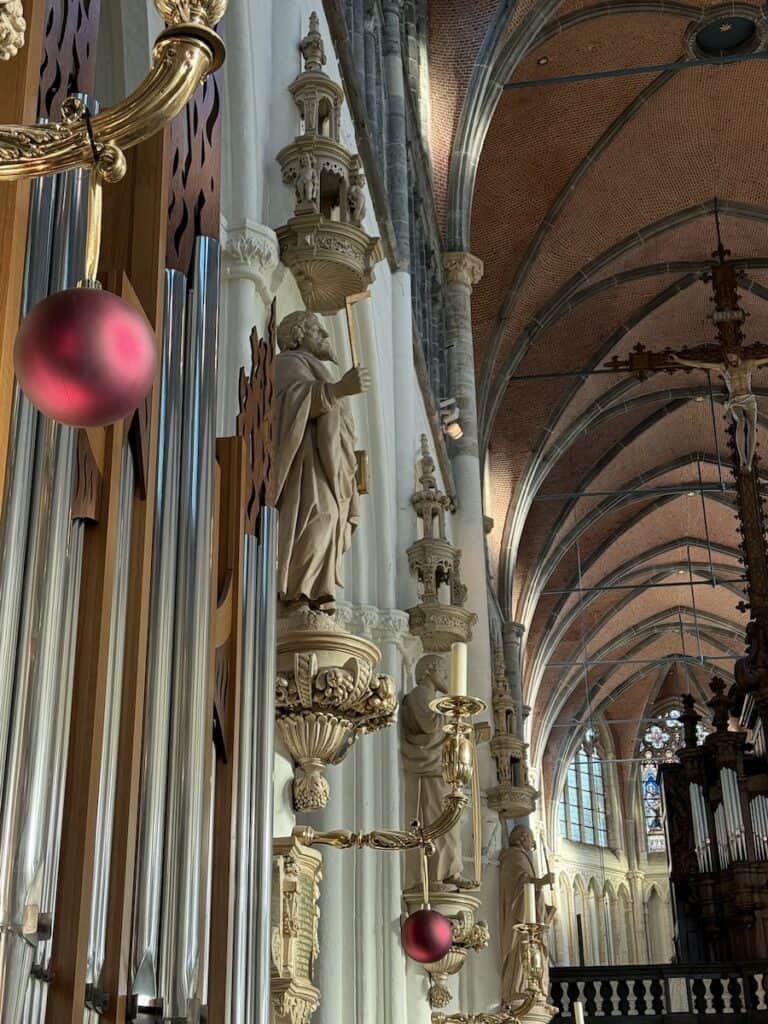
The church itself is extraordinary beyond the Madonna. The stunning and colorful English chapel, the painted tombs, the magnificent sarcophagi of Charles the Bold and his daughter Mary, the coats of arms of the Knights of the Golden Fleece, placed as a symbol of membership for life. Except for the one guy who got expelled for being a heathen. They took his plaque down, painted it black, and put it back up. Oof.
And, my personal favorite, the original steeple rooster!
The Witchcraft Museum and the Torture Museum
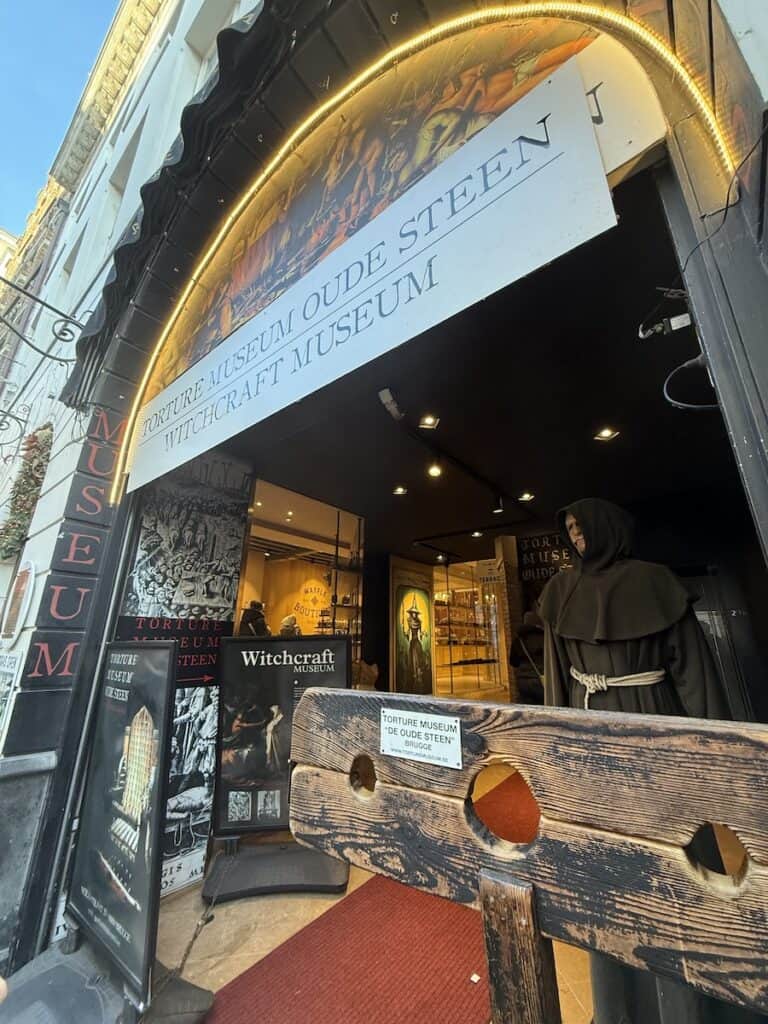
These two sit right next to each other and you can buy a combination ticket. Here is my honest advice:
The Museum of Witchcraft
Go if it sounds even a little appealing to you. It’s genuinely interesting, thoughtful, and surprisingly comprehensive. European witch history, the Inquisition, the Salem Witch Trials, Louisiana voodoo, Joan of Arc, and yes, Glinda the Good Witch of the North. It does briefly rip you out of the Christmas vibe but it’s worth it.
The Torture Museum
You will know immediately whether this is for you. If you have any second thoughts, don’t do it. I had second thoughts. I did it anyway. Don’t be like me.
Bottom Line: Both are interesting and will teach you something about the sensibilities of the Middle Ages. The Torture Museum is far more gruesome than The Witchcraft Museum. Neither is particularly Christmas-y, but use your best judgement as to whether it will kill the vibe.
The Bottle Shop and the Beer Tasting
Two stops worth finding:
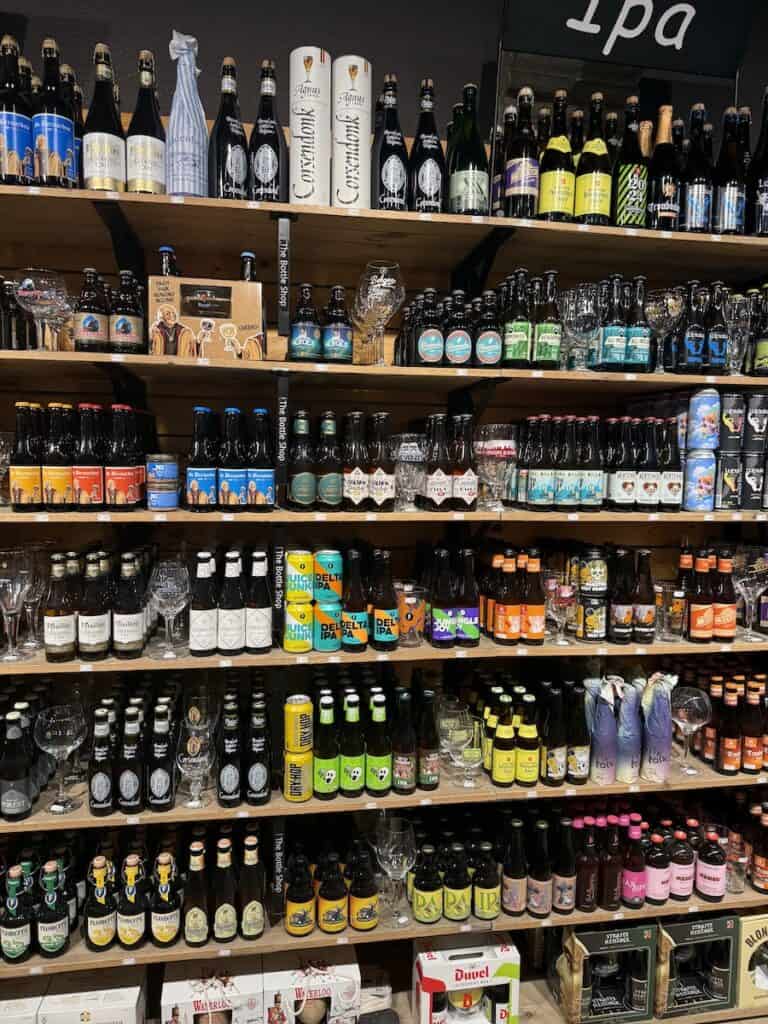
The Bottle Shop
There were more different kinds of beer than I have ever seen in my life. I spent twenty minutes just looking at the label art. If you or anyone you know has any interest in Belgian beer this is a mandatory stop.
Belgian Beer Tasting
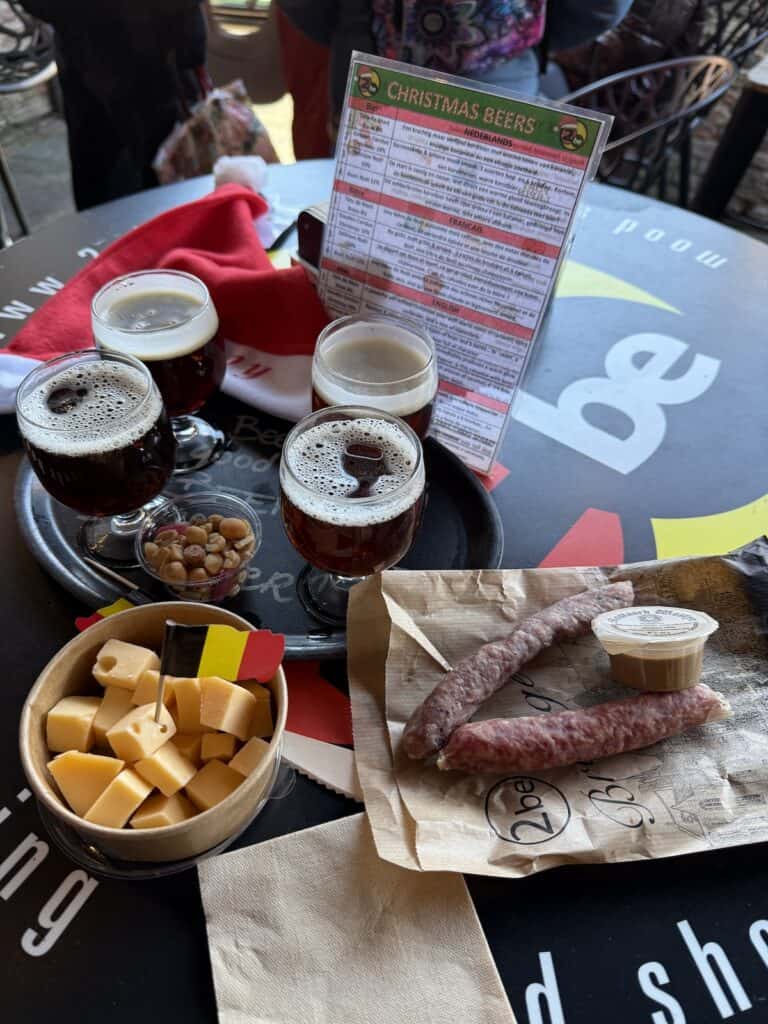
This is how we recovered from the Torture Museum, but I’d recommend it highly regardless. We found a fabulous spot at 2be, a legendary Bruges institution where you walk in through a 100-foot hallway lined floor to ceiling with over 1,250 different bottles of beer. We chose four tap beers and some snacks, and sat bundled up on the canal terrace with a view of the water and historic buildings… One of the best moments of the entire trip.
Best Places to Stay in Bruges for the Christmas Market
Use the map above to target your hotel early! We stayed in Ghent and drove in, which is absolutely an option, but if you want to stay in Bruges, I’d suggest the closer to the center, the better.
Practical Tips for the Bruges Christmas Market
⭐ The light show is worth staying for. The whole city transforms after dark and the Winter Glow light trail is genuinely spectacular. Plan to still be there when the lights come on.
🕐 Go after Christmas if you can. The Bruges market runs all the way through early January, long after most Christmas markets have packed up. We visited between Christmas and New Year and found it beautifully manageable. The city was still fully festive without the peak crowd intensity.
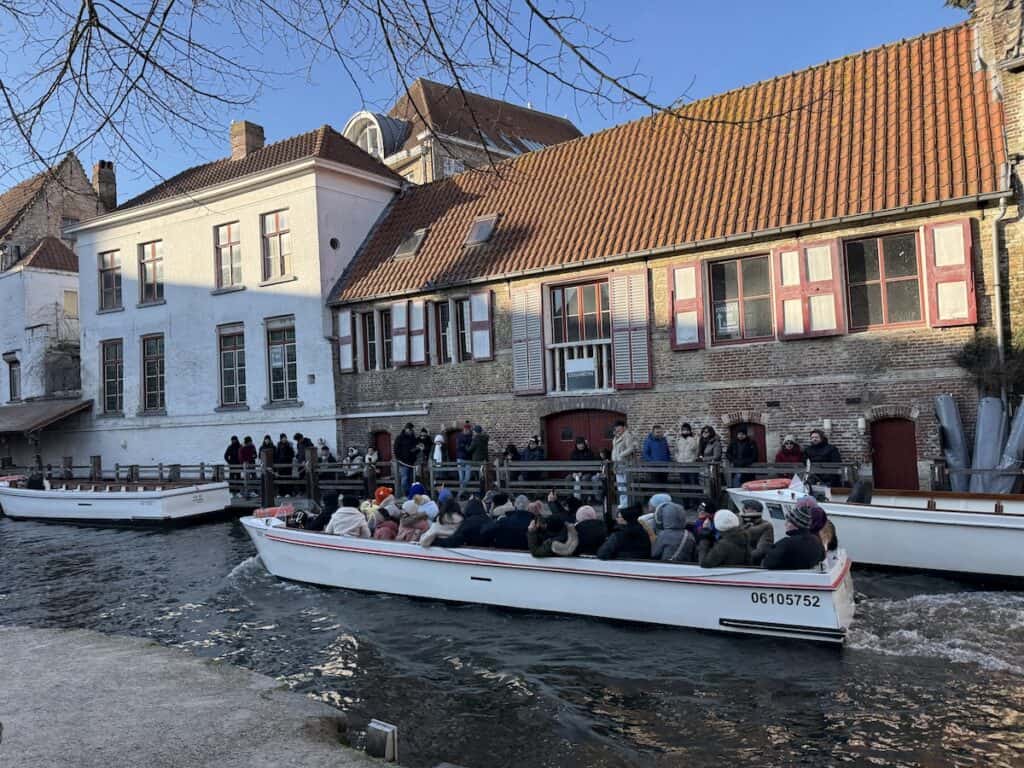
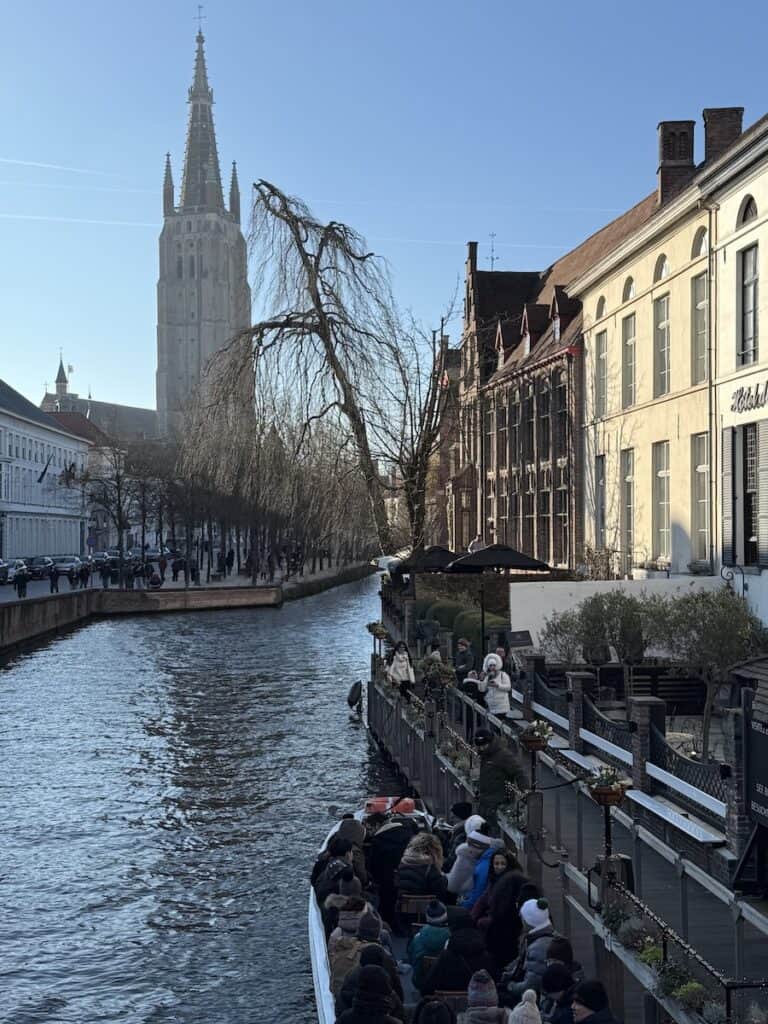
❄️ Canal boat rides are available during the Bruges Christmas market, but all boats are open. In freezing cold December weather we decided to wait for a warmer visit. We watched the boats from the bridges instead which was lovely in its own right.
🇺🇸🇬🇧 English is everywhere. Signage is often in English and most people under 40 speak it fluently. You will have zero language stress in Bruges.
👢Wear warm layers and bring good boots. We visited in very cold, windy weather and after five or six hours outside we were done. Cobblestones and cold feet are the enemy. Prepare accordingly.
⛸️ The ice rink at Minnewater, the Lake of Love, adds a lovely additional activity if skating is your thing. It’s also fun to watch the skaters from the shore.
Bruges Christmas Market vs. Ghent Christmas Market
Of everything on our Belgian Christmas trip, which also included Ghent, Bruges was the more medieval, more intimate, more purely fairytale of the two. Ghent is slightly larger and has its own extraordinary things going for it including one of the greatest artworks in human history. But for pure Christmas market magic in a setting that feels completely unreal, Bruges edges it.
If you’re choosing between the Bruges Christmas market and Ghent: don’t unless you have to. They’re an hour apart and complement each other perfectly. Do both, and you absolutely won’t regret it.
For more to help you plan your Christmas market trip across western Germany, Alsace, and more, my Christmas markets guide is the best place to start planning your trip!
Explore More Christmas Markets:
👉 Christmas Markets in Western Germany, Alsace, and Beyond
👉 Ghent Belgium Christmas Market
👉 Valkenburg Netherlands Christmas Market
