
I had just moved to Southwest Germany when I started hearing about all the incredible Christmas markets in the area. Living close to the international border, I discovered lots of good options close by in France. So we ended up attending our very first Christmas market ever in a slightly off-the-grid town in northern Alsace called Haguenau. After that, I was utterly hooked. Four years and dozens of Christmas markets later, I keep getting called back to the Alsace region of France.
Alsace is the best of both Germany and France. From beer and pretzels to champagne and baguettes, sausages to seafood, and ‘wilkommen’ to ‘bienvenue’ – it’s all here, and it’s pure Christmas magic.

I’ve now visited nine Christmas markets across Alsace (several more than once), ranging from the city-scale spectacle of Strasbourg to villages so small the whole market fits behind a church. I’ve discovered Albert Schweitzer’s birthplace, navigated parking, eaten a drunken pear in Riquewihr, rode the ferris wheel in Colmar, and bought the most amazing Christmas presents to send home to the States. You’ll find all my best recommendations, plus links to articles on each individual market so you can dig deeper into the ones that capture your imagination.
Whether this is your first Christmas in Alsace, or if you’ve already done the big ones – Strasbourg and Colmar – and want to know what else the region has to offer, you’ve come to the right place. There is a lot more to Alsace than first meets the eye!
What Is Alsace, and Why Does It Do Christmas So Well?
Alsace is the long, narrow region of northeastern France that runs along the Rhine River between Germany to the east and the Vosges Mountains in France to the west. It has spent most of its history being argued over by France and Germany, changing hands after wars, absorbing influences from both sides of the border, and emerging as something genuinely its own: a place that has menus in three languages, half-timbered houses, serves sauerkraut with Riesling, and puts a pretzel next to the foie gras without anyone finding it strange. Just my kind of place!
That history is exactly why Christmas in Alsace feels so different than Christmas markets anywhere else. The German Christmas market tradition runs centuries deep, and Strasbourg claims the oldest market in France and arguably in all of Europe. But the French flair for decoration, food, and a certain elegance lifts the whole thing into something the German markets, as wonderful as they are, don’t quite replicate.
The geography is simple. The Route des Vins, the famous Alsace Wine Route, runs north to south through the foothills of the Vosges, connecting vineyards and medieval villages for about 170 kilometers (105 miles). Haguenau and Strasbourg anchor the north. Mulhouse (muh-LOOZ) anchors the south. Everything else, including Colmar, Sélestat, Obernai, Kaysersberg, Riquewihr (REEK-veer), and Eguisheim, is strung between them. The whole region is compact enough to drive end to end in under two hours, which makes it an extremely satisfying place to plan a road trip.
Two ways people come to Alsace at Christmas:
If you’re flying in, Strasbourg (SXB) and Basel (BSL) are your closest airports, with Frankfurt (FRA) and Stuttgart (STR) both within two hours by car. Most visitors base themselves in Strasbourg or Colmar and day-trip to the villages.
If you’re stationed at or living near Kaiserslautern, you are sitting approximately 90 minutes from one of the great Christmas market regions in Europe, and there is no excuse not to go. Strasbourg is 1 hour 42 minutes by car. Haguenau is 1 hour 34 minutes. The village markets are further south but still completely manageable as a weekend with a central base. More on that in the itineraries section.
The Nine Alsacian Christmas Markets: North to South
I’ve organized these geographically along the Route des Vins so this section doubles as a logical driving route. Click through to the full post for each market for dates, hours, parking, and details you need on the ground.
Haguenau: The Semi-undiscovered Market in the North
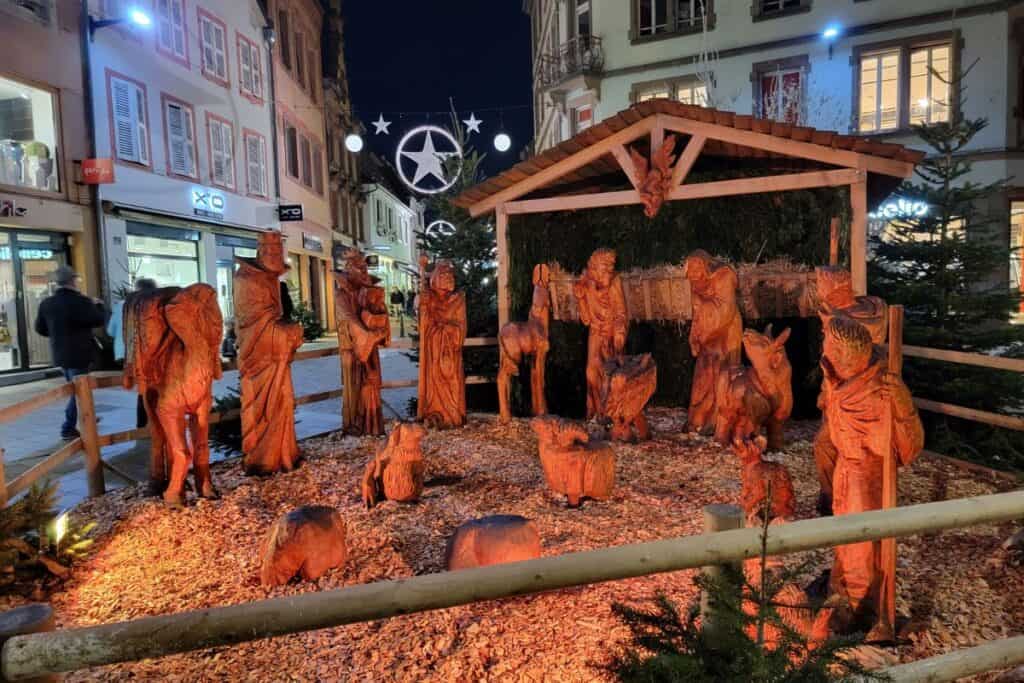
Haguenau was my first Alsace Christmas market, visited not long after we moved to our little village just across the border in Germany. I stood in the pedestrian center surrounded by light projections of huge snowflakes sliding across old stone buildings and thought: it cannot get more charming than this. Several years and eight more Alsacian markets later, I have not changed my mind about Haguenau.
It sits about 26 minutes north of Strasbourg by car, small enough to feel genuinely local, large enough (around 50 stalls, open daily for five weeks) to give you a full Christmas market afternoon. It also holds a specific piece of Alsatian Christmas history – the first written record of a nativity scene in the region comes from Haguenau’s municipal archives in 1420, describing the construction of a manger on the outer walls of the church of Saint Georges. That church is still standing.
There’s a beautiful vintage carousel in the main square that dates to 1900. The crowd level is civilized, even on weekends. And unlike some markets in the region, Haguenau is open weekdays and weekends through December 30, which makes it an excellent option when everything else has closed up.
Best for: Weekday visits, nativity scene collectors (there’s an exhibition and figures for sale), anyone coming from Germany who wants an easy, uncrowded introduction to French markets.
Don’t miss: The light projections after dark, Saint Georges church, and the dampfnudeln (a steamed dumpling with crispy bottom and vanilla custard) plus amazing french cheeses, sausages, champagne, and vin chaud.
Other Haguenau history: Haguenau has deep WWII history and many sites were used for filming locations in the Band of Brothers series.
👉 Full review, logistics, and parking tips: Haguenau Christmas market guide.
Strasbourg: The One That Started It All
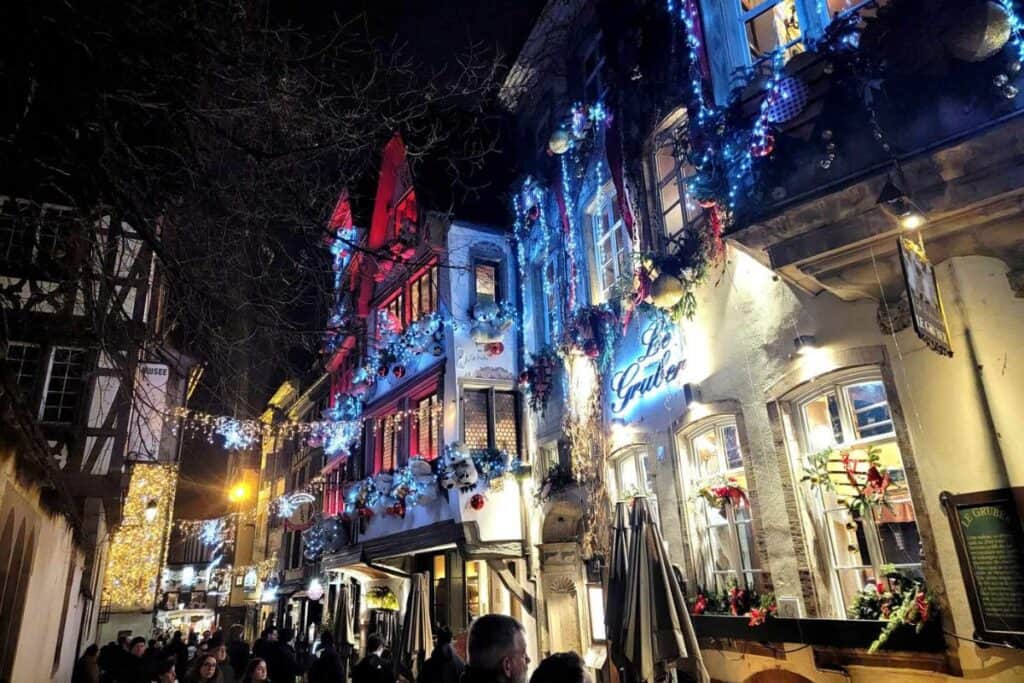
Strasbourg calls itself the Capital of Christmas, and you can’t argue with that. The market traces its origins back to at least 1570, and probably earlier, making it the oldest in France and a strong contender for oldest in Europe. What exists today is not really a market in the traditional sense. It’s a city-wide event with multiple markets spread across several squares, with the enormous Gothic cathedral at the center of everything, a giant Christmas tree with a musical light show after dark in Place Kléber, an ice rink, light installations on every street, and enough food and wine to constitute a problem if you’re not careful!
Every year Strasbourg adopts a new theme for its decorations, so it will look different each time you visit. The crowds on weekends are a lot to deal with, but weekday mornings are a different experience entirely.
One strategy we’ve adopted is going on Christmas Eve! For the last three years, we’ve visited on December 24th and gotten all the Christmas spirit with fewer crowds, and some actual peaceful vibes.
Strasbourg is not a quaint village market, it’s a spectacle! It doesn’t have the intimate scale of Eguisheim or the medieval walls of Riquewihr. What it has instead is scale, history, grandeur, and the thrill of standing in front of a cathedral that has been watching people celebrate Christmas for 500 years.
Best for: First-timers, those without a car, people who want everything in one place, anyone who wants to experience why Christmas markets are such a big deal, those who want a larger city with other things to explore like a cathedral, museums, and river boat tours.
Don’t miss: The Christkindelsmärik at Place Broglie (the traditional heart of the market since the 1870s), the Maison Kammerzell restaurant across from the cathedral if you reserve a table early, and the transition from day to night when Strasbourg goes from beautiful to breathtakingly spectacular.
We’ve stayed at both the Hôtel Léonor and a budget-friendly Appart’City Hotel option in Strasbourg, reviewed in full here: Full review, logistics and parking tips: Strasbourg Christmas market guide.
Sélestat: Small Market, Big Christmas Tree History

Between Strasbourg and Colmar, Sélestat is frequently skipped, which is why it deserves a stop!
Sélestat is the smallest market on this list. The stalls are few, the crowds are thin, and you can visit the whole thing in a couple of hours. What Sélestat has instead of size is a specific claim that no other market in the region can make: the first documented mention of a Christmas tree in Alsace appears in the Sélestat town archives in 1512. There is more than 500 years of Christmas tree tradition, documented and displayed in the Humanist Library, which you can visit for free.
The market itself is low-key and charming in an understated way. The churches are the real draw: Saint George’s has a hanging display showing the evolution of the Christmas tree over the centuries, and Saint Foy has a gorgeous hanging tree made of Meisenthal blown-glass ornaments, the famous (and collectible) hand-blown glass from this region. There’s also the House of Bread, which is a bakery/museum dedicated to France’s favorite carbohydrate.
Helga the frenchie came with us to the market at Sélestat and managed herself with reasonable composure, mostly because the crowds were thin enough that we could duck behind a Christmas tree whenever another dog came into view.
Best for: History buffs, people who need a quiet midday reset between bigger markets, those wanting an authentic Alsacian town without the crowds, anyone traveling with a reactive dog.
Don’t miss: The Humanist Library Christmas exhibition (free), Saint Foy church’s Meisenthal glass tree, and the House of Bread gift shop, from which you will not leave empty-handed.
👉 Full logistics and parking tips: Sélestat Christmas market guide.
Obernai: The Best Base Camp in Alsace
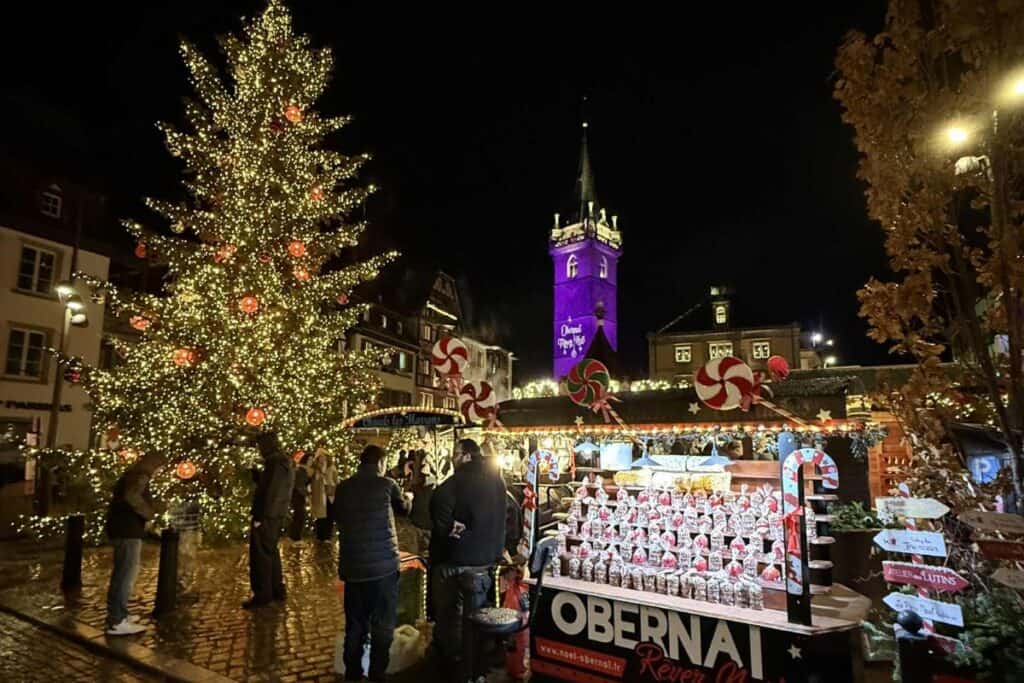
Obernai sits dead center on the north-south axis of Alsatian Christmas markets, which is one reason we chose it as our home base for an entire market road trip. From Obernai you can reach Strasbourg in 25 minutes, Colmar in 30, and everything between without ever driving more than 45 minutes. We stayed at the OneLoft Hotel in Obernai. The free on-site parking, combined with that central location, made the whole week logistically simple and less stressful in a way that Strasbourg or Colmar aren’t.
The market itself is spread across five small medieval squares, about 45 stalls total, with a strong emphasis on local and regional products. Obernai is where I found Riesling soup and Munster cheese soup, neither of which I had encountered at any other market, and both of which I would drive back for on their own. The foie gras vendors are serious. The handblown glass ornaments are stunning. And it’s one of the only markets open until New Year’s Eve if your schedule runs late or you have guests arriving after Christmas.
The town itself, first mentioned in 778 AD, has a gorgeous medieval center with towers, wells, a Renaissance town hall, and old defensive walls that make excellent backdrops.
Best for: Using as a hub to reach multiple markets by car, late December visits, anyone who wants serious regional food shopping rather than decorations, and a less-busy charming medieval town.
Don’t miss: The Riesling soup, the historic six-bucket well near the Hotel de Ville, and the fantastic Atelier Boulangerie next door to the OneLoft for breakfast.
👉 Full logistics and parking tips: Obernai Christmas market guide.
Colmar: Six Markets, One Impossibly Magical Town
I visited Colmar in the spring before I ever came back for Christmas. Even in April it made my list of the most charming places in France. When I came back in December and found it completely transformed, I felt like I was discovering it for the first time all over again. I got to experience Colmar for the first time twice, which is a gift I did not expect.
The Colmar Christmas market isn’t just one market, it’s six, each occupying a different square with its own character and theme. The arts and crafts market sits in front of the 13th century Dominican church, and the historic centerpiece market at Place de l’Ancienne Douane, anchored by the Koifhus, the old customs house, with light shows on the facade after dark.
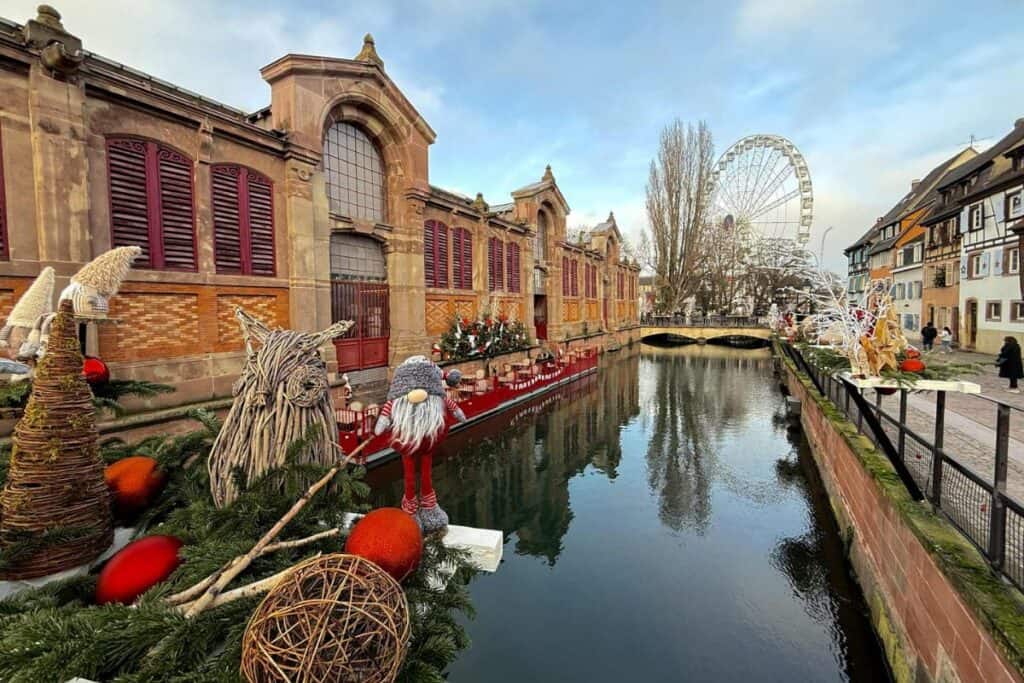
Little Venice, the canal district, is where the half-timbered houses are reflected in the water and the photo opportunities are epic. The Alsatian terroir market at Place Jeanne d’Arc for wine direct from local vineyards. The Gourmet Market for champagne, oysters, and elevated Christmas market food that goes beyond sausages. And don’t forget the indoor Koifhus artisan guild market, where rotating craftspeople occupy the vaulted rooms and where you will probably buy something you didn’t plan to buy. I bought lampwork bead earrings in the Koifhus, and I think of Colmar every time I wear them.
The ferris wheel next to the Gourmet Market gives you a bird’s-eye view of the whole scene. The old covered market, Marché Couvert, is open year-round and worth an hour of your time for the building alone, plus whatever cheese and charcuterie you end up walking out with.
Crowds are intense on weekends, weekdays are better, and you need at least a full day, preferably two to fully explore it all at an unhurried pace.
Best for: Anyone who wants maximum variety, canal photos, elevated food, and the full Alsatian Christmas experience concentrated in one very beautiful place that isn’t quite as overwhelming as Strasbourg.
Don’t miss: The Koifhus indoor market, the Gourmet Market, Little Venice after dark, the ferris wheel, and the Marché Couvert even if you’re not buying anything.
👉 Full review, logistics and parking tips: Colmar Christmas market guide.
Kaysersberg: The One With Depth and Charm
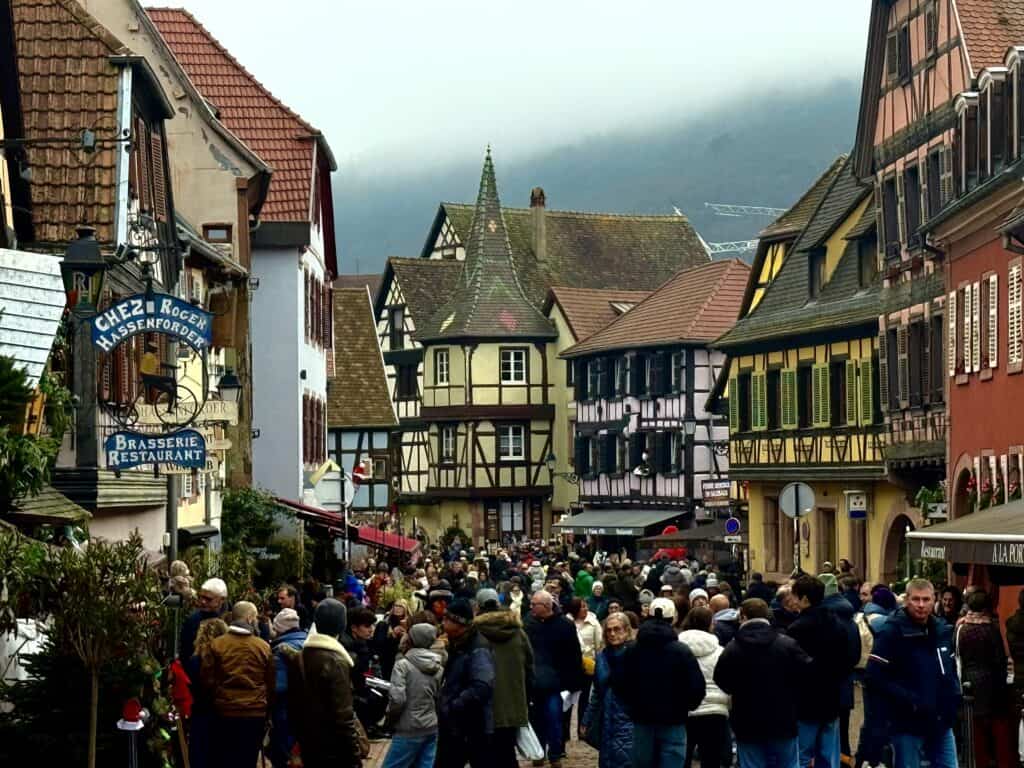
We have left Kaysersberg with fuller bags than any other Alsatian market. Wine from the Schlossberg vineyards. Local cheese and sausage. Gingerbread. Things we bought at the permanent shops because the market stalls and the year-round village shops blur into each other here in a way that makes your budget go out the window.
The setting in Kaysersberg is just beautiful, and surrounded by nature: a valley in the Vosges foothills, a medieval castle ruin on a rocky outcrop above the village, the Weiss River tumbling over rocks through the center of town, and half-timbered buildings in colors (vivid yellows, salmon pinks, brick reds, even a purple one) that are more varied and dramatic than anything you’ll find in most Alsatian villages. During the Christmas market the castle makes its way onto the commemorative glass mug, which we had to have.
The market itself is only about thirty chalets, weekends only, in the courtyard behind the church. But the permanent shops extend the whole experience into the streets.
The church is worth going into: a Romanesque portal from around 1230, a colossal cross, and a 1518 gilded wooden altarpiece by Colmar master Hans Bongart that is a classified Monument Historique and in miraculously good condition.
Behind the church is the thing that makes Kaysersberg different from every other pretty village on this list. There’s a small, quiet courtyard with headstones representing Christians, Jews, and Muslims side by side, a wall with the names of those who died in the liberation of Alsace, and quotes about peace by Nobel Peace Prize recipient Albert Schweitzer, who was born in Kaysersberg in 1875. You can visit his birthplace, now the Centre for the Interpretation of Peace, a short walk away.
Standing in that courtyard surrounded by the noise and festivity of a Christmas market, it’s a useful reminder of what the season is actually supposed to be about.
Best for: The combination of festivity and genuine historical weight; people who want a market that gives them something to think about along with the vin chaud, and a whole half-timbered town that becomes the market.
Don’t miss: The church altarpiece, the Schweitzer memorial courtyard, the Weiss River, and whatever is in the permanent charcuterie and cheese shops on the main street.
👉 Full review, logistics, and parking tips: Kaysersberg Christmas market guide.
Riquewihr: The Most Medieval Time You’ll Spend in Alsace
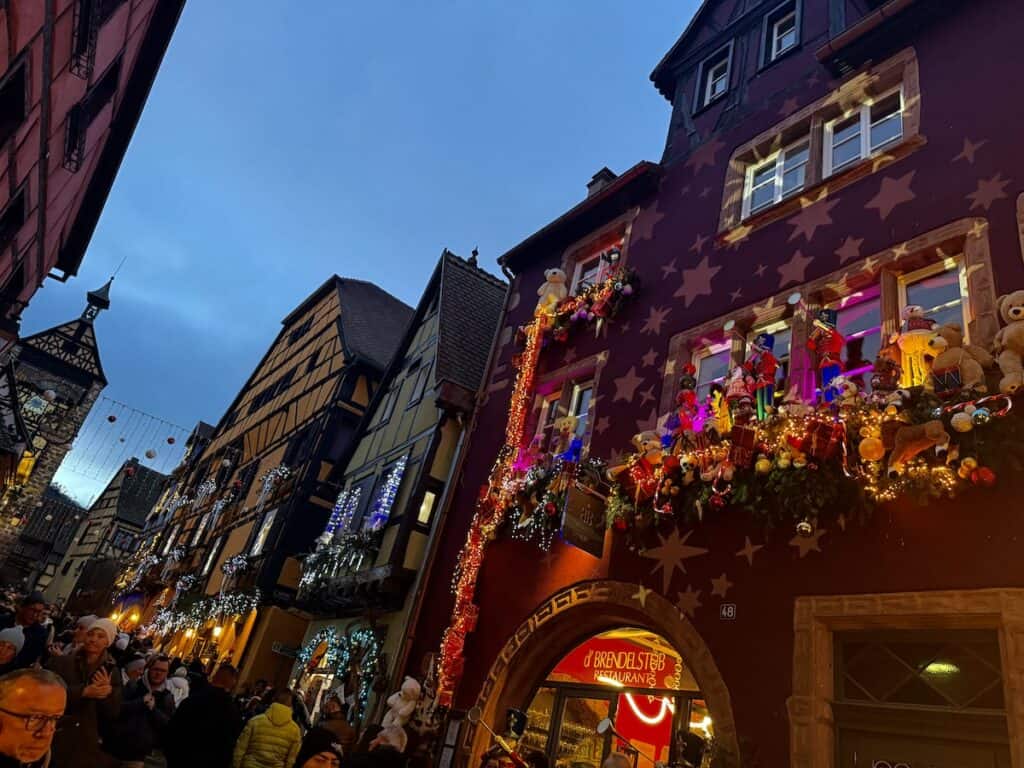
The approach to Riquewihr through dormant winter vineyards is the perfect entrée into this market. Then you walk through the fortification walls and into a medieval town that has, in certain fundamental ways, not changed much since the 15th century.
The medieval streets are narrow and scaled for a world without cars, and they add enormously to the atmosphere. Ancient wells and wine presses sit on corners as if someone just finished using them. In some sections you can still see the double fortifications, an outer wall and an inner wall, which I had never encountered anywhere before.
The market stalls themselves are not in the most picturesque part of town because the streets are simply too narrow for a large market. What they lack in setting they make up for in quality: hand-poured candles, carvings from local vine wood, hand-painted glass ornaments, fool-the-eye chocolates molded to look exactly like hand tools, homemade soups in glass jars. And the drinks are unlike any other market in Alsace. By the clock tower I had a shot of something that felt like French jet fuel with a tiny whole pear in the glass. Also available: absinthe, honeyed apple juice, white wine with Grand Marnier, and hot Christmas gin. I am not making this up.
After the market closed we walked back to the car through small cobblestone alleyways off the main street, the moon above the rooftops. It was one of the best moments of the entire trip. We vowed to come back on a weekday when we could appreciate the town itself without the Saturday crowds.
The Dolder Tower light show after dark is worth staying for. And book the Wihnacht nocturnal guided tour in advance if you want to go deeper into the medieval history after the market closes.
Best for: Atmosphere above all else; people who can visit on a weekday; anyone who wants to feel what a medieval town is really like.
Don’t miss: The Dolder Tower light show, the drink with the tiny pear, and any alleyway you find by turning off the main street.
👉 Full review, logistics and parking tips: Riquewihr Christmas market guide.
Eguisheim: The Best Village Market in Alsace
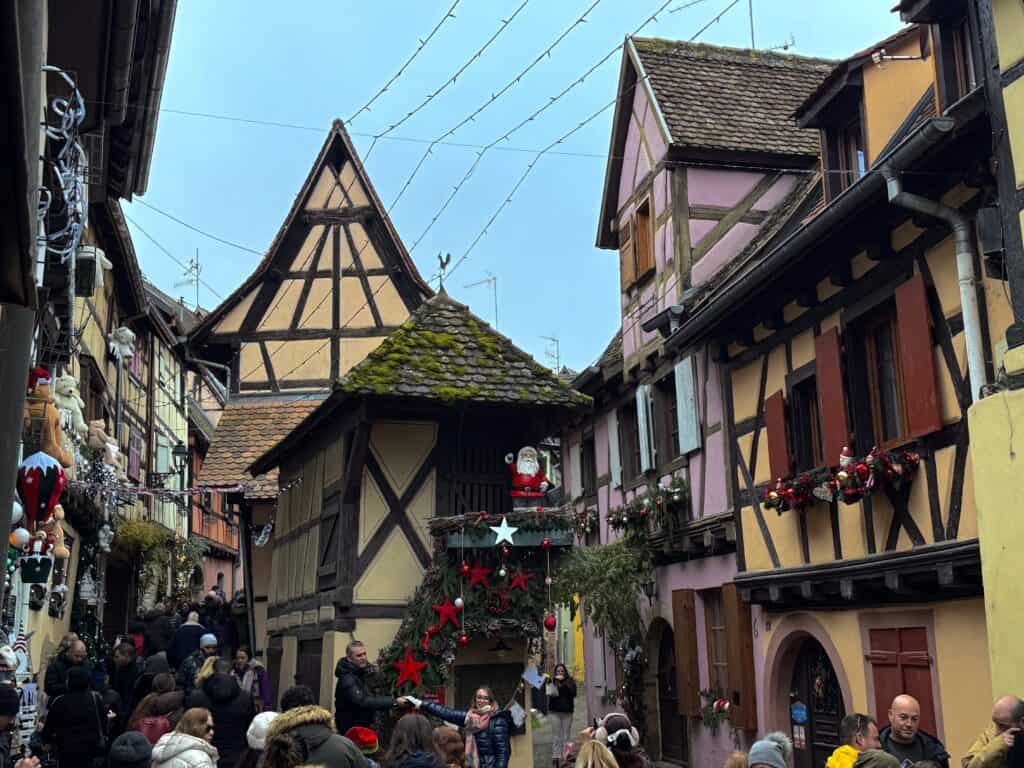
It was hard to choose, but my husband and I agreed, if we had to pick one village market only, it would be Eguisheim.
We almost didn’t make it inside the market. We were ambushed at the entrance by a stall shaped like a giant wine barrel next to a 15th century wine press, which turned out to be the cave of the Wolfberger winery, and we were through the door before we knew what happened. We made a strategic pact to come back at the end of the day so we wouldn’t be lugging wine bottles through cobblestone streets for three hours. We kept that pact, and I bought a bottle of violet liqueur that I have been rationing ever since because I cannot bear for it to end.
If you feel like you’re walking around a circle, it’s because you are! The town was built in concentric rings around its central château, and the streets follow that logic. The half-timbered houses are storybook, the colors restored after being plastered over in the 19th century, and at the center of it all is the crooked yellow house at the junction that everyone photographs. On a Saturday morning it was surrounded by cameras. On a weekday it would be all yours.
The market weaves into the village organically. Stalls in courtyards, vendors spilling out of doorways, the smell of mulled wine drifting through streets that were already spectacular before the first string of Christmas lights was hung.
My husband had a bowl of French lentil soup with sausages that he declared the best soup of his life. He said this while drinking champagne. We also discovered Timothy’s, serving beer and hot dogs in front of a genuine American WWII jeep, which celebrated the American military history woven through this corner of France.
Every evening at 6pm, a window on the Place du Château Saint Léon opens as part of the village’s living Advent calendar, revealing a festive image to whoever has gathered to watch. If your timing works, don’t miss it.
We actually even spotted a stork coming in for a landing above the rooftops. Alsace’s symbol, in its natural habitat, in the middle of a Christmas market. Some days everything just lines up.
Best for: Pure village atmosphere, the combination of a genuinely beautiful town and a market that feels like it grew there naturally, anyone who wants my honest top recommendation for a single village market in Alsace.
Don’t miss: The Wolfberger winery (go back at the end of the day), the Advent calendar window at 6pm, the crooked yellow house, and the storks if you’re lucky.
👉 Full review, logistics, and parking tips: Eguisheim Christmas market guide.
Mulhouse: The Elegant Surprise I Can’t Wait to Go Back To
True confession: we went to Mulhouse because my husband wanted to check out the new Costco.
We added the Christmas market as an afterthought, and it became one of the best decisions we made on the entire trip.
Mulhouse is not on most people’s Alsace Christmas market lists, which is both a loss for them and a benefit for you: the crowds are manageable, the atmosphere is elegant, and the market has a personality unlike anything else in the region or, frankly, anywhere I’ve been.
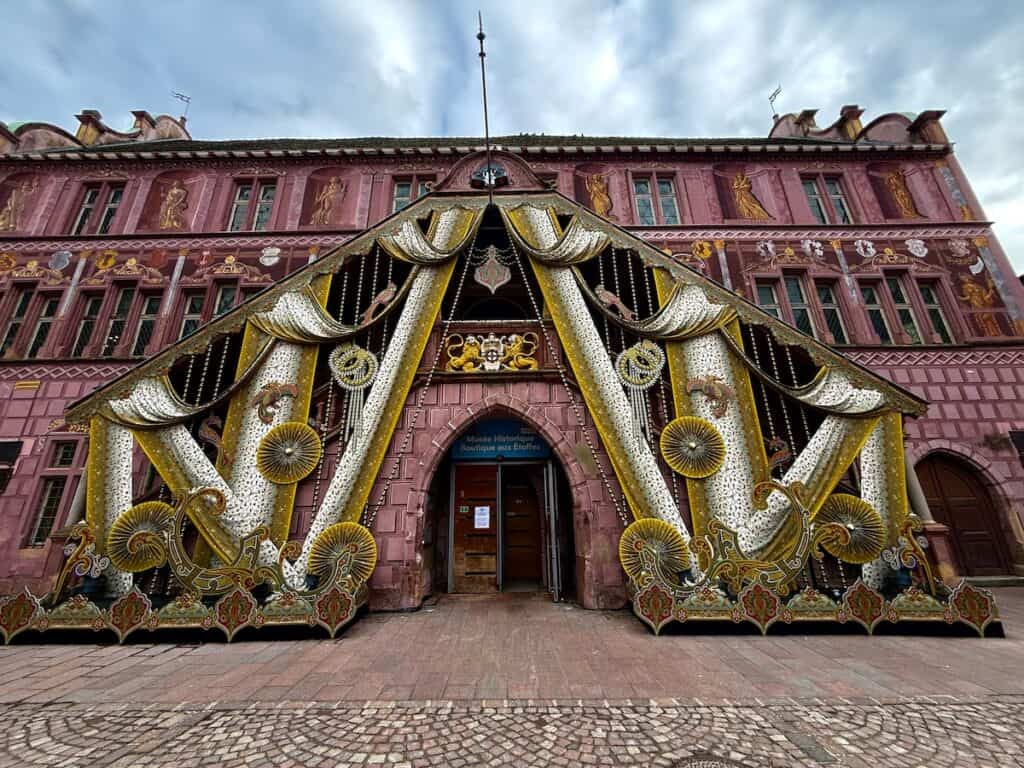
Every year, a French artist is commissioned to create an original Christmas fabric inspired by the collections of the Musée de l’Impression sur Étoffes, Mulhouse’s textile printing museum. That fabric then appears everywhere: draped across building facades, decorating the market stalls, wrapped around the pink Renaissance Town Hall (built 1431, rebuilt 1778), making the whole building look like an enormous frosted cupcake.
Inside the Étoffes boutique on the ground floor of the Town Hall, you can buy the fabric by the meter, or as oven mitts, pillows, throws, aprons, Christmas decorations. The fabric changes every year. I bought several things and I treasure every one of them.
The market itself, officially the Étofferies, has about 90 chalets, almost entirely Alsatian artisans, and extends into the Passage de la Demi Lune and Place des Cordiers beyond the main square, so be sure to wander and explore. Our champagne bar was on the backside of the Temple Saint-Étienne, out of sight of the main crowd. We found it by poking around. A good policy in general at Mulhouse.
Standing on the church steps looking out over the market, all those colorful stalls and the fabric everywhere, was almost surreal. I will be going back, guaranteed.
Best for: People who want something completely different; textile lovers; anyone who’s done the obvious markets and wants to be surprised; people who appreciate elegant over busy.
Don’t miss: The commissioned fabric (buy something, you will regret leaving without it), the champagne bar behind the Temple Saint-Étienne, the view from the church steps, and Café Mozart for a window seat above the market.
👉 Full review, logistics and parking tips: Mulhouse Christmas market guide.
Three Itineraries for Christmas Markets in Alsace
The Long Weekend: 3 Days
Three days is enough to cover the two big markets and one village, which is a solid introduction to Christmas in Alsace without being a logistics marathon.
Where to stay: Colmar or Strasbourg. Colmar puts you closer to the village markets; Strasbourg gives you more to do in the evenings.
Day 1: Arrive and settle in. If you’re in Strasbourg, you’re already at your first market. Spend the afternoon and evening in the Christkindelsmärik at Place Broglie, have dinner at Maison Kammerzell or L’Oignon (reservations recommended), and stay out past dark when the illuminations come on.
Day 2: Full day in Colmar. Hit all six markets at your own pace, don’t skip the indoor Koifhus market, ride the ferris wheel, eat everything. Stay for the light show on the Koifhus facade after dark.
Day 3: Choose your village. On a weekend, take the Christmas shuttle from Colmar station and combine Kaysersberg and Riquewihr on the same day (the shuttle connects them, €17/day pass). Or on a weekday, drive to Eguisheim for the circular village experience and quieter cobblestone wandering. If you want something genuinely off the beaten path, go to Mulhouse.
The Full Week: 7 Days of Christmas in Alsace
Seven days is the right amount of time to do this properly without rushing anything, and getting to experience the full range of what Alsace has to offer.
Where to stay: Split your time. Two nights in Strasbourg or Haguenau for the north, then move to Obernai as your central base for the rest of the week. Obernai’s central location puts every market within 45 minutes by car, the parking situation is manageable, and it has its own market to wander in the evenings.
Day 1: Strasbourg. Full day and evening. Submerge yourself in this large and spectacular city and enjoy it from beginning to end.
Day 2: Haguenau in the morning (26 minutes from Strasbourg), quieter and more local, nativity scene exhibition, dampfnudeln. Return to Strasbourg for the evening.
Day 3: Drive south, check out of your hotel, stop in Sélestat for lunch and the Christmas tree history, check into Obernai for the rest of the week.
Day 4: Full day in Colmar. 25 minutes from Obernai.
Day 5: Christmas shuttle day from Colmar station: Kaysersberg and Riquewihr. Book the €17 day pass in advance.
Day 6: Eguisheim in the morning (15 minutes from Obernai), Mulhouse in the afternoon/evening (45 minutes south). This is a long day but both markets are manageable in half a day each, and the contrast between them is excellent.
Day 7: Flex Day. Go back to wherever you felt you left something undone. Buy the things you talked yourself out of (there’s always one!). Eat more choucroute. Drink more Riesling and/or champagne.
The K-Town Day Trip or Weekend
For anyone based in the Kaiserslautern Military Community: the entire Alsace market region is within reach.
Strasbourg is 1 hour 42 minutes by car from Kaiserslautern. Haguenau is 1 hour 34 minutes. These are legitimate day trips if you start early, and Strasbourg especially is worth doing at least once a season.
For a weekend, base yourself in Obernai. It’s roughly 2 hours and 15 minutes from Kaiserslautern, the OneLoft hotel has free on-site lot parking with large spaces, and from there you can reach every market on this list in under 45 minutes. A Friday night in Obernai, Saturday in Colmar, a Sunday morning in Eguisheim or Kaysersberg, and you’ve had a proper Alsatian Christmas market weekend for a reasonable amount of money.
The Christmas shuttle from Colmar covers Kaysersberg and Riquewihr on weekends, which means you can park once and ride between markets. €17 per person, book in advance.
One tip specific to the KMC: If you’ve been doing the German markets all season and want to understand what’s different about the French side, Haguenau is the easiest-to-get-to comparison. It’s less than 2 hours from Kaiserslautern, has easy parking in lots just outside the center, has strong German culinary influence alongside the French ones, and the crowds are civilized. It’s an easy first step across the border. Don’t forget your passport!
Practical Planning and FAQs
When Do the Markets Run?
Most Alsace Christmas markets run from late November through late December. The exact dates shift slightly each year, and individual markets vary. Haguenau and Obernai both run past Christmas, through December 30 and December 31 respectively, making them good options if your schedule runs late. Kaysersberg runs weekends only (Friday, Saturday, Sunday). Check each individual post, or the table below for confirmed 2026 dates.
Where is the Best Place to Stay for Christmas in Alsace?
Use this interactive map to find great places to stay while you explore the Christmas markets in Alsace. Bear in mind that it’s always smart to book early. Many of these hotels will allow you to cancel with no penalty if your plans change, so play it safe and reserve that room!
On a budget? Instead of staying in Strasbourg or Colmar, choose Haguenau to explore the northern markets, and Obernai to explore the southern markets. Each of these towns has a great market of its own but rooms are easier to find and more affordable.
Best Time to Avoid Crowds
Weekdays are universally better for crowds across all nine markets. Riquewihr and Eguisheim in particular feel genuinely packed on Saturday afternoons; their narrow medieval streets concentrate the crowd in a way that larger towns don’t. Strasbourg and Colmar are busy every day but are large enough to absorb it.
The sweet spot across the board: a weekday afternoon, arriving around 2-3pm, staying through the early evening when the lights come on. You get both the daytime market and the evening atmosphere without the worst of the weekend crowds.
Getting Around the Alsace Christmas Markets
A rental car gives you the most flexibility and is more or less necessary if you want to visit the village markets on your own schedule.
The Christmas shuttle from Colmar station runs on Fridays, Saturdays, and Sundays during Advent, connecting Kaysersberg, Riquewihr, and Ribeauvillé (one weekend only). The day pass is €17 per person (free for children under 12) and needs to be booked in advance because it sells out.
Strasbourg and Colmar are both accessible by train from most major German cities and from Paris.
Money
Bring cash euros. Bring more than you think you’ll need. Most market stalls across all nine markets are cash only, and ATMs in the smaller villages can have lines on weekends. Budget for the mug deposit at each market (usually a couple of euros, refundable if you return it, worth keeping if it’s a good one).
What to Wear to Christmas Markets in Alsace
Layers, always. Waterproof shoes with actual grip; the cobblestones in every village on this list are beautiful and uneven and frequently wet. Hat, gloves, scarf. If you’re planning to go from market to restaurant to market, dress so you can add and remove layers easily because the temperature swings between outside and a packed restaurant are significant. The vin chaud helps with everything, but it is not a substitute for gloves.
For a breakdown and strategy: What to Wear to Christmas Markets & Best Packing Tips
Are Christmas Markets in Alsace Dog-Friendly?
Alsace is generally dog-friendly and you’ll see dogs in markets, cafes, and restaurants throughout the region. For a reactive or nervous dog, Sélestat and Haguenau are the safest bets due to lower crowd levels. Eguisheim, Obernai, and Kaysersberg are manageable with some planning. Strasbourg and Colmar on a weekend is not a good idea for an anxious dog.
Are Alsace Christmas Markets Kid-Friendly?
Everywhere you turn, Christmas markets in Alsace have provided thoughtful, photogenic, and fun things for kids. The 1900 carousel and letters to Santa in Haguenau, the ferris wheel in Colmar, the little Christmas train in Mulhouse, the Santa in his chalet in Haguenau on Wednesdays and weekends, the living Advent calendar window in Eguisheim, and the musical Christmas tree in Strasbourg are just some of the great family-friendly things you’ll discover.
2026: All Nine Markets at a Glance
*Markets are closed on Christmas Day
| Market | Scale | Crowds | Open | Unique Hook |
|---|---|---|---|---|
| Strasbourg | City | High | Nov. 26 – Dec. 24 (some until Dec. 27) | Oldest in France, annual theme |
| Haguenau | Medium | Low-Med | Nov. 20 – Dec. 30 | Nativity scene history since 1420 |
| Sélestat | Small | Low | Nov. 20 – Dec. 27 | Christmas tree archives since 1512 |
| Obernai | Medium | Low-Med | Nov. 27 – Dec. 31 | Best base camp, great food |
| Colmar | Large | High | Nov. 23 – Dec. 29 | Six markets, Little Venice |
| Kaysersberg | Small | Medium | Weekends only (F, S, S) from Nov. 27 – Dec. 20 | Castle, Schweitzer, river |
| Riquewihr | Small | High weekends | Nov. 27 – Dec. 20 | Most medieval, Dolder Tower |
| Eguisheim | Small | High weekends | Nov. 27 – Dec. 30 | Circular village, Wolfberger winery |
| Mulhouse | Medium | Low-Med | Nov. 27 – Dec. 30 | Annual commissioned Christmas fabric |
How to Start Planning Your Alsace Christmas Market Trip
If you’re completely new to Alsace and can only pick two markets, make them Strasbourg and Eguisheim. One gives you the grand city-scale spectacle. The other gives you a more intimate medieval village magic. Together they show you the full range of what Christmas in Alsace can be.
If you’ve already done Strasbourg and Colmar and want to expand, the smaller villages are waiting. Kaysersberg and Riquewihr on the same day is one of the best Christmas market experiences I’ve had anywhere. And if you want to be genuinely surprised and fall hard in love, go to Mulhouse. Trust me on that one.
One last thing: don’t try to do all nine in a single trip unless you have buckets of time. You’ll exhaust yourself. Pick your itinerary, leave a few markets for another year, and give yourself permission to go back to the ones you loved. We keep going back, and we keep finding something we missed the first time. Give yourself a pace and a calendar where you can really relax, feel the joy, and get the most quality time from Christmas in Alsace.
For lots of additional detail and more about Alsacian Christmas traditions check out the official Alsace Christmas site. If you’re looking to expand your Christmas market journey, the place to start is our Christmas Market Guide for Southwest Germany, Eastern France, and beyond!
*These markets are close by, and also deserve a spot on your list!
Freiburg im Breisgau, Germany, Christmas Market
Metz France Christmas Market
