
Most people give Verona a day, maybe two, on their way to Venice or Lake Garda. We gave it four, and we still left things on the table for next time. That’s the case I want to make for this city: don’t rush it unless you have to, because there are more things to do in Verona than you can imagine.
You can do Verona in a weekend and see the highlights, but if you actually stay, the churches, the Roman ruins under a clothing store, the piazzas at different hours, you really start to understand why this city held onto Dante as long as it did, inspired Shakespeare’s most famous setting, and still pulls people back generation after generation.
Here’s the short version if you’re planning: the Roman Arena, Piazza delle Erbe, and Castelvecchio are the must-sees. A guided walking tour on your first day will do more for your trip than almost anything else you book. The churches, especially San Zeno and the Duomo, deserve more time than most visitors give them.
And what about “Juliet’s Balcony” that Verona has become Instagram famous for? We saw that too, and you’ll find our assessment here. But before you do anything in Verona…
Start With a Walking Tour (Here’s Why)
I can’t tell you with certainty that Fabio’s walking tour is the single best one in Verona, because it’s the only one I took. But I’ve taken enough guided tours over the years to tell you with real confidence that this one belongs near the top of any list. We booked it for our first day, and it changed how we saw the rest of the city for the rest of our stay.
Fabio has the kind of knowledge that turns a walk through town into a voyage of discovery. He stopped at a building most people would walk straight past and pointed out where builders had alternated yellow sandstone and red brick after a specific medieval earthquake, so the rebuilt structure could flex instead of crack.
Small things like that stack up over a few hours, and before you know it, you’re noticing the same details on your own for the rest of the trip. That’s the real value of doing this tour early: everything you see afterward will be with new eyes.
On the day we took our tour it was 91 degrees without a cloud in the sky, and we were the only two on the tour. Not only did Fabio not cancel, he gave us a day I’ll never forget, and at the end told me that he felt that he was born to do this work. No argument here!
The tour runs in both English and Italian, and you choose ahead of time which one you want. Book this one before you arrive. Unsurprisingly, it’s highly-rated and sells out. Just look at the comments from people who’ve taken the tour if you have any doubts.
⭐️ Book the essential Verona walking tour here
Roman Verona: The City Beneath the City
Verona was a major Roman city long before it was the setting for that famous fictional tragedy Romeo and Juliet, and the Roman layer is everywhere once you start looking for it.
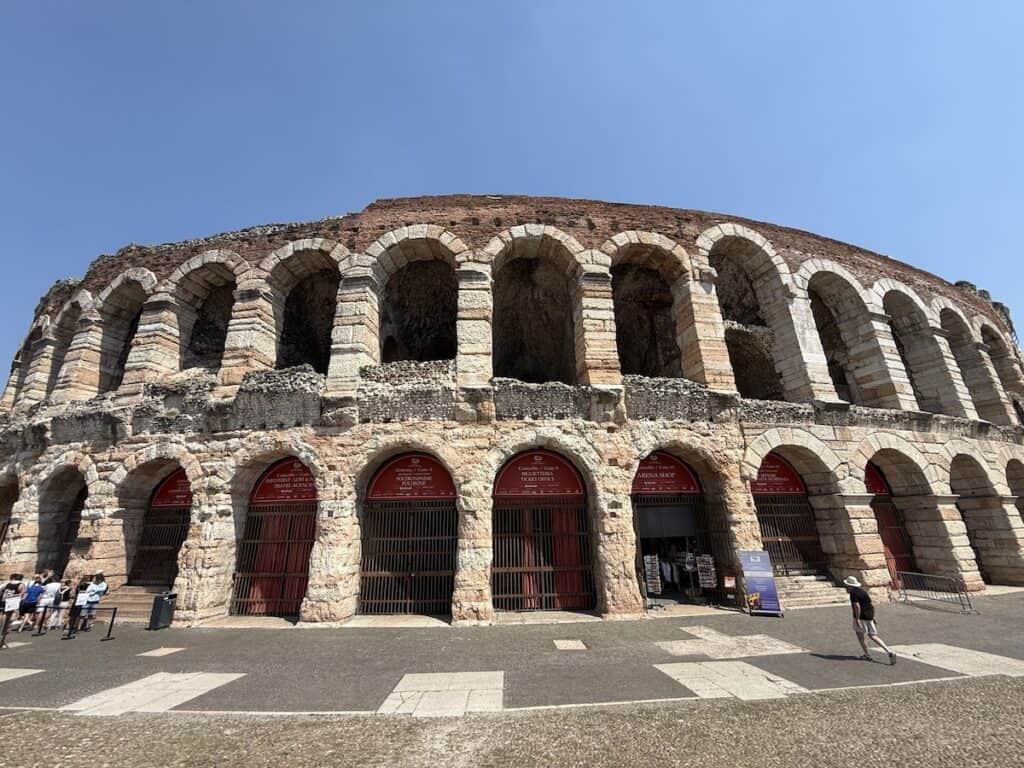
The Roman Arena anchors the expansive Piazza Bra and is the obvious starting point. General admission runs about 12 euros. Built in the first century, it’s still in active use today for opera and concerts, and the scale is the thing that gets you: the amphitheater once held around 20,000 people, more than the entire population of Verona at the time. It was built not to be practical, but to impress, and it still does. Most of the original outer ring is gone, but what remains is enough to make you understand why it’s second only to the Colosseum in Rome for surviving Roman amphitheaters.
Of all the things to do in Verona, this one is the absolute iconic must.
There are also many festivals, exhibitions, and performances in Verona throughout the year in different venues.
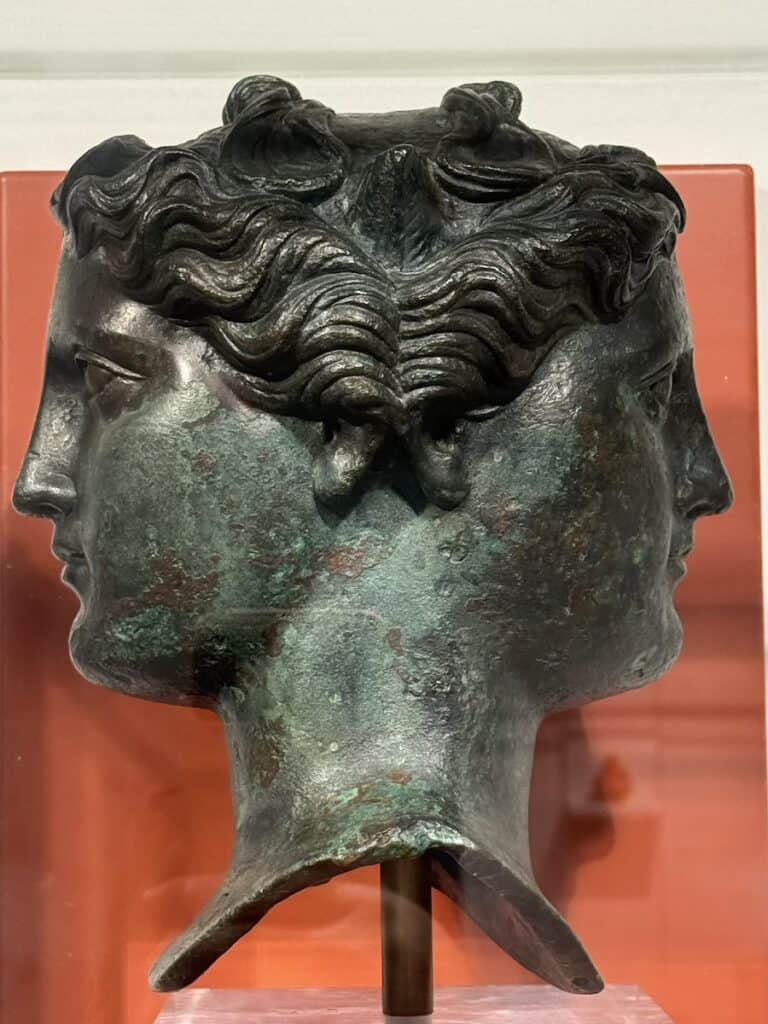
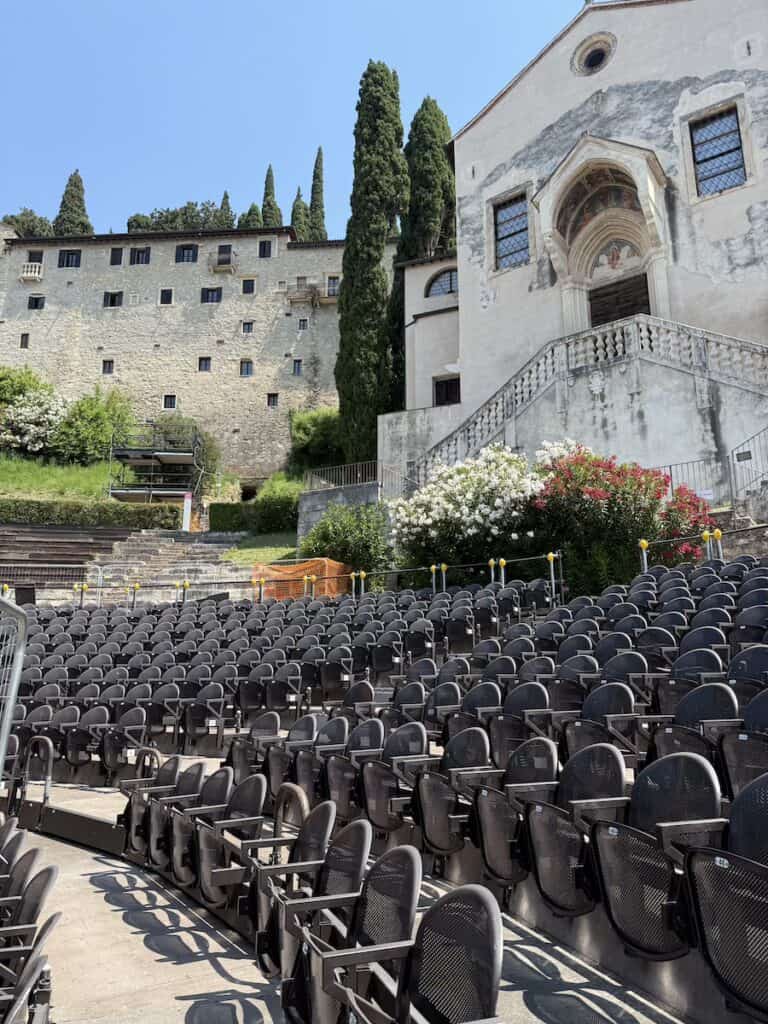
The Archaeological Museum and Roman Theater sit across the river from the Arena and get a fraction of the crowds. The theater itself is smaller and more intimate than the Arena, and when we visited we had the place almost to ourselves, a completely different atmosphere from the bustle at Piazza Bra.
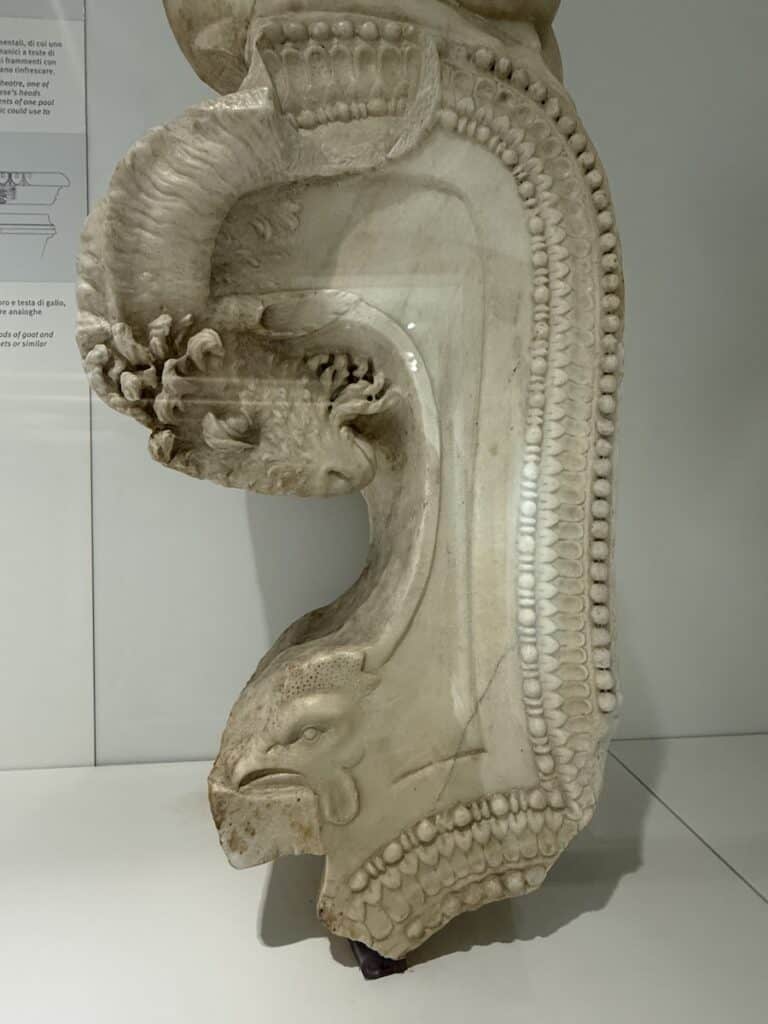
One tip that will save you real time and stairs: at the top of the theater, go right instead of left, and take the elevator to the fifth floor of the museum, then work your way down. Going left means climbing from the bottom instead. Inside, the standout piece for us was a large, intricately carved white marble panel that would have decorated the edge of the VIP seating at the Arena.
Seeing it up close reframes what the Arena must have looked like in its prime, refined rather than just massive. Give yourself 1.5 to 2 hours here. The collection is truly outstanding.
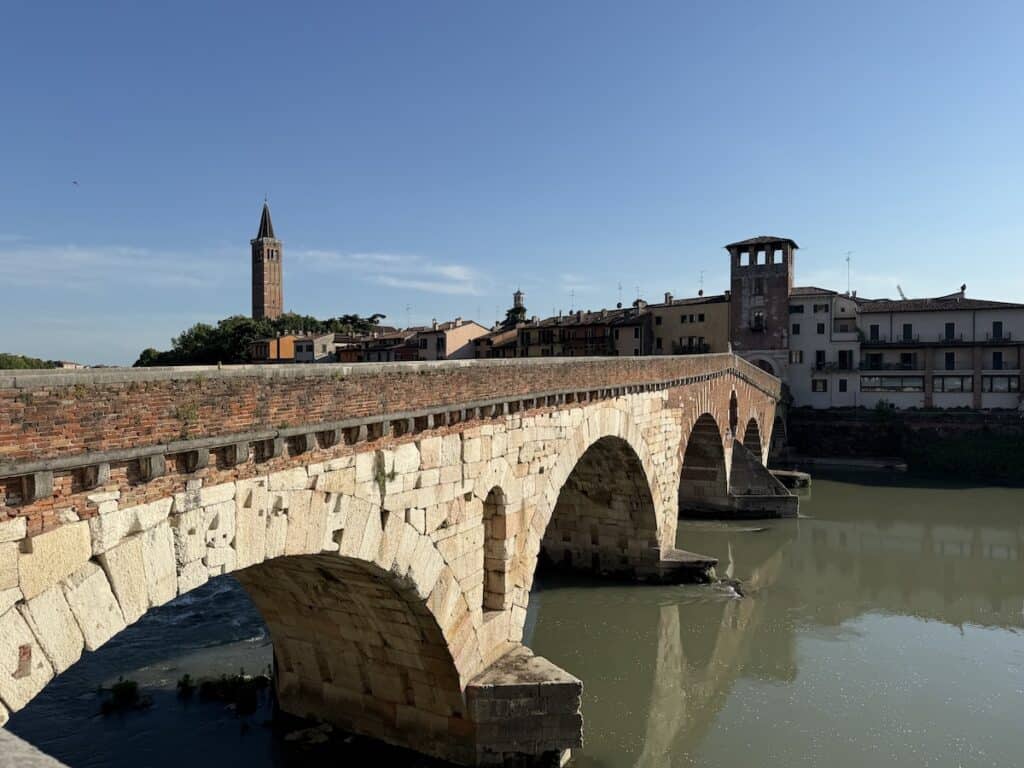
The Roman Bridge (Ponte Pietra) connects the two halves of Roman Verona, and it’s the only one of the four original Roman bridges over the Adige that survives. The best way to appreciate it isn’t from directly on top of it, walk down along the riverbank instead, where you can actually see the different bricks and blocks that make up its construction and get a sense of how old it really is.
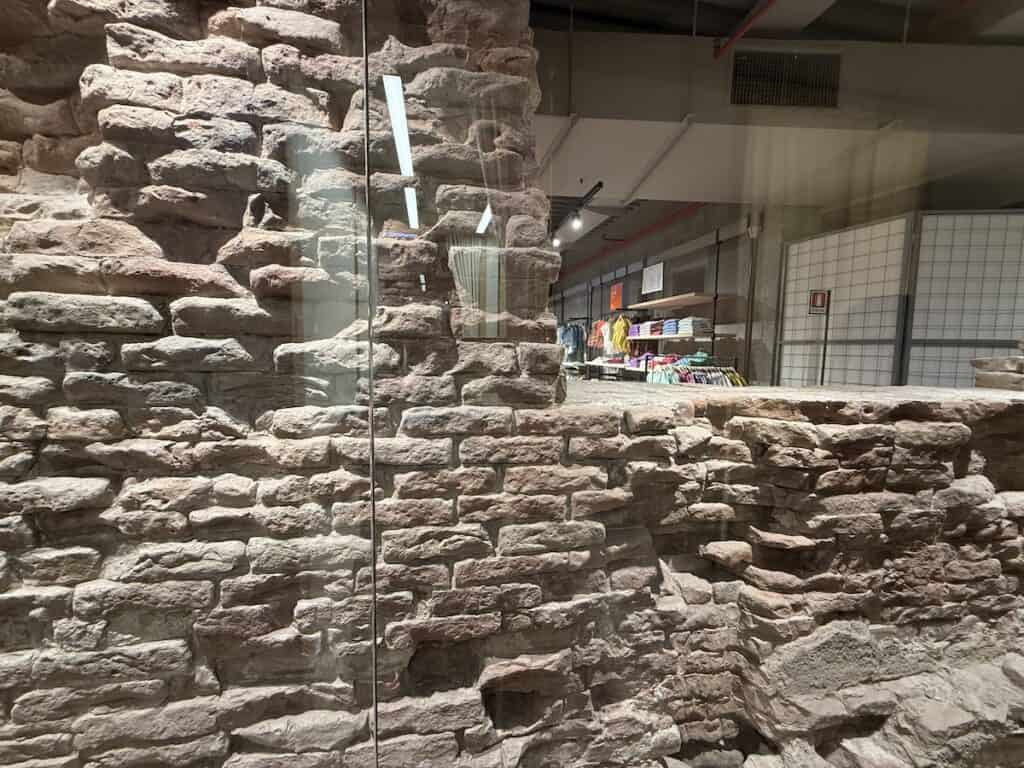
And then there’s the wall inside a clothing store. This one will blow your mind! Walk into the United Colors of Benetton store on Via Mazzini, head toward the children’s section, and go downstairs. Right in front of the dressing rooms is a segment of the old medieval city walls, along with a well and the mosaic floor of an old Roman villa, preserved exactly where it was originally built. It’s free, it’s unmarked, and almost nobody knows it’s there. It might be the single best example in Verona of how many layers of history sit on top of each other in this city.
Castelvecchio: The Scaliger Fortress
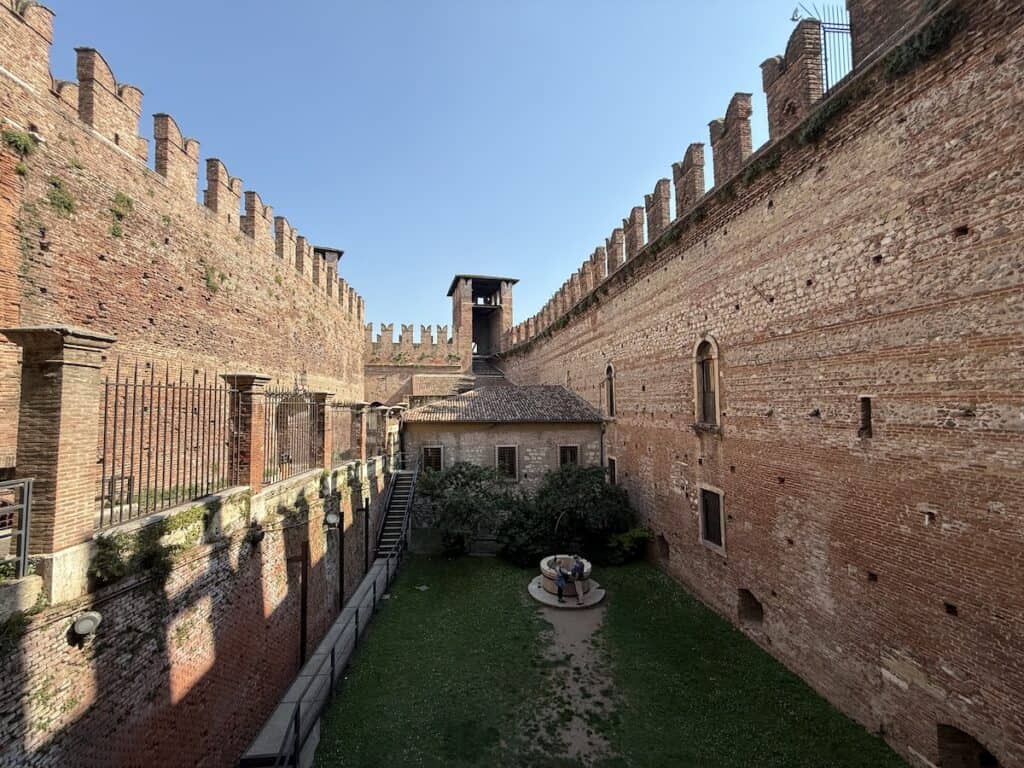
If Roman Verona is one layer of the city, Castelvecchio is the next one up: the fortified stronghold of the della Scala family, who ruled Verona for 125 years until 1387. Cangrande II della Scala had it built between 1354 and 1356, less as a show of wealth and more as insurance against his own city, a fortified residence and military base meant to protect him from internal revolt as much as outside attack.
That defensive purpose shows in the design: a rectangular fortress with seven corner towers and a 40-meter central keep, connected to the far bank of the Adige by the Castelvecchio Bridge (Ponte Scaligero), built specifically as an escape route in case the family needed to flee the city fast.
It’s been a museum since the 1920s, and the building itself is half the reason to visit. Architect Carlo Scarpa’s mid-20th-century renovation is still considered a landmark of modern museum design, letting medieval stonework and contemporary materials sit side by side rather than pretending the castle is frozen in the 1300s.
Inside, the collection runs from Romanesque sculpture through the 18th century: Pisanello’s Madonna of the Quail, works by Bellini, Mantegna, Carpaccio, Tintoretto, and Tiepolo, a room of 14th-century jewelry, and a genuinely good collection of medieval armor and weaponry, including a sword taken from Cangrande’s own tomb when it was opened in the 1920s. The equestrian statue of Cangrande I della Scala, originally mounted on his funeral monument, now stands inside the museum itself.
Don’t skip walking the castle walls. The views back over the Adige and across to the rest of the city are some of the best vantage points in Verona, and they’re included with your museum ticket rather than costing extra.
The Churches: Verona’s Best-Kept Secret
If you have only one day in Verona, you’ll hit the Duomo. If you have four, spend real time in all three of these. You’ll quickly get why Verona’s highlight reel is much bigger than you thought.
The Cathedral
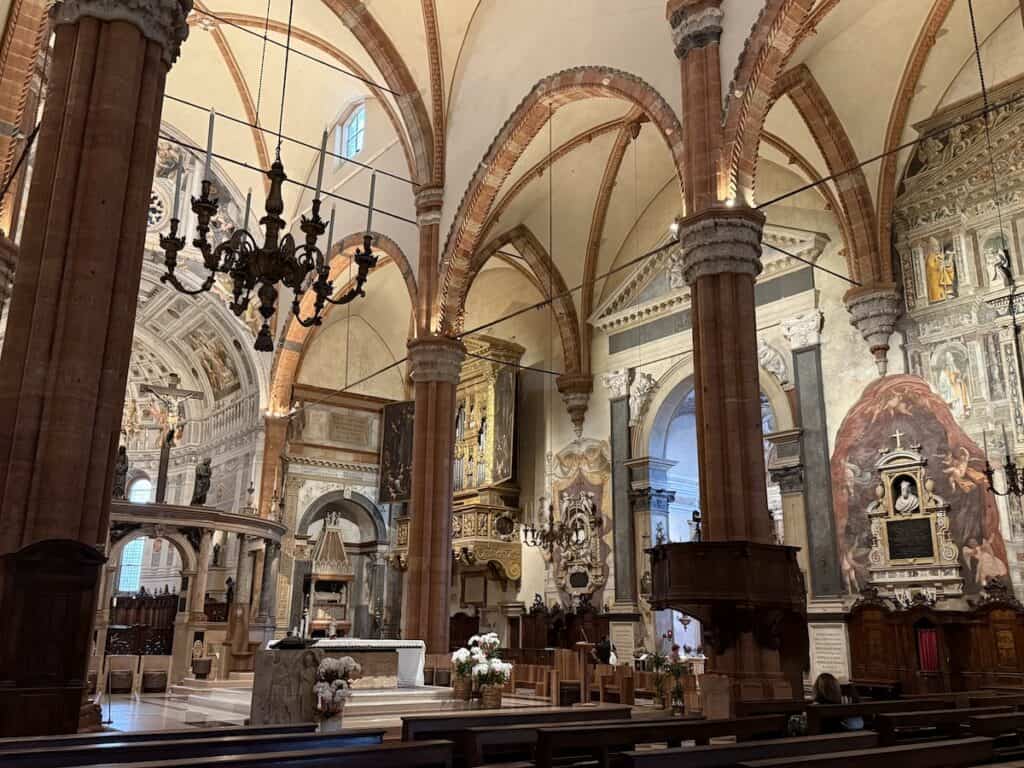
The Duomo (Cathedral of Santa Maria Matricolare) deserves a slow visit. What struck me most was how openly the cathedral shows its own history: through a section of plexiglass floor beneath the pews, you can see the mosaic floor and foundations of the early Christian church that stood on this site before the current building. Entrance is 4 euros on its own, or 8 euros for a combination ticket that also covers San Zeno, Santa Anastasia, and San Fermo. Buy the combo ticket. We didn’t, and ended up paying separately at each church. Once you start, it’s hard to stop visiting Verona’s churches!
Inside, the main nave has massive red porphyry columns and elaborate marble floors. The Mazzanti chapel, at the end of the right aisle, holds the 14th-century sarcophagus of St. Agatha. Just past it is the Cartolari-Nichesola chapel, home to Titian’s Assumption, the only painting by Titian anywhere in Verona, painted in 1535. It’s easy to miss how significant that is: one of the most important painters of the Venetian Renaissance, and this is the single work he left in this city.
Don’t skip the adjoining Baptistery of San Giovanni in Fonte. This is where the real showpiece is, an octagonal marble font carved from a single block of stone, attributed to the sculptor Brioloto de Balneo in the late 1100s. It holds a second, smaller basin shaped like a four-leaf clover, used historically for full-immersion baptism, and the sides are carved with eight relief panels depicting scenes from the life of Christ. It’s easy to walk past this door, it’s unassuming from the outside, but it’s one of the most striking pieces of Romanesque carving in the city.
The Duomo also has a whale bone hanging inside, which sounds strange until you learn there are three of these scattered around Verona: one here, one in Santa Anastasia, and one in Piazza delle Erbe. Nobody fully agrees on why, medieval trophies, symbolic warnings, trade curiosities, take your pick. But it’s worth seeking out these three unlikely ribs and enjoying the mystery.
The Church of Santa Anastasia
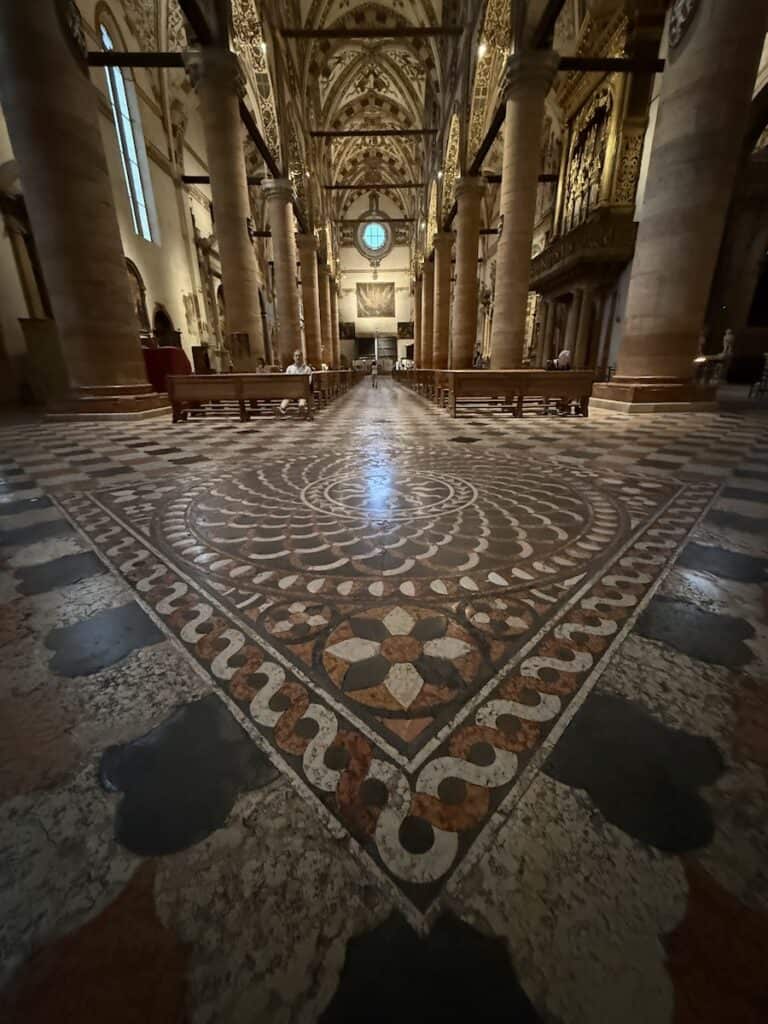
Santa Anastasia is, to my eye, the more beautiful of the two major churches. The facade alternates bands of white, pink, and pale blue stone, and the interior floor is an elaborate patchwork of marble shapes and colors that took my breath away. I’m a marble girlie, and I was in heaven. Stained glass installed in 1935 catches the light well, and the ceiling is painted in green and maroon botanical patterns that make the whole space feel closer to walking into a jewelry box than a church.
Look for the terra cotta high-relief sculptures by Michele da Firenze from the early 1400s depicting biblical scenes, and for the mausoleum of Cortesia Serego from 1429, mounted high on the wall and showing Serego on horseback. It was my favorite single artwork in any of the three churches. Ane everything is labeled in both Italian and English, which was a nice surprise.
The Church of San Zeno
San Zeno, dedicated to Verona’s patron saint, sits a little outside the historic center, but that extra walk is worth taking. Zeno served as the city’s eighth bishop and died around 380 AD. His relics rest in the crypt, visible from the pews above, and information panels nearby explain how the relics have been studied over the centuries and the occasions when they’ve been carried out and displayed publicly in the Arena. The crypt itself incorporates incredible repurposed Roman stones taken from other monumental buildings featuring carvings and inscriptions, a detail easy to miss if you’re not looking for it.
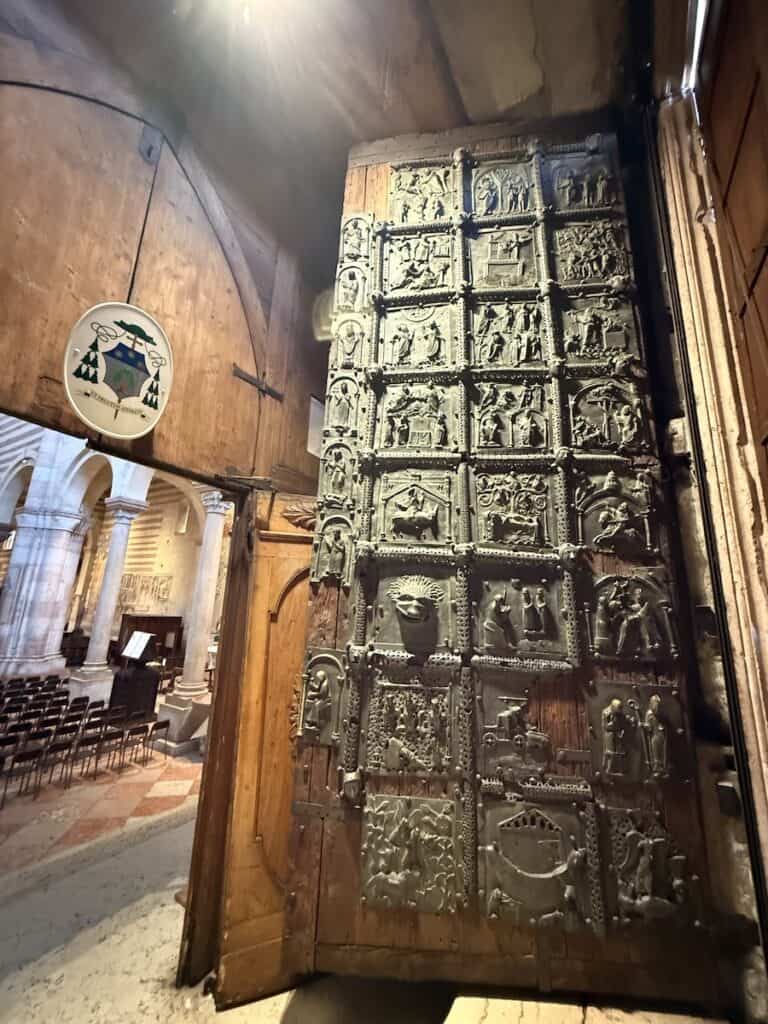
The basilica’s real showpiece, though, is its bronze doors: dozens of high-relief panels, the work of several anonymous medieval “masters,” depicting scenes from the Old Testament, the New Testament, and Zeno’s own life. I stood in front of them for a solid ten minutes, matching panels to Bible stories and admiring the craftsmanship.
The wooden ceiling dates to the 1300s, which is remarkable in itself, most wooden church ceilings from that era were lost to fire centuries ago. There’s also an oversized red porphyry basin near the entrance, taken from a Roman bathhouse. Local legend says it was so heavy that the devil was forced to carry it into the church. I don’t know how that works out, but the thing itself is astounding.
The gift shop here is definitely worth a stop on its own. Bronze reproductions of the door panels are sold in a range of sizes, from small 15-euro pieces up to a large panel for around 1,200 euros. We bought a mid-sized bronze featuring a lion’s head, the same lion that, on the original doors, had a rope fed through its mouth so the massive bronze doors could be opened and closed. I was glad it was our last stop of the day because it truly was overwhelming (in a good way).
Piazzas and Everyday Verona
Piazza delle Erbe
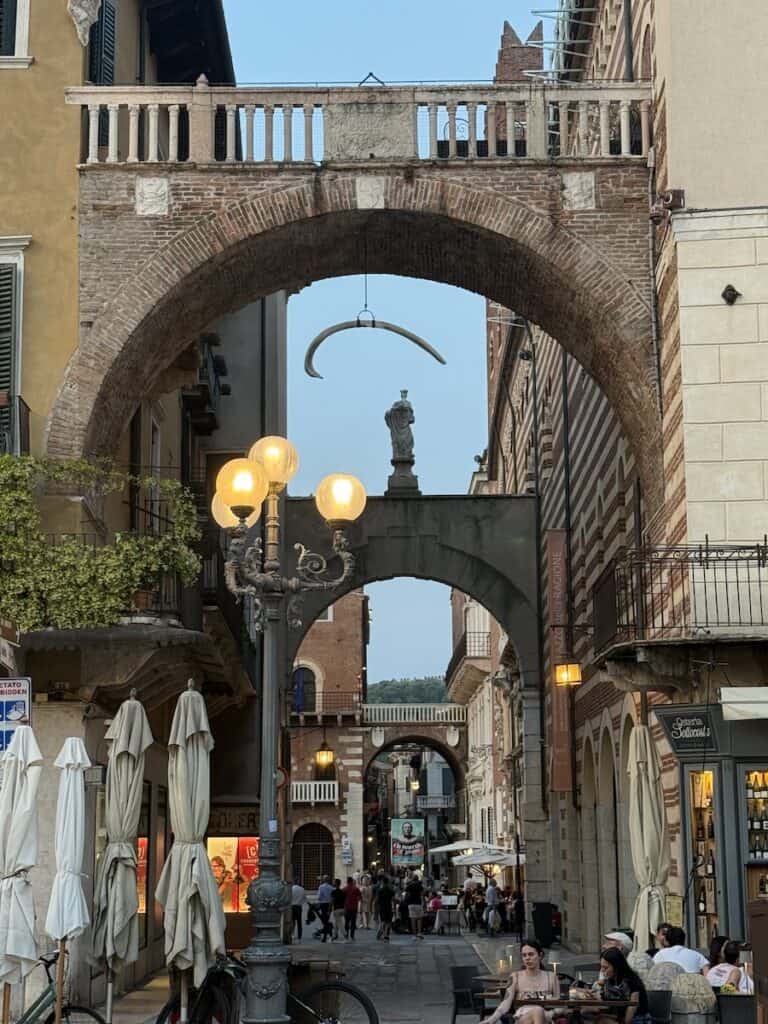
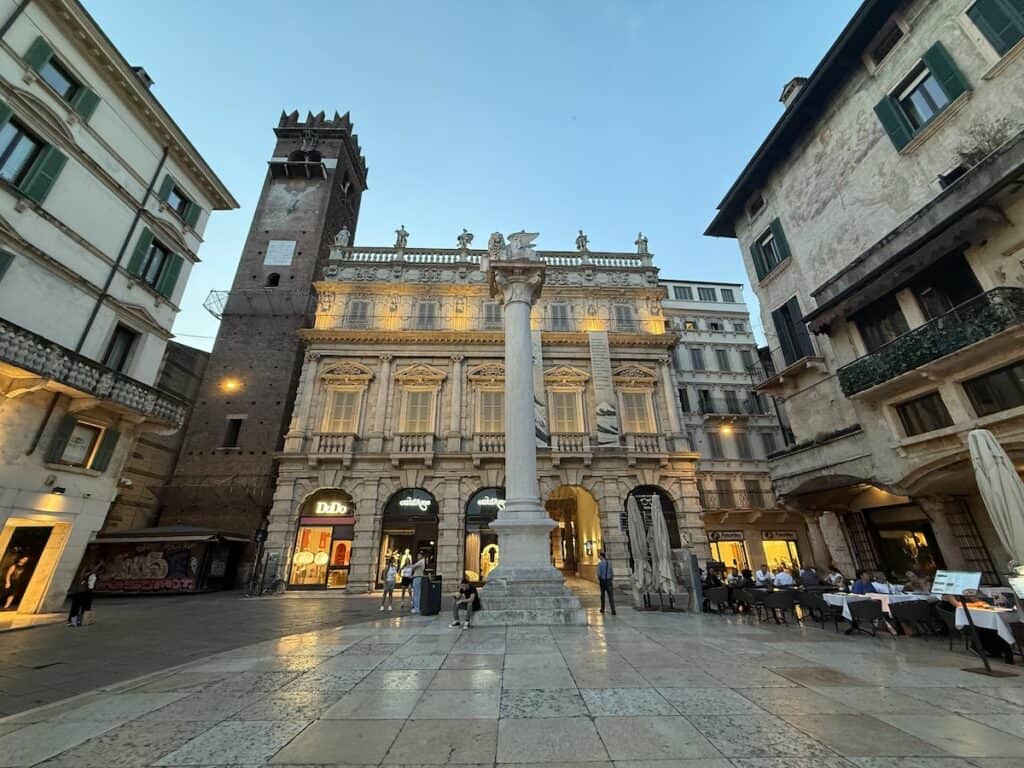
Piazza delle Erbe is the piazza (plaza) I’d send you to first. Yes, it’s lined with kitschy souvenir stalls, but the history underneath is worth pushing past that. And actually, vendor stalls have been in that exact place for centuries so it’s fulfilling its historical role. At its center is the Madonna Verona fountain: a Roman statue, repurposed Roman column pieces, and a medieval crown added later, assembled by locals into what became known as the Lady of Verona. I don’t know which goddess or important Roman she used to be, but her new incarnation is beautiful.
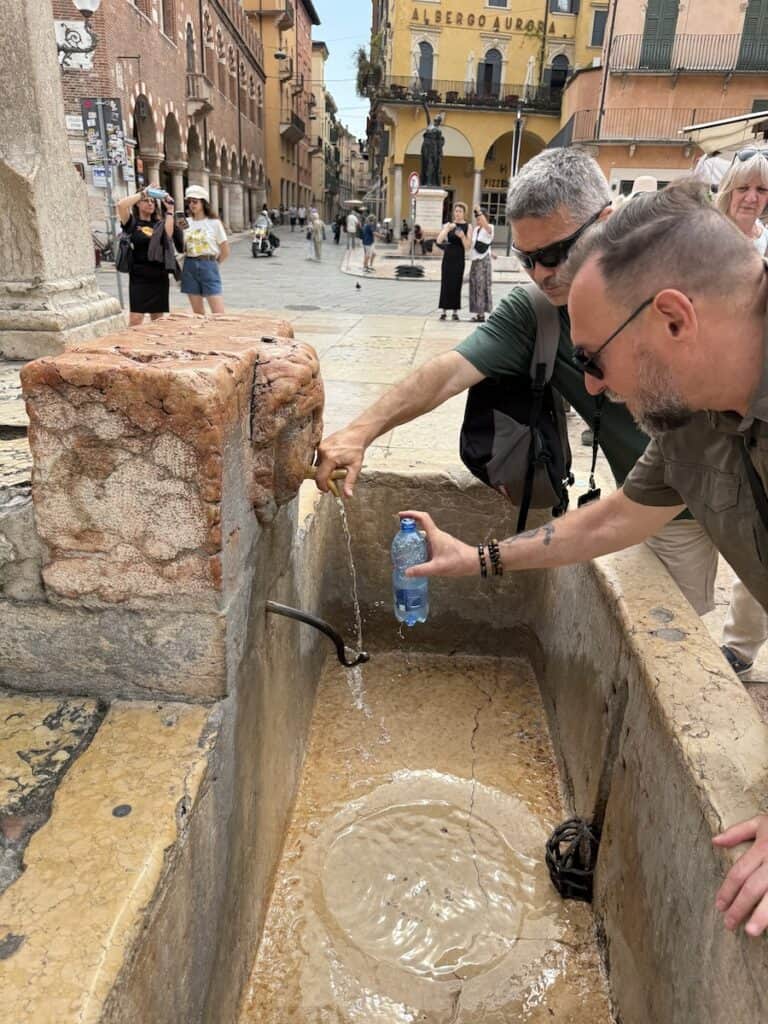
There’s a spigot nearby with free drinkable water, which we were grateful for on a hot day. Around the square you’ll also find a small marble structure once used as an official measuring station for goods like bundles of wood, and the winged lion of St. Mark mounted on a column, along with a clock tower, and the Mazzanti Houses, which run the length of the square. These well-preserved 12th century houses were the canvas for impressive 16th-century mythological frescoes painted by Alberto Cavalli in 1527.
Piazza Bra
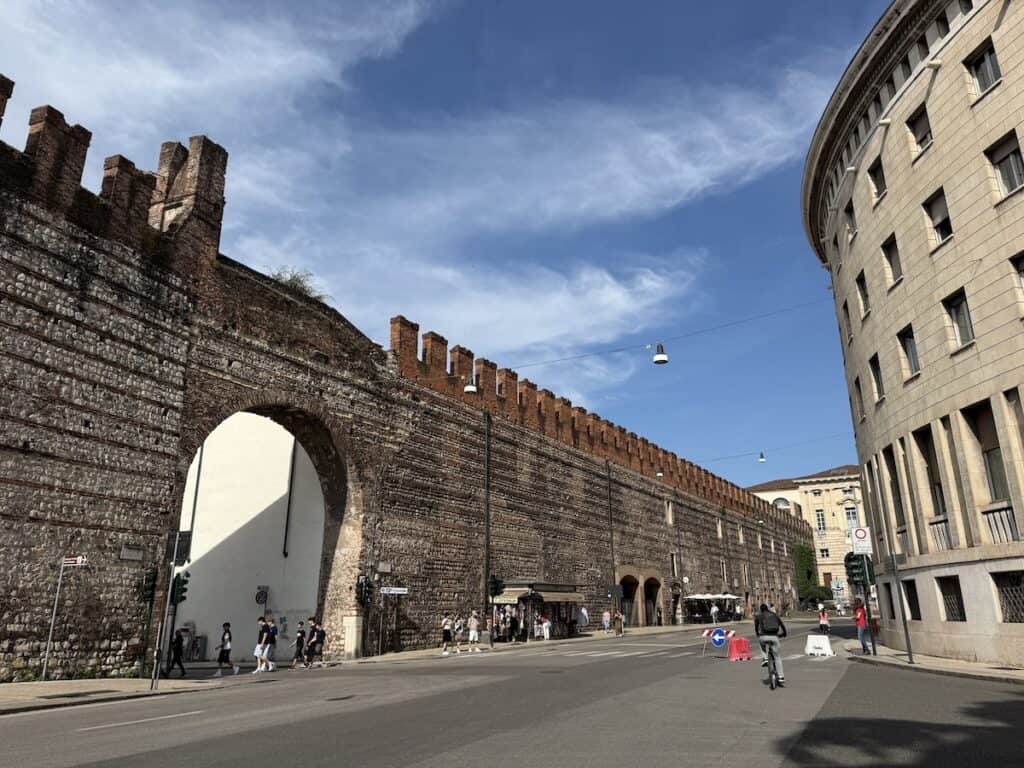
Piazza Bra is basically the city’s entrance hall, wide open and lively, ringed by historic buildings and a huge row of cafés with a direct view of the Arena. It’s a great spot for people-watching with a gelato or espresso rather than a full meal – most of the restaurants directly on the square lean toward tourist pricing, but we did enjoy a couple meals there. From here you’re within easy walking distance of the shopping street Via Mazzini, the Arena itself, and the old town’s winding lanes.
Don’t miss the stretch of brick city wall along the southern edge of the square. They aren’t Roman, but date to the 1100s, part of the medieval wall built as Verona expanded beyond its old Roman footprint, later extended under Cangrande della Scala in the 1300s. You can walk directly along the wall and through it near the Portoni della Bra gate, and it’s one of the better photo spots on the square.
Piazza Dante
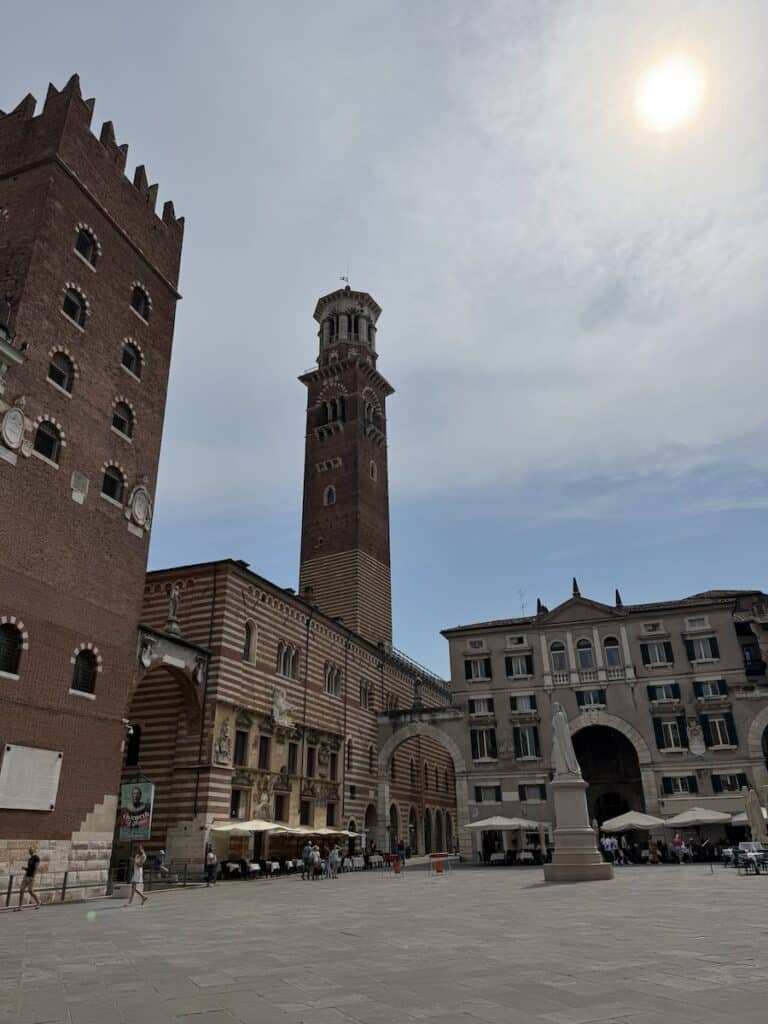
Piazza Dante, officially Piazza dei Signori, is the square I did not expect to fall for. Italy’s epic poet Dante Alighieri spent roughly seven years in Verona across two stretches of his exile from Florence, first in 1303 to 1304 under Bartolomeo della Scala, then again from 1312 to 1318 under Bartolomeo’s brother Cangrande, to whom Dante dedicated the entire Paradiso.
A statue of Dante stands at the center of the square, and nearby you can see the outside of the house where his son Pietro later settled with his own family, after studying law in Bologna on Cangrande’s dime. Pietro’s descendants, the Serego Alighieri family, still produce Amarone wine in the Valpolicella hills outside Verona today, a real, living thread back to Dante that almost nobody visiting this square knows about. If you’re a literature nerd, it’ll give you goosebumps.
If you want to go deeper on Dante, I’ve written about his tomb, his funeral church, and his library in Ravenna in One Day and Things to Do in Ravenna, where he died in 1321.
Scaliger Tombs
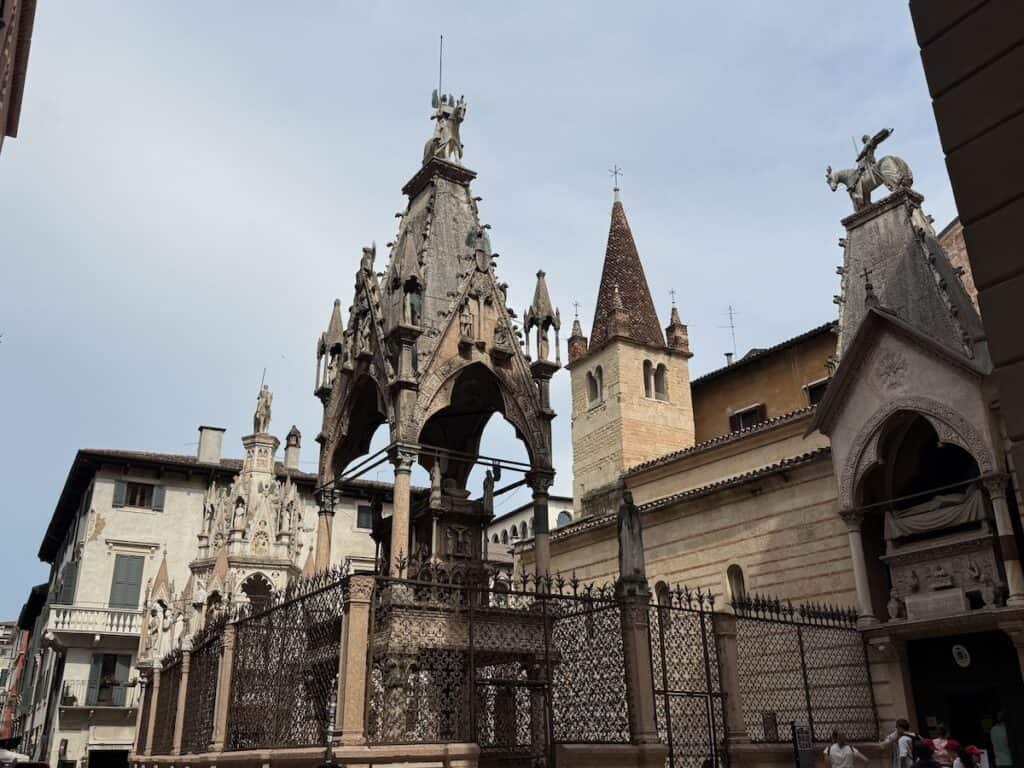
Just around the corner, tucked beside the small church of Santa Maria Antica, are the Scaliger Tombs (Arche Scaligere), the burial ground of the della Scala family, who ruled Verona from the late 1200s until 1387. The five Gothic monuments sit in a small courtyard behind an iron grille, each topped with an equestrian statue of the ruler buried beneath it.
Cangrande I’s tomb, added after his death in 1329, sits directly above the church’s side entrance and is the most elaborate of the group, an unknown sculptor’s Gothic masterpiece that still ranks among the finest funerary art of the period.
The Church of Santa Maria Antica
Santa Maria Antica, dates back to the 8th century in origin, though the building you see today is largely 12th century. It’s a small, quiet space, easy to walk past if you’re not looking for it, but the tombs beside it are one of the most photogenic corners of the old town, and one of the few places in Verona where you can stand this close to the family that shaped the city for over a century.
Juliet’s Balcony: Worth It or Not?
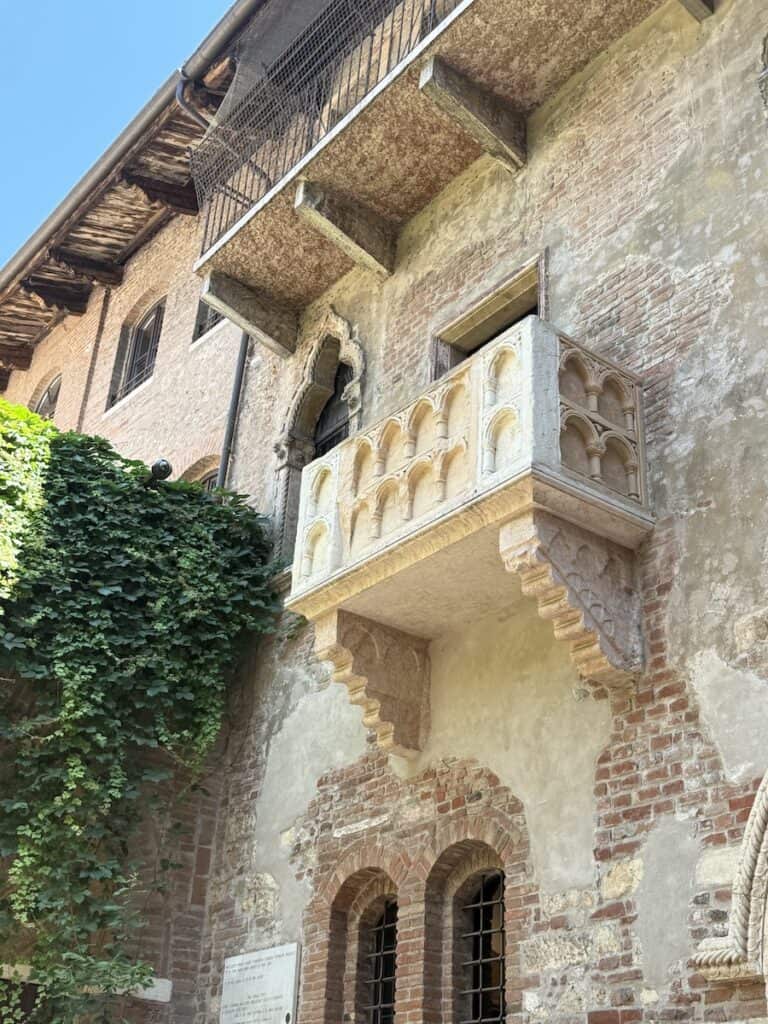
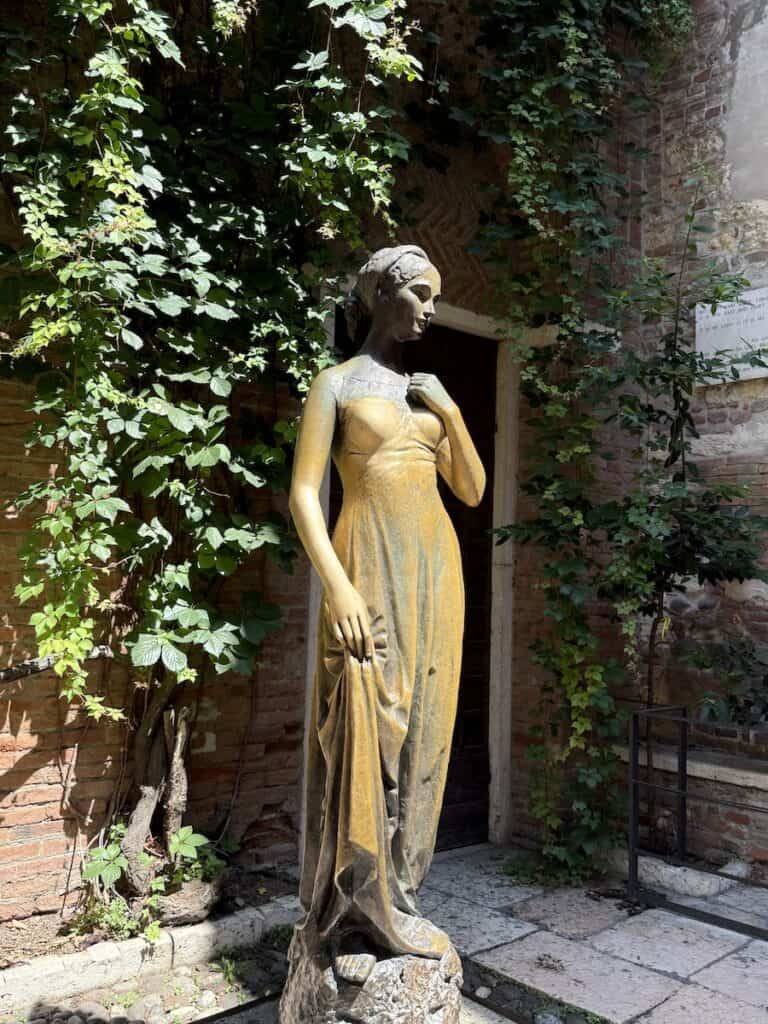
Yes, it’s touristy. Yes, the balcony itself was added in the 1930s purely for tourists. And yes, I still think it’s worth a quick verdict, especially coming from an Early English Drama major who’s actually performed Shakespeare on stage. There’s also a real, interesting literary history behind the legend that almost nobody covers.
I wrote up the full story, what the visit actually involves, current pricing, and my honest take in a dedicated post: Juliet’s Balcony in Verona: New Entrance, New Fees, Worth it in 2026?
San Pietro Hill: The View
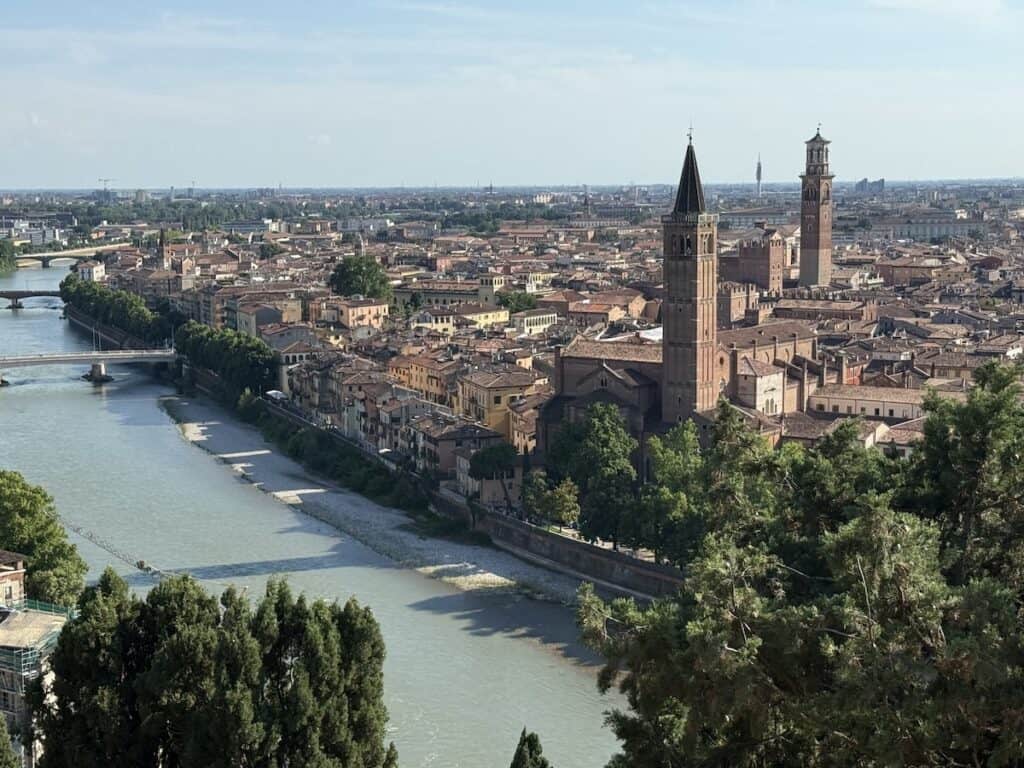
The funicular up San Pietro Hill costs about 3 euros round trip and is absolutely worth it. If you’ve got strong legs and it’s a cool day, you could walk the stairs instead, but on an 86-degree afternoon with 15,000 steps already logged, the funicular was the way to go for us.
At the top, there’s a bar with some outdoor tables, an ideal spot for an aperitivo or a glass of wine if you time it for sunset. We arrived during the golden hour and the view over the river bending through the city, the rooftops, the Roman bridge, was worth the trip on its own, even before we set foot inside the castle.
The castle itself was the one disappointment of our whole stay: free to enter, but only a small portion is open, and the art exhibit inside during our visit leaned violent and disturbing enough that we moved through quickly. The castle closes at 6pm. Skip it on a foggy or rainy day, since the view is the entire reason to come up here.
The hill itself carries real historical weight beyond the view: it was the site of Verona’s first Iron Age settlement, then a Roman temple to Jupiter (the Roman Theater sits just below), then a church after the fall of the Empire, then eventually the fortified castle you see today.
Where to Eat in Verona
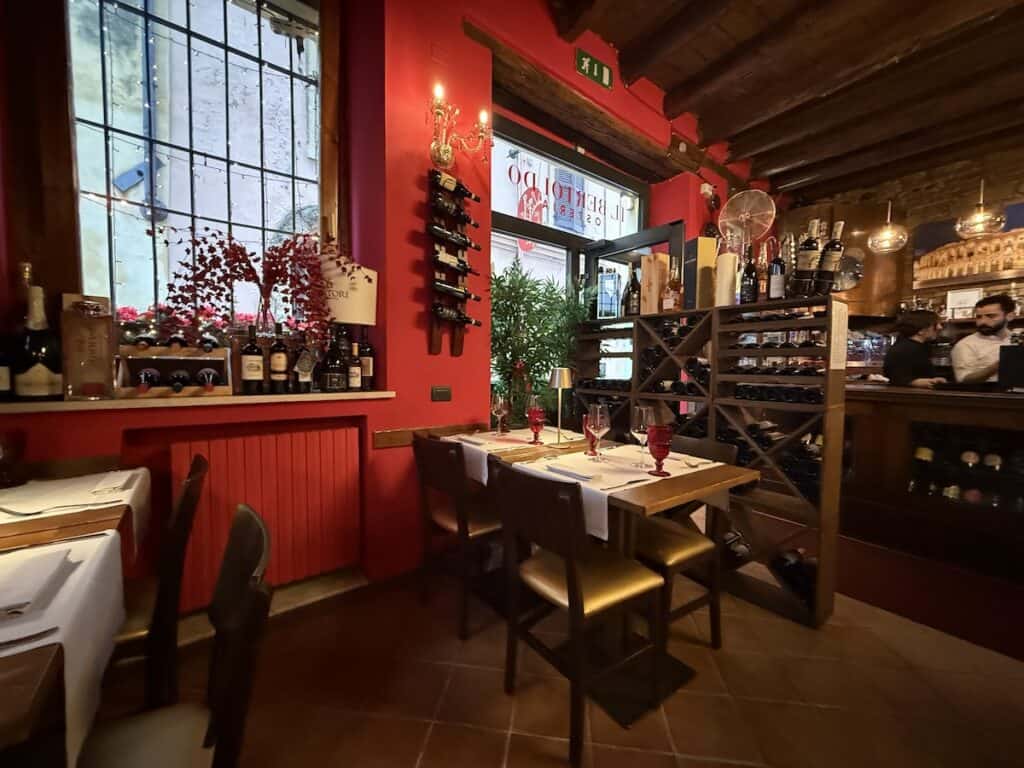
Osteria Bertoldo delivered one of the best meals of the trip, and it happened to coincide with the only hour of bad weather we had all week, a sudden thunderstorm with real lightning and thunderclaps. We ducked in, laughing, like something out of a rom-com, and were the only ones in the restaurant. The interior is warm-toned with dark-wood, with an excellent wine list and a menu that made choosing seriously difficult. I had the polenta trio and a Mediterranean sea bass that’s the best I’ve had anywhere. My husband’s duck ragout pasta and rosemary roast pork both got enthusiastic approval. Live piano music added to it. If I lived in Verona, this would be a regular spot.
Tre Marchetti Trattoria
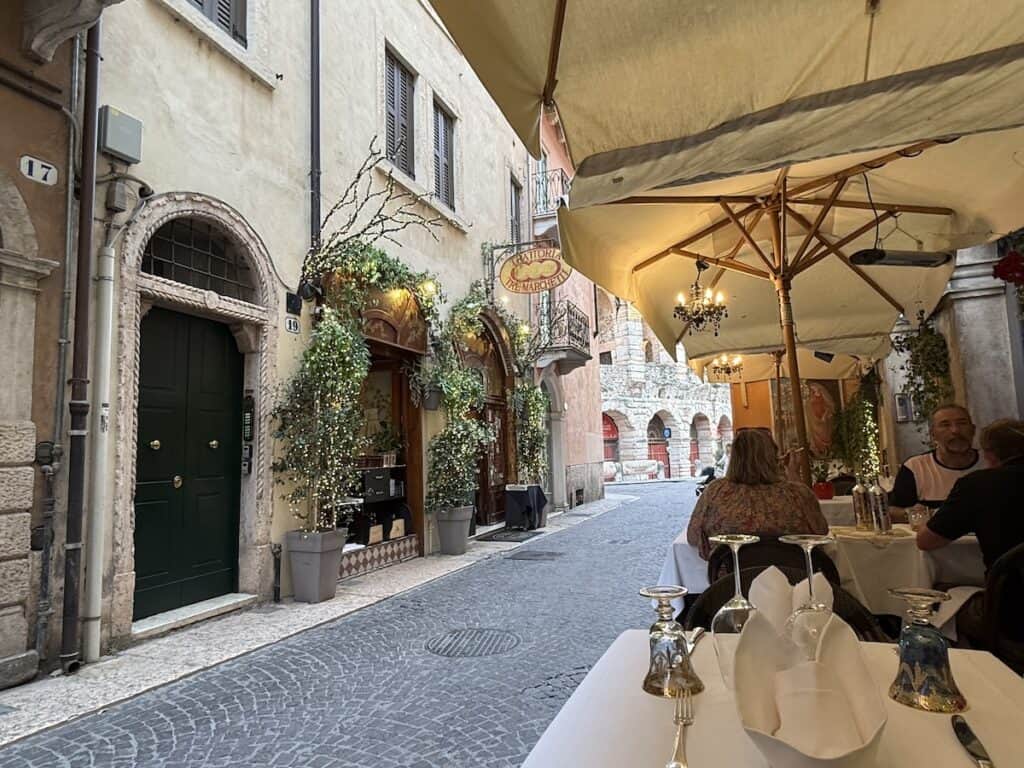
This is another one of those places and experiences you never forget. It was right next to our hotel, and we made a reservation on a whim. I would have eaten here twice if we’d have been able to get a table. We ate outside, under vines and little white lights on a cobblestone street, view of the arena, completely unhurried. We had the local amarano wine, we had anchovies, we had pasta, and filet of beef in puff pastry. It was absolutely sublime. We know we want to return to Verona one day, and making reservations at this place is first on my list of things to do. Don’t miss it if you’re looking for somewhere special.
Mannarino is a fun spot built around a glass “choose your own meat” case at the front, though we both ended up ordering pasta instead. The cavatelli with house made ragout was outstanding, and the fried zucchini flowers and meatballs were worth ordering on their own. This place had a nice local, rustic feel, and was unique in the city.
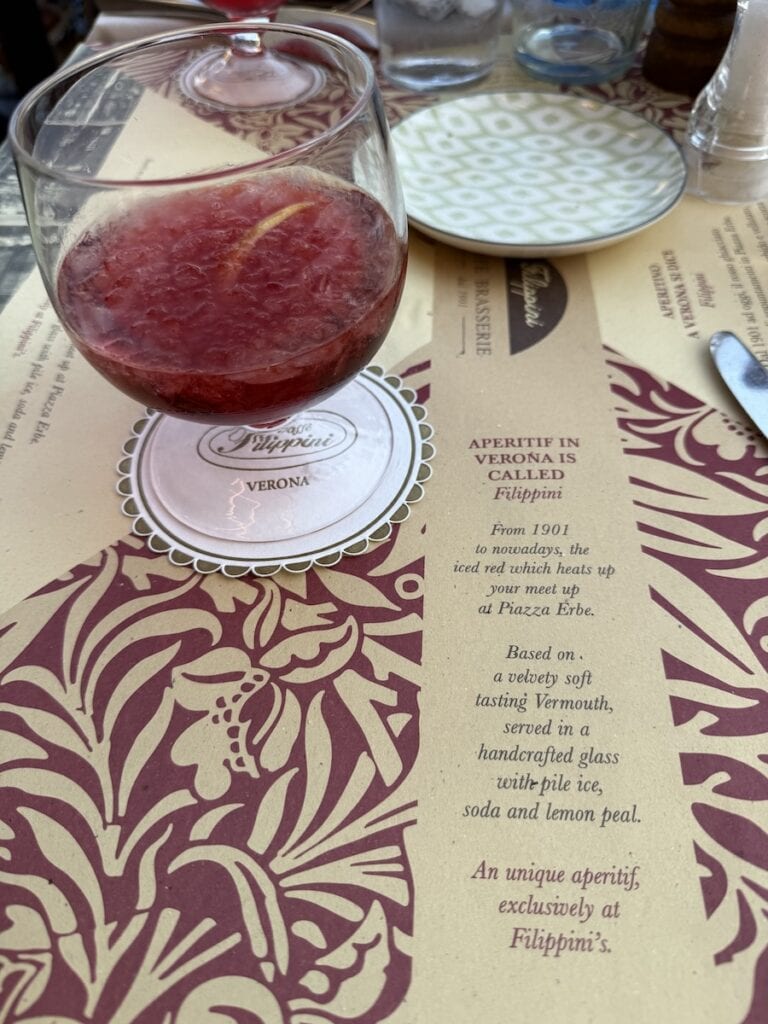
Filippini, right on Piazza delle Erbe, was our last dinner in the city. We chose it because we love the piazza so much we wanted an excuse to linger there. Their aperitivo is made in-house, similar to an Aperol spritz but a touch sweeter, with a hint of dark cherry – a must-try. The prosciutto and melon was excellent, and the pesto pasta was some of the best we had all trip.
Caffe Portoni is a good stop for a casual lunch while you’re crossing the city. We picked up cured ham on a flaky pastry with herbed cream cheese and a brioche sandwich, both good, and the outdoor tables at the intersection are great for people-watching.
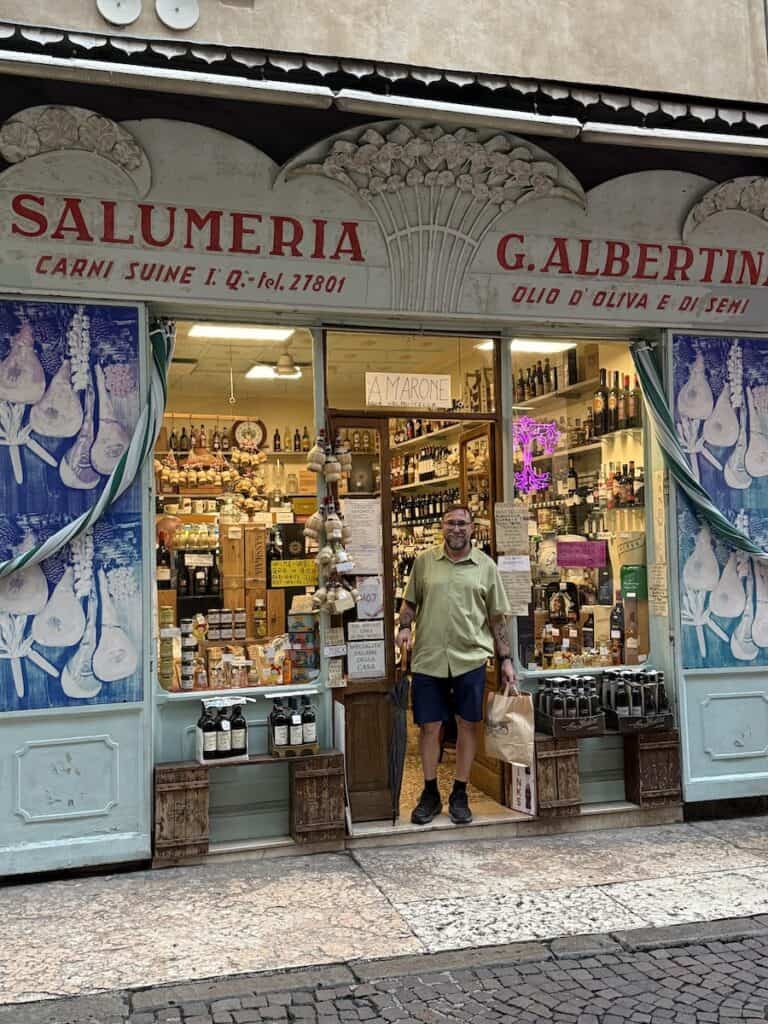
Salumeria G. Albertini isn’t a restaurant, it’s a proper Italian grocery worth a visit on its own: cheese, cured meats, marinated vegetables, olives, wine. They’ll vacuum-seal a wheel of parmesan for you if you’re flying home. Bring an empty suitcase.
For pizza, try one of the casual spots lining the square of Piazza Bra. Local Veronese-style pizza often includes potato as a topping, which sounds strange and works. It’s a great place to sit and look out over the arena, and if it’s a hot day you can sit under an umbrella which will mist you with cool lemon water.
And gelato: get it daily, it’s basically a rule when the weather is hot. Look for shops with fewer flavors served from covered round metal containers rather than towering piles in open rectangular bins, that’s usually the sign of the better stuff. Pistachio and black cherry were our favorites.
Don’t forget the pandoro! One more thing to bring home: pandoro. It’s Verona’s answer to panettone, minus the candied fruit and raisins. It’s just an enriched, buttery dough baked in a star-shaped mold and dusted with vanilla sugar. It was invented here, patented in 1894 by a Veronese pastry chef named Domenico Melegatti, and the city still treats it as a point of local pride.
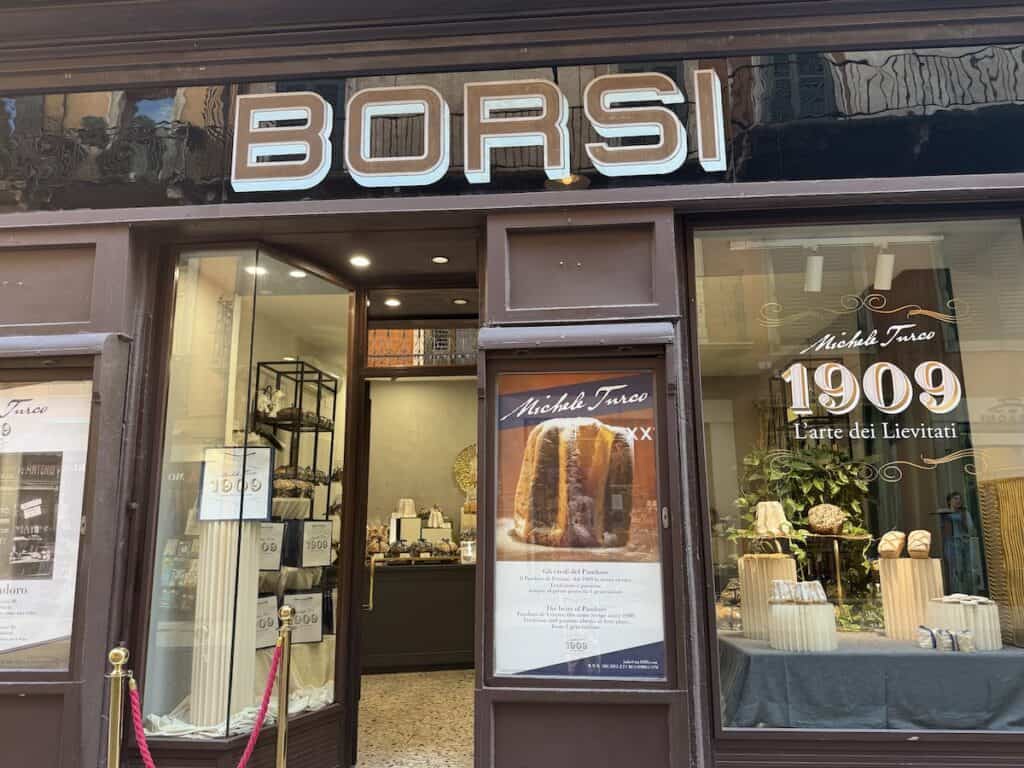
We bought ours at Michele Turco 1909, a boutique shop near Piazza delle Erbe run by Melegatti’s own great-grandchildren, Giuliomaria and Melania Turco, whose family worked inside the Melegatti company for generations before launching their own label baking pandoro from the original family recipe. We picked up three versions, plain, an orange almond, and one studded with chocolate chips, and all three were worth the suitcase space!
How Many Days Do You Actually Need in Verona?
Two full days will cover the Arena, Piazza delle Erbe, Juliet’s House, and one or two churches. Three to four days lets you add the Roman Theater and Archaeological Museum, all three major churches at an unrushed pace, San Pietro Hill, and a day trip to Lake Garda, which sits about 20 minutes away by train. We did four full days and still didn’t get to everything, including the rooftop Skybar overlooking the Arena, a tip from our guide that we ran out of time for.
Is Verona Worth Visiting Beyond Romeo and Juliet?
Yes, and honestly the Romeo and Juliet material is the least interesting part of the city once you’ve spent real time here. Verona’s Roman ruins, its churches, and its layered history under the della Scala family hold up on their own, with or without the fictional balcony.
Planning Your Trip
That’s the full rundown of things to do in Verona for a 3-4 day itinerary. If you’re building out a longer Italy itinerary, pair Verona with a day trip to Lake Garda, specifically Sirmione, which we think beats trying to squeeze in the whole lake in a single day, about 30 to 40 minutes away by car in good traffic.
Renting a Car for Verona and Lake Garda
If Lake Garda is on your list, or you’re arriving from elsewhere in Italy or over the border from Austria or Germany the way we did, a car makes this whole area far easier to see on your own schedule. Verona’s historic center is entirely walkable once you’re there, so you don’t need a car for the city itself, but for Garda, the surrounding Valpolicella wine country, or a side trip to smaller towns like Soave or Sirmione, having your own car beats waiting on train schedules.
We use DiscoverCars to compare rental options across multiple companies at once rather than booking direct with just one, which has consistently gotten us better rates and clearer cancellation terms. If you’re flying into Verona’s airport or picking up in the city center, search early, especially around the Christmas market season or summer months, when good rates and manual transmissions (still the default in most of Italy) sell out fastest.
Related Posts You May Enjoy
Juliet’s Balcony in Verona: New Entrance, New Fees, Worth it in 2026?
Where to Stay in Verona: Our Honest Picks
Lake Garda from Verona: Why Sirmione is the Best Day Trip
Are Dogs Allowed in Venice? Taking Our Dog by Vaporetto and Water Taxi
